
Summit Therapeutics: Regulatory Inflection, Strategic Backing, and the Stakes of Oncology Differentiation
With ivonescimab approaching a pivotal FDA action date, Summit Therapeutics stands at a crucial crossroads—bolstered by a $2B AstraZeneca investment and late-stage trial data, yet exposed to regulatory, execution, and competitive risks inherent to oncology innovation.
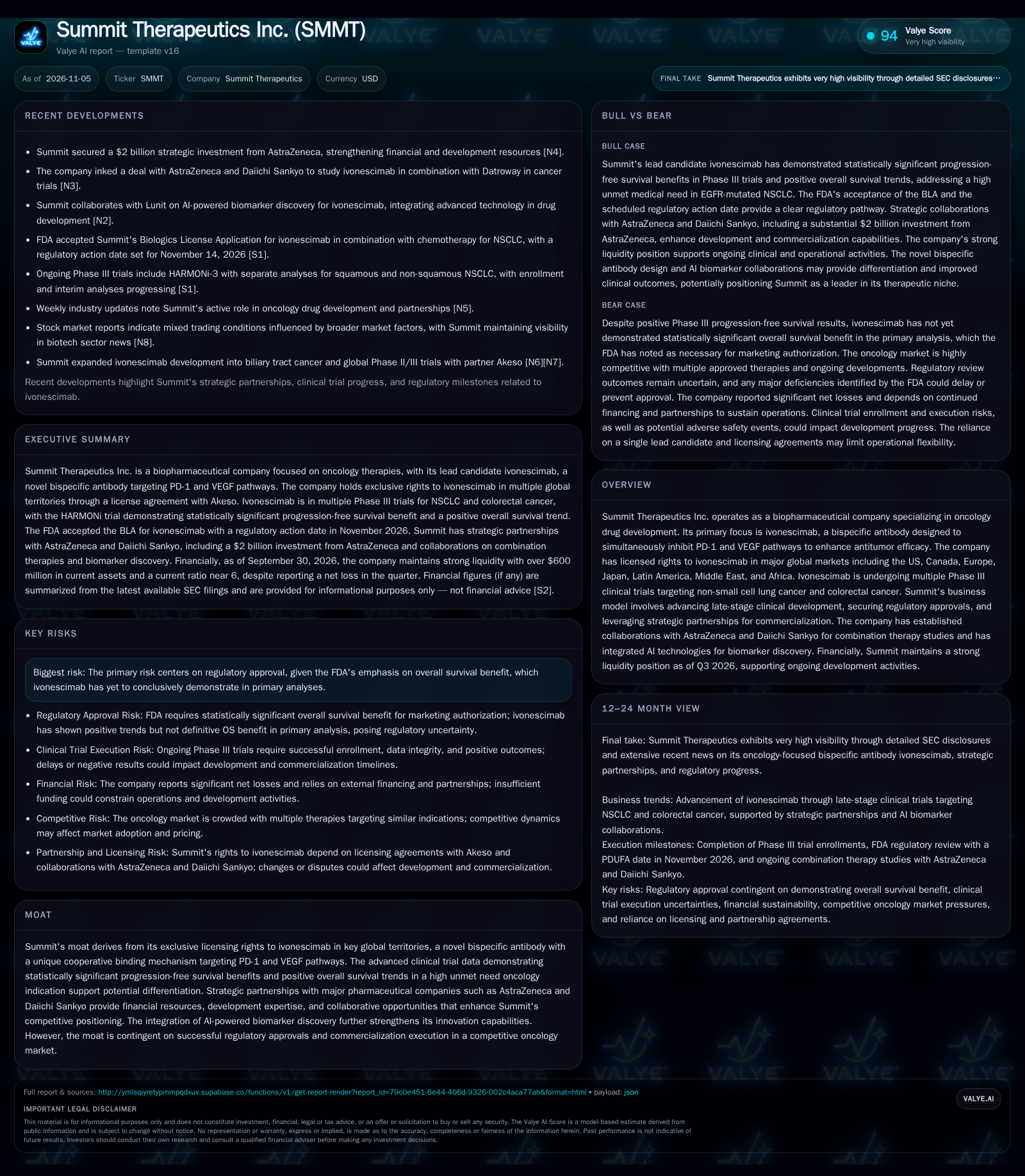
Summit Therapeutics’ lead asset, ivonescimab, is under FDA review with a decision expected November 2026. The company’s future hinges on regulatory outcomes, clinical execution, and its ability to carve out a differentiated position in a crowded oncology landscape. Near-term milestones and partnership dynamics will likely determine whether Summit can translate scientific promise into durable commercial success. [S1] [N2] [N4]
Summit Therapeutics is entering a pivotal period as its lead oncology candidate, ivonescimab, nears an FDA decision set for November 2026. The company has attracted a $2 billion strategic investment from AstraZeneca, signaling external confidence in its late-stage pipeline and partnership-driven model. With statistically significant progression-free survival data but inconclusive overall survival results, Summit faces a classic biotech crossroads: strong scientific rationale and financial resources, but regulatory and commercial success are not assured. Strategic collaborations, reported liquidity position, and integration of AI for biomarker discovery round out a story defined by both promise and high-stakes uncertainty. [S1] [N2] [N4] [S2]
FDA Decision Looms and AstraZeneca Investment Shifts Summit’s Trajectory
Summit Therapeutics is approaching a critical regulatory milestone: the FDA has accepted the Biologics License Application (BLA) for ivonescimab in combination with chemotherapy for non-small cell lung cancer (NSCLC), with a Prescription Drug User Fee Act (PDUFA) action date set for November 14, 2026. This event will determine whether Summit’s lead asset can begin commercial rollout in the world’s largest oncology market. [S1]
Financially, Summit’s position has been transformed by a $2 billion strategic investment from AstraZeneca, providing both resources and external validation. As of September 30, 2026, Summit reported $150.8 million in cash and $479.0 million in short-term investments, supporting a current ratio near 6. However, the company continues to report quarterly net losses, with Q3 2026 net loss of $208.4 million. [S2] [N4]
On the clinical front, ivonescimab demonstrated statistically significant improvement in progression-free survival (PFS) in Phase III trials, but overall survival (OS) improvement did not reach statistical significance in the primary analysis, introducing regulatory uncertainty. [S1]
How Summit’s Oncology Model Could Create Value—Or Consume Capital
Summit’s business model is predicated on advancing ivonescimab through late-stage clinical development, securing regulatory approval, and leveraging licensing and strategic partnerships for commercialization in major markets. The economics of oncology therapeutics are typically characterized by high fixed R&D and regulatory costs, offset by the potential for premium pricing and large addressable patient populations if approval is secured.
The $2 billion AstraZeneca investment reduces near-term funding risk and positions Summit to support both clinical trial costs and commercial launch preparations. However, with ongoing net losses and a single lead asset, Summit’s economic profile is highly leveraged to regulatory and market outcomes. If ivonescimab is approved, revenue could scale rapidly given Summit’s exclusive rights in major markets, but launch costs, commercialization buildout, and potential milestone or royalty obligations to Akeso (the original licensor) could compress margins in the early years.
The integration of AI-powered biomarker discovery via collaboration with Lunit could enhance patient targeting, potentially improving response rates, trial efficiency, and future pricing power. Still, without clear disclosure of commercial terms, it remains uncertain whether Summit will pursue direct sales, co-promotion, or out-licensing strategies—each with distinct margin and capital requirements.
Positioning Ivonescimab in a Crowded and Evolving Oncology Landscape
Summit’s competitive positioning hinges on ivonescimab’s novel dual mechanism: simultaneously targeting PD-1 and VEGF pathways. This approach aims to improve anti-tumor efficacy versus single-pathway agents, potentially differentiating ivonescimab in the crowded NSCLC and CRC markets. However, the oncology sector is marked by rapid innovation, with numerous approved PD-1/PD-L1 inhibitors, VEGF inhibitors, and emerging bispecifics from both large pharma and biotech challengers.
Summit’s exclusive rights in major global markets provide a significant strategic asset, but commercial success will depend on demonstrating clear clinical superiority or meaningful advantages in safety, tolerability, or biomarker-driven patient selection. Partnerships with AstraZeneca and Daiichi Sankyo, both with deep oncology franchises, may enable combination regimens and accelerate market access if clinical synergies are established.
The use of AI for biomarker discovery could, if successful, enable more precise patient stratification—potentially improving outcomes, differentiating the product, and supporting premium pricing. However, competitors are also investing heavily in combination therapies and precision oncology, making durable advantage contingent on execution and ongoing innovation.
If Regulatory and Clinical Milestones Converge: Summit’s Path to Rapid Value Creation
In a favorable scenario, the FDA approves ivonescimab based on robust PFS data, with subsequent readouts or extended follow-up confirming a statistically significant OS benefit. This would validate the clinical value proposition and unlock commercial launch in the U.S. and other key markets. AstraZeneca’s backing facilitates rapid scale-up, while collaborations with Daiichi Sankyo and Lunit support combination studies and precision targeting.
Summit could then leverage its exclusive territory rights to capture substantial market share in second-line NSCLC and, if further trials succeed, expand into additional indications such as colorectal cancer. AI-driven biomarker strategies may enable superior patient targeting, improving real-world efficacy and supporting payer adoption.
Evidence supporting this scenario would include positive FDA approval, improved OS data from ongoing or expanded trials, swift uptake in initial launch markets, and early signals of combination therapy success. Confirming outperformance versus existing standards of care, as well as favorable pricing and reimbursement outcomes, would further reinforce the upside case.
What Steady Progress Looks Like: Incremental De-Risking, but No Guaranteed Breakout
The most plausible trajectory for Summit is a mixed regulatory outcome: ivonescimab is approved for a narrower label or with post-marketing requirements, based on strong PFS and positive but not definitive OS trends. Commercialization proceeds, but initial uptake is moderate as clinicians and payers await mature survival data or head-to-head comparisons.
Revenue growth is gradual, offset by high launch and marketing expenses and potential milestone or royalty payments to partners. The company’s AI collaborations yield incremental improvements in trial design and patient selection but do not immediately confer a dominant market position.
This scenario would be confirmed by conditional FDA approval, ongoing real-world data collection, measured adoption reflected in prescription trends, and a stable but not rapidly expanding commercial footprint. Falsifying evidence would include broad payer exclusions, significant safety signals, or failure to meet post-marketing study requirements.
When Clinical or Regulatory Setbacks Compound: Risks of a Single-Asset Biotech
In the adverse scenario, the FDA withholds approval due to insufficient OS benefit or emergent safety concerns, or requires prohibitively narrow labeling. This stalls or derails commercialization, forcing Summit to rely on remaining cash and AstraZeneca partnership terms to reconsider clinical strategy or pursue alternative indications.
Clinical trial setbacks—such as negative interim results in ongoing Phase III studies or safety events—could further erode confidence and trigger partnership renegotiations or asset reprioritization. The company’s reliance on a single late-stage asset magnifies the impact of such setbacks, and ongoing net losses would rapidly deplete liquidity absent near-term revenue.
Evidence for this scenario would include a complete response letter from the FDA, public disclosure of adverse safety findings, partnership withdrawals, or missed enrollment and trial milestones. Accelerated cash burn and lack of alternative pipeline assets would heighten financial and operational risk.
Milestones and Metrics That Will Prove or Disprove Summit’s Oncology Thesis
Final FDA decision on ivonescimab’s BLA and any associated labeling or post-marketing requirements.
Updated overall survival (OS) data from the HARMONi and HARMONi-3 Phase III trials, especially in Western patient populations.
Commercial launch timing and initial prescription or sales figures, if disclosed, in the U.S. and other major markets.
Progress and interim results from ongoing combination therapy studies with AstraZeneca and Daiichi Sankyo.
Outcomes of AI-powered biomarker discovery collaborations and any impact on patient selection or clinical trial efficiency.
Evolution of Summit’s net cash position and quarterly burn rate as commercialization and trial activities scale.
Changes to partnership terms, territory rights, or licensing agreements with Akeso, AstraZeneca, or Daiichi Sankyo.
Disclaimer: This is research-only, informational analysis and not investment advice. It may include AI-generated interpretation and general industry context. Always verify important details using primary sources.

Comments