
Tutor Perini: Backlog Expansion, Execution Leverage, and the Infrastructure Funding Cycle
Tutor Perini’s recent surge in revenue and backlog signals improved operational momentum and exposure to a robust public infrastructure funding environment. The company’s future profitability, however, hinges on project execution discipline, margin management amid complex long-duration contracts, and the durability of public funding streams.
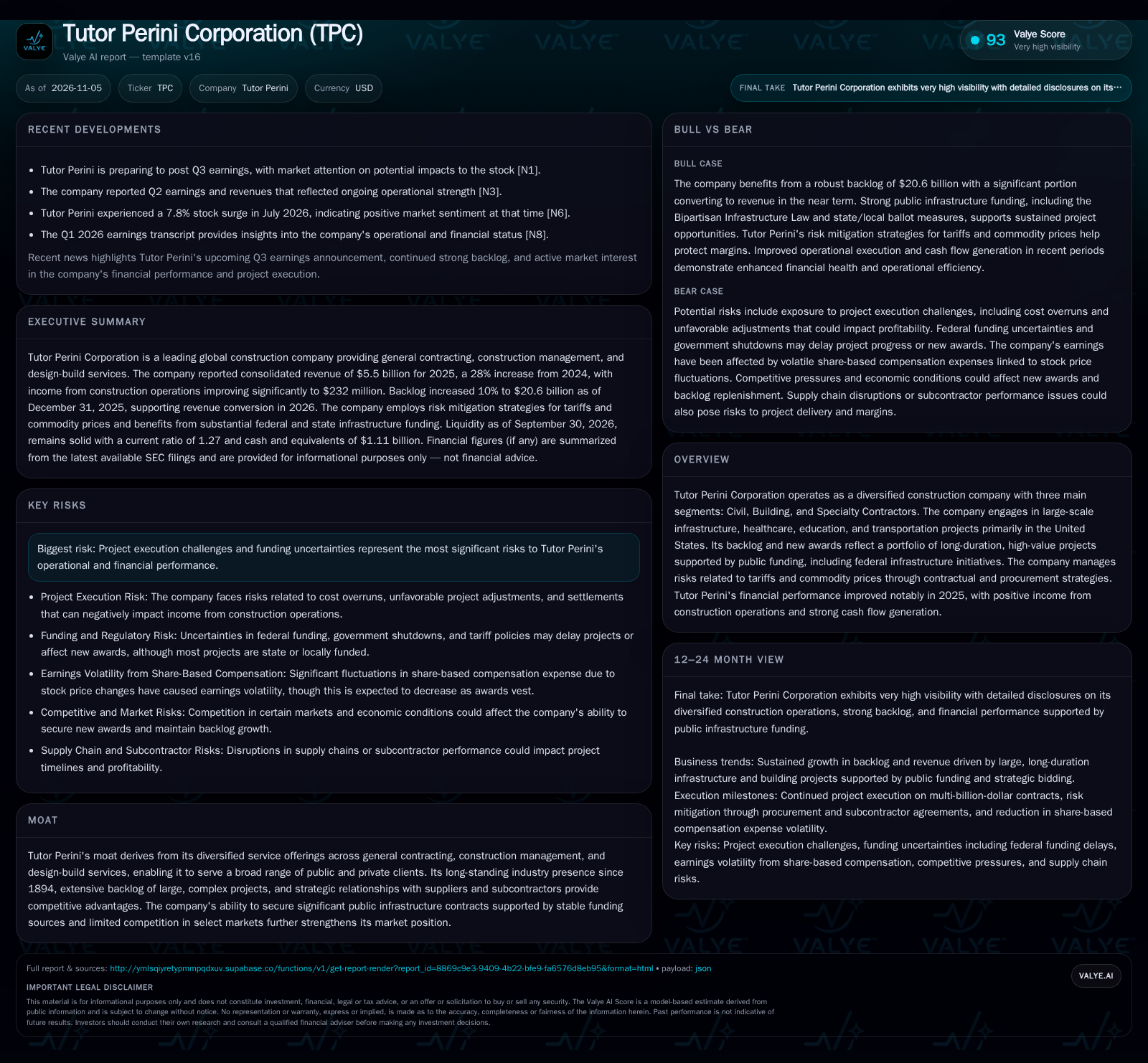
Tutor Perini posted a sharp turnaround in 2025, with revenue up 28% and a swing to positive construction operating income, underpinned by a growing, high-value backlog. The company’s fate now depends on its ability to convert backlog into profitable revenue, control execution risk on large infrastructure projects, and navigate the ebb and flow of public funding cycles. Key watchpoints include backlog burn, project margin trends, and signs of project cost containment or overruns. [S1] [S2]
Tutor Perini Corporation has emerged from a turbulent period with clear operating momentum, posting double-digit revenue growth and a return to profitability in 2025. The company’s massive backlog and cash generation reflect the benefits of an infrastructure supercycle, but the next phase will test its ability to maintain margins and replenish its project pipeline as public funding dynamics evolve. The interplay between execution quality, funding reliability, and competitive intensity will define Tutor Perini’s value creation potential over the next several years.
Recent Turnaround: Revenue Growth, Backlog Expansion, and Cash Generation
Tutor Perini reported consolidated revenue of $5.5 billion in 2025, a 28% increase from 2024, marking a sharp recovery from previous operational challenges. Income from construction operations swung to $232 million, a notable reversal from the $103.8 million loss in 2024, reflecting improved project execution and a more favorable mix of newer, higher-margin contracts. The company’s backlog reached $20.6 billion at the end of 2025, up 10% year-over-year, with about $6 billion anticipated to convert to revenue in 2026, providing strong near-term visibility. The company reported cash and liquidity metrics for the period; these figures do not by themselves establish operating runway, investment capacity, financial flexibility, or financing capacity. New awards, however, fell to $7.4 billion in 2025 from $12.8 billion in 2024, suggesting a potential slowdown in future backlog replenishment. [S1] [S2]
How the Project Portfolio Drives Tutor Perini’s Earnings Power
Tutor Perini’s business model is built on securing and executing large, complex construction contracts—primarily in infrastructure (Civil), buildings (Building), and specialized trades (Specialty Contractors). Revenue recognition depends on project progress, with the majority of contracts likely structured as fixed-price or guaranteed maximum price agreements, exposing the company to both upside from cost discipline and downside from overruns. The company’s 2025 margin improvement suggests successful management of project costs and favorable adjustments on certain contracts, but these gains require sustained operational rigor.
Operating leverage is substantial: as project volumes and execution quality rise, fixed overhead is spread across a larger revenue base, amplifying bottom-line impact. This dynamic was visible in the swing from operating loss to profit as revenue surged in 2025. However, labor, materials, and subcontractor costs are largely variable, making margin expansion contingent on procurement discipline and risk-sharing arrangements. Tutor Perini’s risk mitigation tactics—such as locking in fixed prices with subcontractors and early procurement of materials—are designed to shield margins from commodity volatility, but the effectiveness of these strategies will only become clear as projects progress.
Working capital needs are significant due to the scale and duration of infrastructure projects. The company’s cash generation in 2025 was partly a function of project timing and working capital releases, which may not be sustained if new project starts or change orders slow. Capital requirements for new bidding and bonding also remain high, reinforcing the need for consistent operating cash flow.
Navigating a Crowded Infrastructure Landscape: Tutor Perini’s Relative Advantages
Tutor Perini competes with a mix of national and regional construction firms, as well as specialty subcontractors, in bidding for large-scale public and private projects. Its core advantages stem from scale, a diversified portfolio spanning civil infrastructure and buildings, and a deep track record in delivering complex, multi-billion-dollar projects. The company’s $20.6 billion backlog, anchored by transportation and healthcare contracts in major states like California and New York, signals customer trust and pre-qualification for high-profile bids.
However, the market is intensely competitive, with pricing discipline and execution track records distinguishing winners from also-rans. Tutor Perini’s ability to lock in material and subcontractor costs, along with its long-standing supplier relationships, may provide some buffer against inflation and supply chain shocks. Still, the company faces ongoing pressure from both established rivals and smaller, more agile players, particularly as public infrastructure funding attracts new entrants and joint ventures.
The Bipartisan Infrastructure Law and other public funding streams create a strong demand backdrop, but they also draw in more competitors, potentially compressing margins on new awards. Tutor Perini’s historical presence and qualification for federally funded projects offer some insulation, but sustained advantage will depend on execution reliability and the ability to absorb or pass through cost surges.
Margin Expansion and Backlog Conversion: What a Winning Cycle Looks Like
The most favorable scenario for Tutor Perini is one in which it executes its record backlog on time and on budget, capturing the higher margins embedded in recent awards and translating backlog into cash flow. If risk mitigation strategies continue to work—containing commodity and labor cost inflation—and project execution remains disciplined, the company could sustain or even improve on its 2025 operating margins. This would enable further deleveraging, potential capital return, and renewed investor confidence.
Upside confirmation would come from evidence of stable or rising gross margins on major projects, consistent backlog conversion to revenue without significant write-downs or cost overruns, and a resumption of strong new award activity as prior projects complete. Continued robust cash flow from operations, above-historical-average return on capital, and reduced earnings volatility from share-based compensation would further validate the positive scenario.
Sustained Project Execution but Slower Award Momentum
The most plausible mid-term scenario is that Tutor Perini continues to execute its existing backlog with generally positive project outcomes, but faces slower growth in new awards as competition intensifies and some public funding cycles moderate. Revenue in 2026 would be anchored by the $6 billion in backlog slated for conversion, but margin improvement could plateau as the company works through older, lower-margin contracts and faces renewed pricing pressure on new bids.
Evidence supporting this path would include steady but not accelerating revenue, stable but possibly flattish operating margins, and moderate new award figures. Backlog would remain robust but may begin to shrink slightly if new wins do not keep pace with revenue burn. Cash flow from operations would be positive but less pronounced than the 2025 spike, reflecting normalization of working capital dynamics. Some volatility from project settlements or supply chain issues could persist, but not at levels that fundamentally threaten the company’s operating stability.
Execution Missteps and Funding Disruption: How the Thesis Breaks
A negative scenario would be triggered if Tutor Perini experiences significant project execution failures—such as cost overruns, delays, or unfavorable contract adjustments—that erode margins and generate negative headlines. Simultaneously, if public funding is delayed or reduced (due to political shifts, government shutdowns, or regulatory disputes), new project awards could dry up, leading to a shrinking backlog and revenue shortfalls.
This scenario would be confirmed by a spike in project-related write-downs, declining gross margins, and negative operating cash flow. Backlog would fall materially as new awards disappoint, while liquidity could tighten if working capital is consumed by loss-making contracts. Prolonged volatility in share-based compensation or material legal settlements from project disputes would further amplify earnings risk.
Benchmarks for Tutor Perini’s Execution and Funding Cycle
Backlog conversion rate: Monitor the proportion of backlog recognized as revenue each quarter and whether the $6 billion target for 2026 is met or exceeded.
Gross and operating margin trends: Track margin progression on both a consolidated and segment basis for signs of project cost containment or overruns.
New award velocity: Watch quarterly new award announcements for evidence that the company is replenishing backlog at or above burn rates.
Cash flow from operations: Assess whether operating cash flow remains positive and robust as project mix and working capital cycles evolve.
Project write-downs or unfavorable adjustments: Note any disclosed impairments or loss provisions on major contracts as leading indicators of execution risk.
Share-based compensation expense: Observe the trajectory of share-based comp as awards vest and its impact on reported and adjusted EPS.
Public infrastructure funding environment: Track major federal and state legislative developments or delays affecting project pipelines, especially for transportation and healthcare infrastructure.
If disclosed, project-level margin or schedule performance: More granular disclosure would help test the effectiveness of risk mitigation strategies and execution discipline.
Disclaimer: This is research-only, informational analysis and not investment advice. It may include AI-generated interpretation and general industry context. Always verify important details using primary sources.

Comments