
AppLovin’s AI Advertising Engine: Platform Growth, Margin Strength, and Scaling Complexities
AppLovin’s Q3 2026 results underscore its transformation into a highly profitable, AI-driven advertising platform with deep investments in product breadth and operational leverage. With legacy app operations divested and new verticals in its sights, the company’s ability to sustain outsized margins and growth will depend on competitive dynamics, regulatory adaptation, and the stickiness of its AI-powered ecosystem.
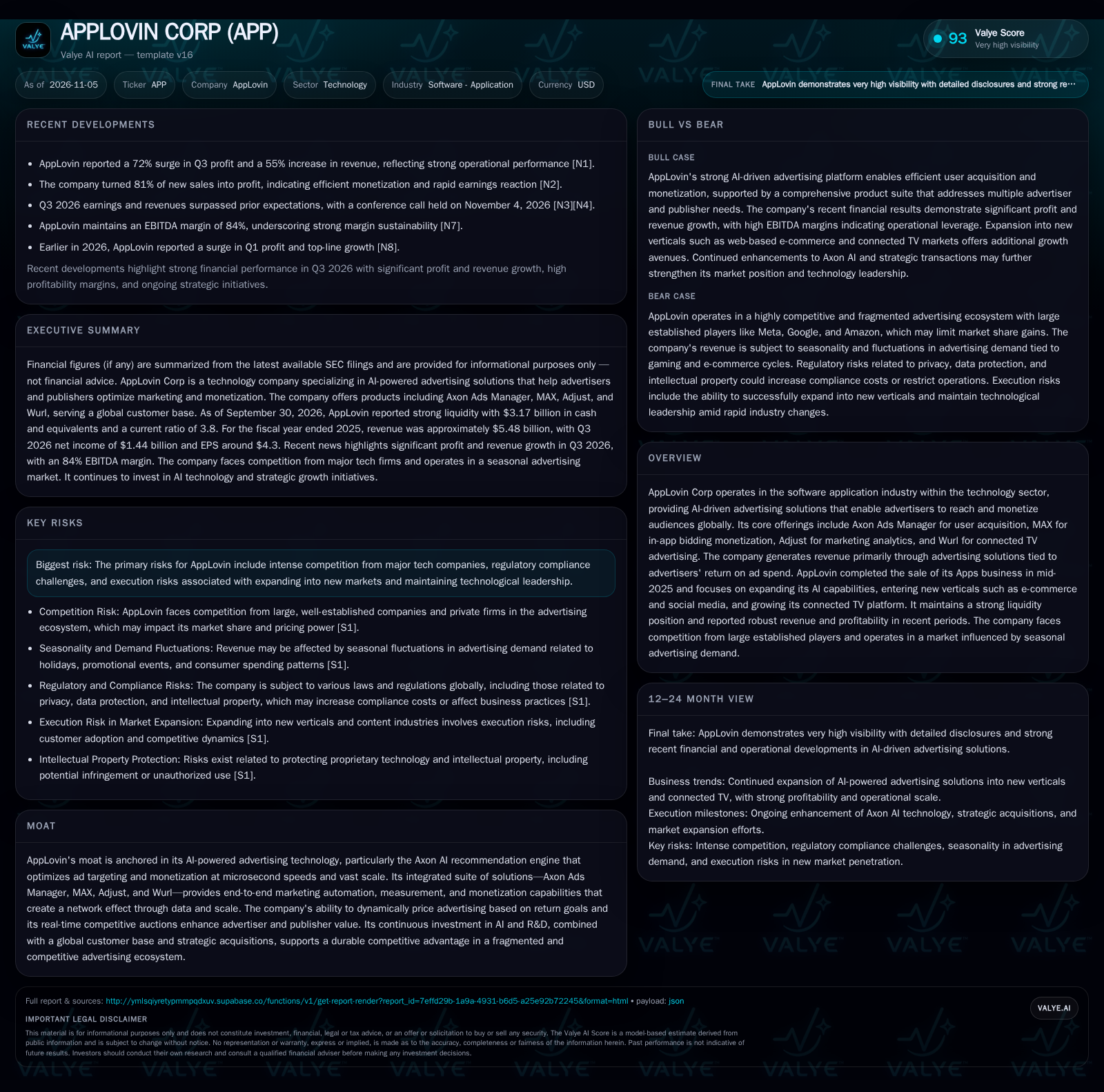
AppLovin has delivered a step-change in profitability and operational efficiency, posting a 72% profit surge and 55% revenue growth in Q3 2026, with 81% of new sales translating to profit and an EBITDA margin of 84%. The company’s shift to a pure-play advertising platform, powered by Axon AI and a full-stack suite, positions it for continued expansion into e-commerce, social, and connected TV. The durability of its margin profile and ability to capture share from entrenched competitors will be tested as it scales into new markets and faces evolving regulatory pressures.
AppLovin’s latest quarterly results mark a pivotal moment in its evolution from a diversified app and ad network operator to a focused, AI-first advertising technology platform. With the sale of its Apps business behind it and a robust suite of products spanning mobile, analytics, and connected TV, the company is now defined by its ability to turn incremental sales into profit at a rate rarely seen in software. The question for investors and industry observers is whether this margin structure—and the underlying technology moat—can withstand the dual pressures of scaling into new verticals and fending off intensifying competition from platform giants and emerging AI-native rivals.
Q3 2026 Results Highlight Margin Gains, Revenue Growth, and Strategic Priorities
AppLovin reported a 72% surge in Q3 2026 profit and a 55% increase in revenue, with 81% of new sales converting to profit, underscoring a dramatic improvement in operational leverage and monetization efficiency [N1] [N2]. For the quarter ended September 30, 2026, net income reached approximately $1.44 billion, with basic and diluted EPS over $4.30 [S2]. The company maintains an EBITDA margin of 84%—well above typical adtech peers—demonstrating robust margin discipline and cost control [N7]. AppLovin’s liquidity position is also notable, with $3.17 billion in cash and a current ratio of 3.8 as of Q3 2026 [S2]. Importantly, the company completed the sale of its Apps business in June 2025, making its financials now representative of a pure-play AI-driven advertising platform [S1]. These developments set the stage for AppLovin’s next phase of growth and competitive engagement.
Monetization Mechanics: AI, Real-Time Auctions, and Enhanced Operating Leverage
AppLovin’s revenue model is built on a high-velocity, AI-powered advertising marketplace, where its Axon Ads Manager matches advertiser demand with publisher inventory through real-time, programmatic auctions [S1]. MAX enables in-app bidding, maximizing yield for publishers by leveraging dynamic pricing and competition. Adjust provides attribution, fraud prevention, and advanced analytics on a SaaS basis, while Wurl extends the platform into connected TV ad delivery and monetization.
The company’s primary revenue source is advertising solutions, with monetization linked to advertisers’ return on ad spend (ROAS) objectives rather than fixed contract minimums [S1]. This creates a variable revenue base with strong volume sensitivity but also aligns AppLovin’s incentives with advertiser outcomes. Its ability to convert 81% of new sales into profit suggests a highly automated, software-driven cost structure where incremental revenue flows through at very high margins [N2].
R&D remains a substantial investment area, with 42% of employees focused there as of 2025, supporting rapid iteration and AI model refinement [S1]. Fixed costs are largely tied to infrastructure, data acquisition, and ongoing product development, but the platform’s scale allows for significant operating leverage. Capital needs are modest relative to the cash position, though future M&A or technology investments could increase capital deployment if strategic opportunities arise.
Navigating Competition: AI Differentiation Against Major Platform Players
AppLovin’s moat is rooted in its proprietary Axon AI engine and the integration of user acquisition, monetization, analytics, and connected TV into a single ecosystem. This breadth allows the company to offer end-to-end solutions for both advertisers and publishers, potentially increasing switching costs and data network effects as more participants join the platform [S1].
However, the company operates in a fiercely competitive arena dominated by global technology leaders such as Meta, Google, Amazon, and Unity Software, all of which have vast data resources, entrenched customer relationships, and the ability to cross-subsidize advertising products [S1]. The risk is that these giants can replicate or outspend AppLovin in AI and infrastructure, making long-term differentiation challenging unless AppLovin can maintain a lead in speed, accuracy, or vertical-specific solutions.
Private adtech firms, new AI-native entrants, and evolving privacy regulations also threaten to erode the company’s data advantages or squeeze margins. While AppLovin’s current margin profile is exceptional, the durability of this advantage depends on sustained innovation, ecosystem lock-in, and regulatory adaptation.
Potential Gains from AI-Driven Network Effects on Margins and Vertical Integration
In a favorable scenario, AppLovin’s AI models continue to outpace peers in targeting precision and yield optimization, driving sustained share gains among both advertisers and publishers. The seamless integration of Axon Ads Manager, MAX, Adjust, and Wurl could create a self-reinforcing data network effect, where each incremental advertiser or publisher improves the platform’s predictive power, further differentiating AppLovin’s offering.
Expansion into web-based e-commerce, social, and connected TV would diversify revenue streams and reduce seasonality, while continued R&D investment could accelerate the development of new AI features or vertical-specific solutions [S1]. If the company is able to maintain EBITDA margins near current levels while growing top-line revenue, it could establish itself as a structurally advantaged player even against platform giants.
Evidence confirming this scenario would include sustained or rising EBITDA margins above 80%, continued high conversion of new sales to profit, increasing customer concentration within new verticals, and growing adoption of integrated platform offerings across mobile, web, and connected TV.
Characteristics of a Resilient and Competitive Advertising Platform
The most plausible path is that AppLovin retains a lead in certain segments—such as mobile user acquisition and in-app monetization—while facing incremental pressure as it expands into new verticals and confronts stronger competition. Margins may normalize somewhat as competitive intensity rises and as the company invests in new products and compliance, but operational efficiency and automation should keep profitability well above industry averages.
Revenue growth is likely to moderate from the current surge, reflecting a maturing mobile ad business and the time required to build traction in e-commerce and connected TV. Regulatory costs and privacy constraints could increase, but AppLovin’s focus on AI-driven optimization and measurement should allow it to adapt more nimbly than larger, less specialized rivals.
Evidence for this scenario would include stable (but not expanding) EBITDA margins in the 60–80% range, steady (not accelerating) revenue growth, and a gradual increase in R&D and compliance expenses. The company would remain a key independent player, but not fully displace the largest platforms.
Risks of Margin Pressure and Market Share Erosion
In an adverse scenario, AppLovin’s AI and integration advantages are eroded as platform giants improve their own adtech stacks or as privacy regulations restrict data collection and targeting. The company could see price competition increase, with ROAS outcomes less differentiated versus competitors, leading to lower take rates and reduced publisher loyalty.
Expansion into new verticals might prove costly and slow, with established players in e-commerce and connected TV leveraging their own ecosystems to limit AppLovin’s penetration. Regulatory or compliance costs could outpace the company’s ability to automate or absorb them, compressing margins toward industry norms.
Falsifying evidence would include a rapid decline in EBITDA margins, a material drop in the proportion of new sales converting to profit, customer churn among top advertisers or publishers, or slowing adoption of new platform features. Negative regulatory developments or major data privacy incidents would also increase downside risk.
AppLovin’s Progress Benchmarks and Strategic Inflection Points
The trajectory of EBITDA margin—whether it remains above 80% or begins to compress—will be the clearest indicator of durable operating leverage and product differentiation [N7].
Tracking the conversion rate of new sales to profit (currently 81%) over subsequent quarters will signal whether margin discipline and automation are sustainable [N2].
Adoption rates and revenue contribution from new verticals such as web-based e-commerce, social media, and connected TV would help test the scalability of the platform’s AI and integration strategy [S1].
Customer retention and publisher churn rates, if disclosed, would clarify the strength of AppLovin’s ecosystem and switching friction.
R&D spend as a percentage of revenue, and headcount devoted to AI/engineering, will indicate continued technological investment and innovation pace [S1].
Any material regulatory actions, privacy rule changes, or compliance cost disclosures could affect the company’s ability to sustain margins and growth [S1].
Evidence of major strategic acquisitions or partnerships—especially in AI, data, or new verticals—would signal management’s commitment to long-term platform expansion.
Disclaimer: This is research-only, informational analysis and not investment advice. It may include AI-generated interpretation and general industry context. Always verify important details using primary sources.

Comments