
COPT Defense Properties: High-Security Real Estate Anchored by U.S. Government Demand
COPT Defense Properties delivers stable growth by specializing in mission-critical, high-security office and data center shells near U.S. defense installations. Recent results highlight continued leasing strength, but the durability of this model will be tested by government budget cycles, competitive capital, and the evolving needs of defense tenants.
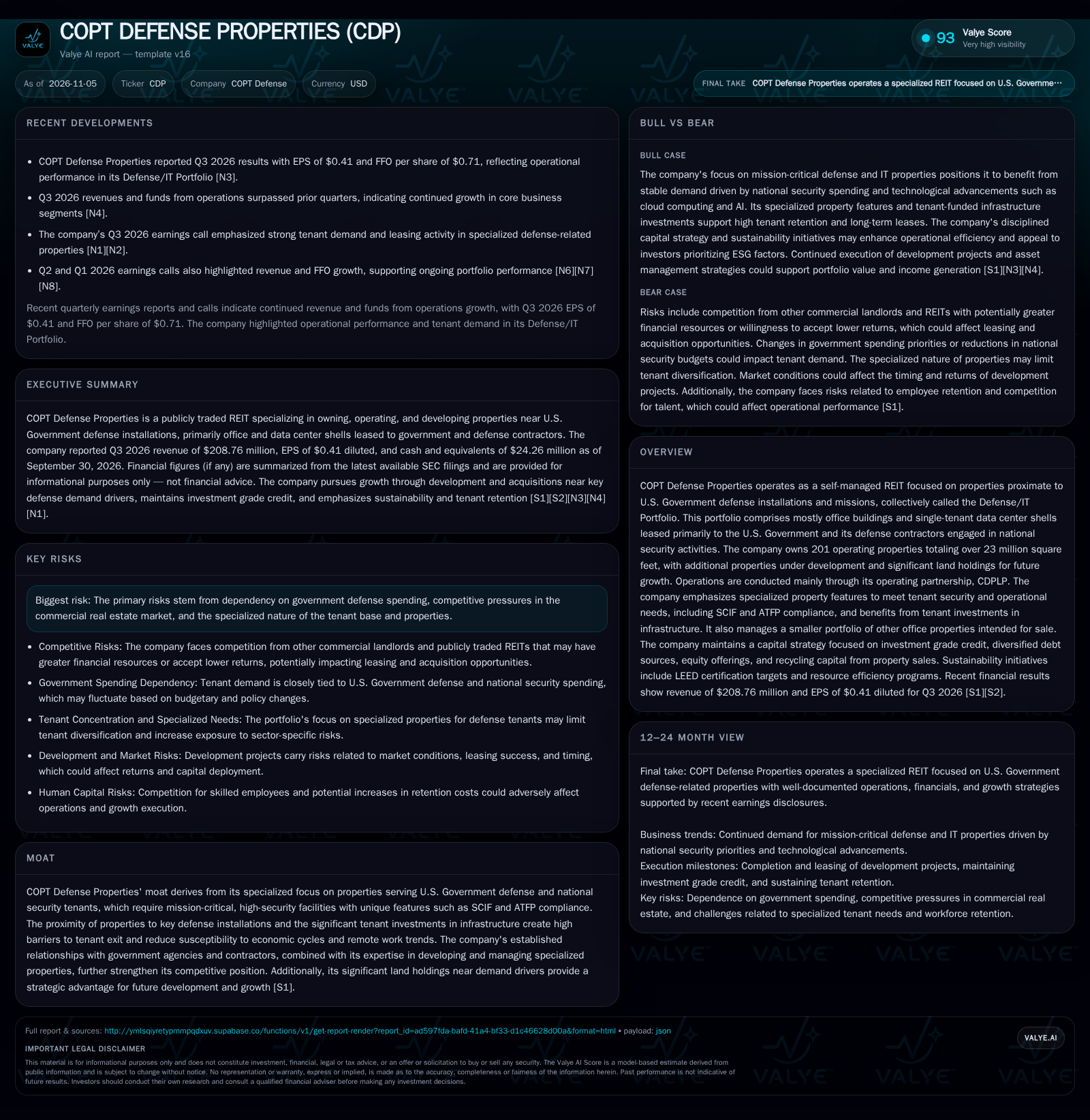
COPT Defense Properties' Q3 2026 results confirmed ongoing demand for its specialized, high-security real estate portfolio leased to U.S. Government and defense contractors. With 201 operating properties and a development pipeline, the REIT’s performance is underpinned by proximity to defense missions and tenant investments in infrastructure. However, its future trajectory depends on sustaining leasing momentum, navigating capital markets, and managing risks tied to government spending and specialized asset concentration. [S1] [S2] [N3] [N4]
COPT Defense Properties stands out in the REIT landscape by focusing almost exclusively on high-security office and data center shells near U.S. defense installations—a niche that has insulated it from broader office market headwinds. Q3 2026 results confirmed that this strategy continues to deliver steady revenue and FFO growth, with leasing and tenant retention driven by the unique requirements of defense and intelligence tenants. Looking ahead, the company’s ability to convert its significant land holdings and development pipeline into income-producing assets, while managing risks tied to government budgets and specialized asset concentration, will be central to the long-term thesis.
Q3 2026 Performance Validates Resilient Leasing and Development Platform
COPT Defense Properties reported Q3 2026 revenue of $208.76 million, with EPS of $0.41 (diluted) and FFO per share of $0.71—both surpassing prior quarters and underscoring operational strength in its Defense/IT Portfolio. The company’s asset base includes 201 operating properties totaling 23.2 million square feet, with a further five properties (646,000 sqft) under development and control of 1,000 acres for potential 10.6 million sqft of future projects. Tenant demand remains robust, particularly for properties with specialized security features, as highlighted in recent earnings calls. These results reinforce the thesis that COPT Defense’s highly tailored portfolio continues to attract and retain mission-critical tenants, even as broader office markets face secular headwinds. [S1] [S2] [N3] [N4]
How COPT Defense Converts Security-Driven Demand into Durable Cash Flows
COPT Defense’s business model centers on stable cash flow generation from long-term leases to the U.S. Government and defense contractors, who require facilities with unique security features such as SCIF (Sensitive Compartmented Information Facility) and ATFP (Anti-Terrorism/Force Protection) compliance. Many properties, especially single-tenant data center shells, are leased on triple-net terms, with tenants responsible for property taxes, insurance, and maintenance. Lease structures typically include rent escalators and multiple renewal options, which can provide predictable, inflation-hedged income. Tenants frequently invest significant capital in property-specific infrastructure—raising switching costs and reducing the risk of early lease termination.
The fixed-cost nature of property ownership, combined with high occupancy and tenant retention, creates operating leverage as incremental leasing or rent increases flow through to the bottom line. The REIT structure requires distributing at least 90% of taxable income, supporting a consistent dividend stream but limiting retained earnings for growth. To fund development and acquisitions, COPT Defense relies on a mix of unsecured and nonrecourse debt, revolving credit, equity offerings, and recycling capital from asset sales. The company’s focus on maintaining investment-grade credit supports access to capital at reasonable rates, which is crucial given ongoing development commitments and the capital-intensive nature of the business. [S1]
Specialization, Location, and Tenant Investment: The Real Moat Against Office Market Pressures
COPT Defense’s competitive edge lies in its deep specialization and proximity to U.S. Government defense installations. Properties are engineered to meet stringent security and operational requirements that most generic office REITs cannot easily replicate. The long-standing relationships with federal agencies and defense contractors further reinforce tenant loyalty, as does the significant tenant investment in property-specific infrastructure.
However, competition exists from other landlords and REITs targeting government and defense tenants, some of whom may have greater financial resources or be willing to accept lower returns to win leases. The specialized nature of COPT Defense’s assets means tenant diversification is limited, increasing exposure to sector-specific risks if government spending priorities shift. Substitution risk is low for existing tenants due to the unique buildouts and security clearances required, but new entrants could compete for future developments near defense hubs if land becomes available. Asset concentration in the Greater Washington, DC/Baltimore region also creates some geographic risk, although this is mitigated by the clustering of defense missions in that corridor. [S1]
If National Security Spending Expands, Development Pipeline and Rent Growth Could Accelerate
A favorable scenario for COPT Defense would see sustained or increased federal defense and IT spending, driving further demand for high-security office and data center space near mission-critical installations. In this environment, the company could achieve higher pre-leasing rates for properties under development, accelerate groundbreakings on its 1,000-acre land bank, and push through higher rent escalations on lease renewals. Strong tenant retention and new leasing to emerging defense tech contractors could support both occupancy and rental rate growth.
Confirmation of this scenario would include: a rising pace of signed leases for new developments before completion; upward revisions to development guidance; increasing same-property NOI (net operating income); and a sustained premium to FFO and EPS guidance. Evidence of new defense/intelligence missions or technology initiatives requiring additional secure facilities would further validate this upside case. Conversely, a slowdown in leasing velocity, muted rent escalations, or delays in development starts would undermine the scenario.
Defensive Real Estate Delivers Consistency, but Growth Remains Tethered to Government Demand Cycles
The most plausible trajectory for COPT Defense sees continued stable occupancy and incremental growth, as existing tenants renew leases and the company brings new developments online at a measured pace. Government spending on defense and cybersecurity is likely to remain a priority, but not accelerate dramatically. The company’s specialized portfolio and tenant relationships should support high retention rates, and rent escalators embedded in long-term leases will drive gradual FFO growth.
In this scenario, external growth from new developments is steady but not explosive, with leasing activity keeping pace with expiring leases and market absorption. Asset recycling—selling non-core or mature assets—could provide capital for selective reinvestment without excessive balance sheet risk. Falsification would be signaled by a drop in leasing activity, unexpected government program cuts, or margin compression from cost or capital market pressures.
Budget Shocks or Defense Realignment Could Stall Leasing and Pressure Asset Values
A negative scenario for COPT Defense would unfold if U.S. Government defense spending contracts or is reprioritized away from current missions, reducing demand for specialized office and data center facilities. This could result from political gridlock, deficit-driven budget cuts, or shifts in security doctrine (e.g., toward more distributed or remote work models, or greater use of commercial cloud). In this environment, leasing velocity would slow, renewal rates could soften, and properties with highly customized buildouts might become difficult to re-tenant.
Confirmation would be visible in declining occupancy, rising concessions to retain or attract tenants, delays or cancellations in the development pipeline, or asset sales at discounted valuations. Inability to recycle capital efficiently or maintain investment-grade credit would further compound the downside, as would any evidence of government tenants consolidating space or reducing onsite presence due to changing security or technology needs.
Milestones That Will Reveal the Staying Power of COPT Defense’s Mission-Critical Model
Pace of pre-leasing and leasing velocity for properties under development—especially on the 1,000-acre land bank and upcoming data center shells.
Same-property NOI growth and rent escalations on renewals, which would signal pricing power and tenant stickiness.
Occupancy rates across the Defense/IT Portfolio, as a decline could indicate softening demand or greater tenant churn.
Changes in the mix of U.S. Government versus contractor tenants, which could affect lease stability and renewal risk.
Evidence of new government defense/IT missions or major contract wins in COPT Defense’s core geographies, as these would drive incremental demand.
Execution on property sales and capital recycling—timing, pricing, and the redeployment of proceeds.
Maintenance of investment-grade credit ratings and terms/costs of new debt or equity issuances, given ongoing development needs.
If disclosed, tenant renewal rates, lease terms (duration, escalators, options), and the proportion of leases with triple-net structures would help test the sustainability of cash flows.
Disclaimer: This is research-only, informational analysis and not investment advice. It may include AI-generated interpretation and general industry context. Always verify important details using primary sources.

Comments