
Cytek Biosciences: Advancing Cell Analysis with Clinical Growth and Platform Economics
Cytek Biosciences is advancing multiplexed cell analysis with Full Spectrum Profiling technology, targeting both research and emerging clinical markets. While its installed base and product breadth support recurring revenue potential, net losses and regulatory timing shape the trajectory from innovation to profitability.
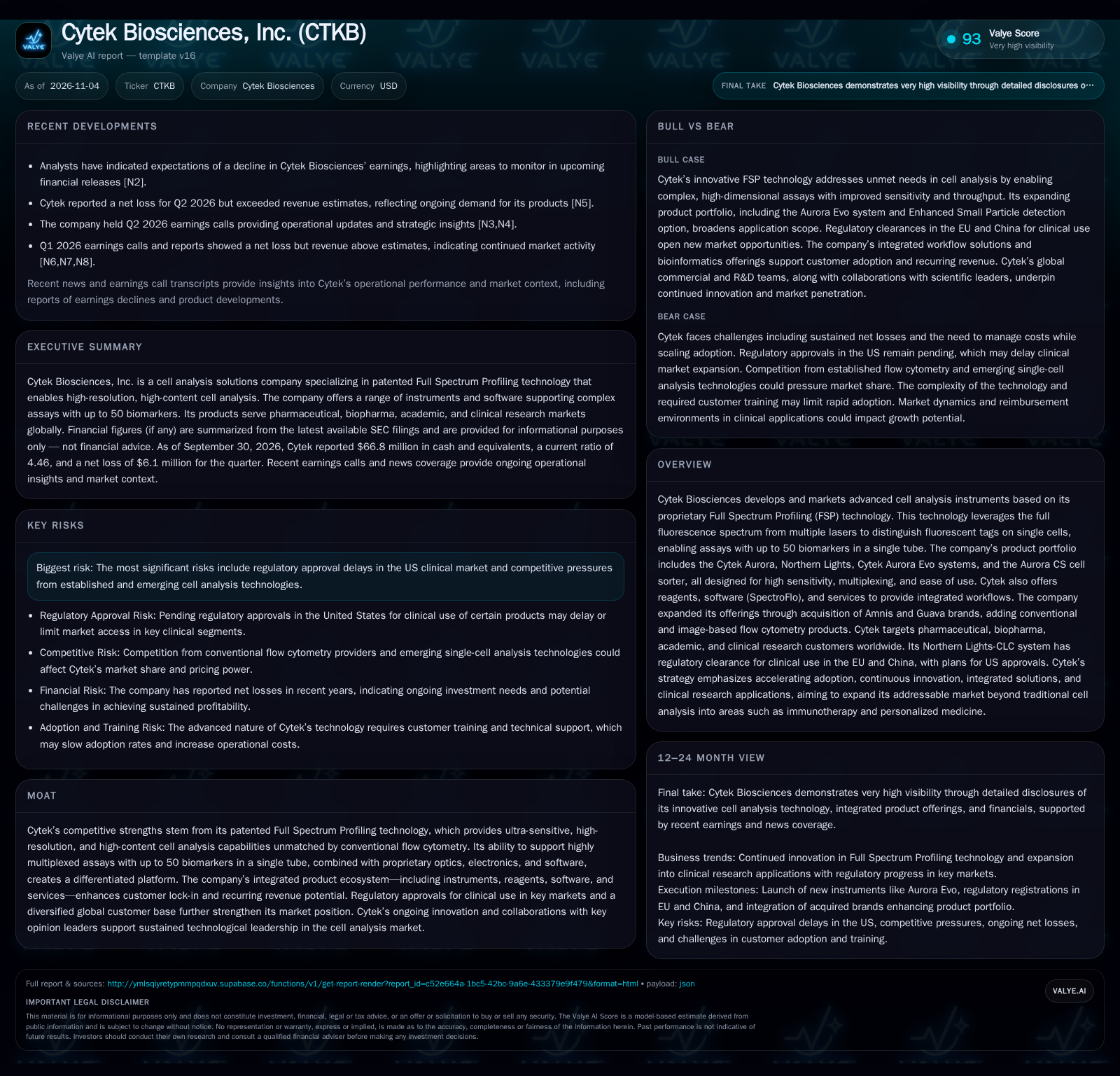
Cytek Biosciences leverages its proprietary Full Spectrum Profiling (FSP) platform to enable high-content cell analysis for research and clinical applications. Recent product launches and regulatory clearances in Europe and China support market expansion, but continued net losses and pending US clinical approvals remain critical inflection points for the business model and its path to recurring revenue scale. [S1] [S2]
Cytek Biosciences sits at the intersection of advanced research instrumentation and the evolving clinical diagnostics market, aiming to redefine the boundaries of cell analysis through its proprietary Full Spectrum Profiling (FSP) technology. With systems capable of detecting up to 50 biomarkers in a single assay, Cytek is pushing the envelope in multiplexed cytometry. Recent expansion into clinical applications—bolstered by regulatory wins in the EU and China—and the integration of new product lines following strategic acquisitions, have positioned Cytek for broader market reach. Yet, persistent net losses and the critical hurdle of US clinical approval keep the company firmly in a transition phase, where execution on commercial adoption, regulatory progress, and recurring revenue realization will determine the next leg of its growth story. [S1] [S2]
Innovation Progress and Profitability Challenges Reflected in Recent Results
Cytek Biosciences reported Q3 2026 revenue of $51.5 million and a net loss of $6.1 million, continuing a multi-year trend of operating losses despite steady revenue growth. The company ended the quarter with $66.8 million in cash and equivalents, a current ratio of 4.46, and a cash ratio of 0.79, reflecting a reported liquidity position but not yet profitability. [S2]
The launch of the Enhanced Small Particle (ESP) Detection Option in May 2024, and regulatory clearance for the Northern Lights-CLC system in both the EU and China, underscore ongoing innovation and global expansion efforts. However, US regulatory approval for clinical use remains outstanding, which is material for unlocking the largest clinical diagnostics market. [S1]
Cytek's acquisition of the Amnis and Guava brands in 2023 has expanded its portfolio into both conventional and image-based flow cytometry, diversifying its addressable market and customer base. [S1]
Platform Growth as a Catalyst for Margin Improvement and Recurring Revenue
Cytek's core revenue model centers on sales of high-complexity cell analysis instruments—Aurora, Northern Lights, Aurora Evo, and Aurora CS—each built around the FSP platform. Instrument sales currently constitute the majority of revenue, but the company's strategy aims for a shift toward recurring revenues from reagents, consumables, and service contracts as the installed base grows. [S2]
The FSP platform's ability to multiplex up to 50 biomarkers per assay enables premium pricing and appeals to research and clinical labs requiring high-content analysis. However, instrument sales are capital-intensive, with long sales cycles and potentially lumpy revenue recognition. In contrast, recurring pull-through from reagents and services could offer higher margins and more predictable cash flows over time, provided utilization rates and customer retention are strong.
Operating leverage is plausible as service and consumable revenues scale, particularly if fixed manufacturing and R&D costs are amortized over a growing installed base. The acquisition of Amnis and Guava may also enhance cross-selling opportunities, increasing the odds of multi-instrument placements and deepening customer relationships. However, persistent net losses indicate that current scale is not yet sufficient to cover ongoing R&D, commercial buildout, and support costs. [S2]
Future capital needs will depend on the pace of clinical adoption, regulatory progress, and the company's ability to transition to a more recurring, margin-rich revenue mix. If clinical applications gain traction, especially in the US, the economics could shift meaningfully toward higher visibility and profitability.
Full Spectrum Profiling Sets Cytek Apart Amid Technology Moat Constraints
Cytek’s competitive edge lies in its proprietary Full Spectrum Profiling technology, which allows for high-sensitivity, multi-parameter assays beyond the reach of conventional flow cytometry. This enables customers—pharma, biopharma, academic, and clinical research centers—to conduct highly multiplexed experiments in a single tube, reducing sample requirements and increasing data richness. [S1]
However, the flow cytometry market is characterized by entrenched incumbents with deep distribution, service networks, and established customer relationships. Emerging single-cell analysis platforms, including mass cytometry and high-content imaging systems, present ongoing substitution threats, particularly if they close the gap on multiplexing or ease-of-use.
Cytek's integrated ecosystem of instruments, reagents, and proprietary software (SpectroFlo) may foster switching frictions and lock-in, but the magnitude of these effects will depend on how seamlessly customers can integrate Cytek’s solutions into their existing workflows and the ongoing value delivered by new applications. The acquisition of Amnis and Guava broadens Cytek’s product range, but also brings it into more direct competition with players focused on conventional and image-based cytometry.
Clinical Adoption Could Significantly Boost Recurring Revenue
If Cytek secures US regulatory approval for the Northern Lights-CLC system and demonstrates robust clinical adoption, the addressable market could expand significantly—potentially shifting the revenue mix toward higher-margin, recurring service and reagent sales. Success in the clinical segment would validate the FSP platform’s utility beyond research, positioning Cytek as a leading provider for immunotherapy, infectious disease, and personalized medicine workflows.
Evidence confirming this trajectory would include rapid growth in reagent and service revenue as a share of total sales, improving gross margins, and a narrowing of net losses. Additional leading indicators would be high clinical instrument placements, published case studies from marquee clinical labs, and multi-year service contract signings. Sustained innovation, such as the Enhanced Small Particle Detection Option, would reinforce Cytek’s reputation as a technology leader and broaden its use cases. [S1]
This scenario could be falsified if clinical adoption remains slow even after regulatory clearance, or if recurring revenues do not scale as expected due to lower-than-anticipated utilization or competitive encroachment.
Slower Growth and Ongoing Losses Characterize Core Business Trajectory
The most plausible near-term scenario is a continued mix of instrument-driven growth and incremental gains in recurring revenues, with profitability remaining elusive until the installed base reaches sufficient scale. Research and academic customers may continue to drive the bulk of placements, while clinical adoption proceeds at a measured pace due to regulatory timing, training requirements, and budget cycles.
Confirming evidence would include steady instrument sales, modest growth in reagent/service revenues, and ongoing but narrowing net losses as operating leverage slowly improves. The revenue mix may remain volatile, reflecting the lumpy nature of capital equipment sales and the time lag before recurring revenue streams meaningfully offset fixed costs. [S2]
This scenario would be challenged if either instrument sales stall (due to competition or market saturation) or recurring revenue fails to gain momentum as expected.
Substitution Risks and Regulatory Delays Threaten Margins and Market Share
If US regulatory approval is delayed or denied, Cytek could be locked out of the largest clinical diagnostics market, constraining its ability to transition from research-centric growth to more stable clinical revenue streams. Meanwhile, if competitors—either incumbent flow cytometry providers or next-generation single-cell platforms—erode Cytek’s differentiation, price and margin pressures could intensify.
A downside trajectory would be marked by stagnating or declining instrument sales, weak pull-through of reagents/services, and sustained or widening net losses. Evidence would include loss of major customer accounts, negative year-over-year revenue growth, or a deterioration in gross margins due to aggressive discounting or underutilization of manufacturing assets. [N2] [S2]
This scenario could be reversed if Cytek adapts its commercial model, accelerates innovation, or secures new international regulatory approvals to offset US delays.
Critical Milestones Shaping Cytek’s Path from Innovation to Profitability
The pace and breadth of US regulatory clearance for the Northern Lights-CLC system and other clinical products—timing and scope will directly influence clinical market access.
Recurring revenue growth from reagents and service contracts—if disclosed, the proportion of total revenue from these sources versus instruments will clarify the business model's evolution.
Gross margin trends, particularly as recurring revenues scale—sustained improvement would signal operating leverage and product mix benefits.
Utilization rates and retention for the installed instrument base—data on customer usage and renewal rates would help test the stickiness and economic durability of the platform.
Competitive product launches or pricing actions by established flow cytometry or emerging single-cell analysis players—external shocks could pressure both volume and margin.
International regulatory progress, especially in large markets outside the US—new approvals could partially offset domestic delays.
R&D pipeline milestones and new product launches—evidence of continued innovation would support the case for long-term differentiation.
Disclaimer: This is research-only, informational analysis and not investment advice. It may include AI-generated interpretation and general industry context. Always verify important details using primary sources.

Comments