
Oyster Enterprises II Acquisition Corp: The Race to Secure a Transformative Deal in AI and Blockchain
Oyster Enterprises II Acquisition Corp faces a narrowing window to deploy its $260 million trust and deliver value through a high-stakes acquisition in the volatile AI and blockchain sectors. With no operating business and a 2027 deadline, the SPAC’s future hinges on deal execution, competitive target sourcing, and management discipline.
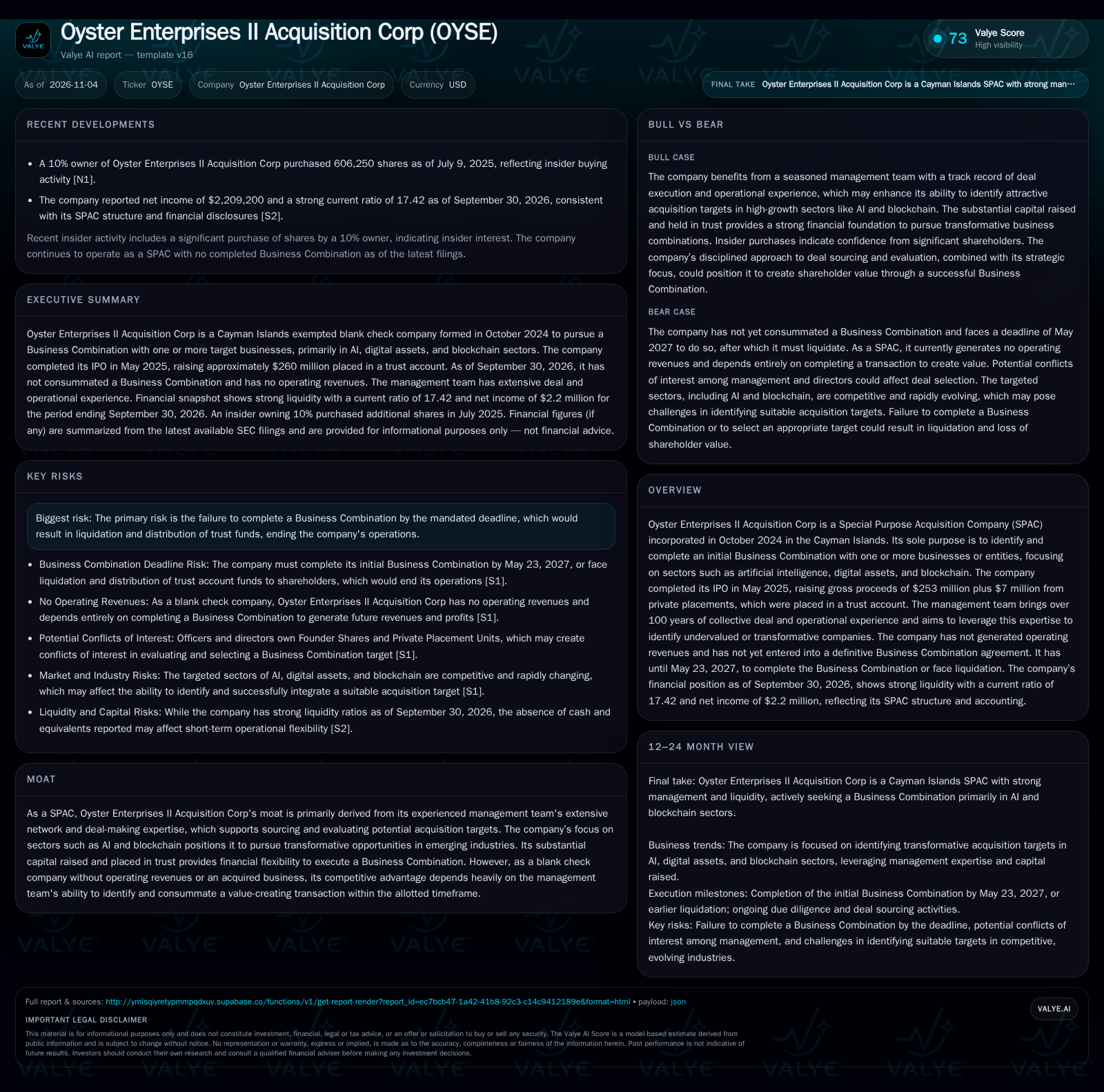
Oyster Enterprises II Acquisition Corp is a SPAC with $260 million in trust, no operating revenues, and a deadline of May 2027 to acquire a company—most likely in AI, digital assets, or blockchain. The next 18 months are critical, with success dependent on identifying and winning a competitive deal.
Oyster Enterprises II Acquisition Corp sits at a crossroads familiar to late-stage SPACs: flush with $260 million in trust, but with the clock ticking toward a hard deadline to secure a transformative acquisition in AI or blockchain. The company’s value proposition is entirely future-oriented, hinging on management’s ability to source, negotiate, and close a deal that can withstand the scrutiny of public markets and deliver upside for shareholders. In a market where high-quality targets are scarce and competition for them is fierce, Oyster’s next moves will determine whether it can leverage its financial war chest and experienced team, or join the ranks of SPACs forced to return capital after a failed search.
SPAC Structure, Capital Base, and the Deal Deadline: Where Oyster Stands Today
Oyster Enterprises II Acquisition Corp completed its IPO in May 2025, raising $253 million through public units and an additional $7.08 million from a private placement, for a total of approximately $260 million placed in a trust account [S1]. As of September 30, 2026, the company has not entered into a definitive agreement for a Business Combination, and, consistent with its SPAC status, has generated no operating revenues [S2]. The management team, led by Mario Zarazua as CEO and Vice Chairman, brings extensive deal and operational experience, a key argument for its ability to identify and execute a complex acquisition [S1]. The SPAC has until May 23, 2027, to complete a transaction or face liquidation and distribution of trust assets to shareholders [S1]. The company reported cash and liquidity metrics for the period; these figures do not by themselves establish operating runway, investment capacity, financial flexibility, or financing capacity. [S2]
How Value Creation Hinges on the Business Combination Transaction
As a SPAC, Oyster's business model is binary: it exists to deploy trust capital into a single transformative acquisition. Until a Business Combination occurs, there is no operating revenue, margin structure, or recurring cash flow. The economics post-deal will depend entirely on the sector, maturity, and growth profile of the acquired company. In the likely event that the target operates in AI, digital assets, or blockchain, revenue models could span SaaS subscriptions, transaction fees, infrastructure services, or digital asset monetization—each with distinct fixed/variable cost dynamics and capital needs.
SPACs typically face pressure to structure deals that are both accretive and scalable, as public investors expect a path to operating leverage and value realization. The $260 million in trust provides meaningful firepower, but acquisition multiples in AI and blockchain can be high, especially for targets with proven traction. Oyster may need to supplement its trust proceeds with PIPE (private investment in public equity) financing or creative deal terms, particularly if the target is larger or if public market sentiment is risk-off. Post-merger, the combined entity’s capital requirements will depend on its growth ambitions, competitive intensity, and sector-specific regulatory or infrastructure needs.
Competing for Transformative Targets in a Crowded SPAC Market
Oyster is targeting acquisition opportunities in AI, digital assets, and blockchain, sectors characterized by rapid innovation, high volatility, and intense competition for scarce, high-quality targets. The company’s competitive strengths are rooted in its management team’s transaction experience and operational expertise, which may help in sourcing off-market deals, conducting disciplined due diligence, and structuring creative transactions [S1].
However, the SPAC landscape is crowded, and many well-capitalized peers are also searching for similar technology-driven assets. Competing bidders—including other SPACs, private equity, and strategic buyers—drive up acquisition prices and compress the window for due diligence. Additionally, targets in these sectors may be wary of the scrutiny and regulatory complexity of going public via a SPAC, especially after a period of heightened skepticism toward speculative deals. Oyster’s ability to differentiate itself may hinge on offering favorable deal terms, supporting post-merger operational upgrades, or leveraging management’s network to secure proprietary opportunities.
If Oyster Lands a High-Growth AI or Blockchain Target: The Path to Value Creation
The best-case outcome is that Oyster identifies and closes a Business Combination with a high-quality, scalable company in AI or blockchain that is undervalued or poised for rapid growth. In this scenario, the management team’s deal experience enables effective negotiation, and the trust capital—potentially supplemented by PIPE financing—secures a controlling stake in a business with clear product-market fit and a defensible moat.
The combined entity could benefit from public market access, acquisition currency, and management oversight, accelerating growth and operational improvements. Value creation would be confirmed by post-deal revenue growth, margin expansion, and positive investor reception, reflected in sustained share price appreciation and trading liquidity. Evidence supporting this scenario would include a definitive agreement announced well ahead of the deadline, robust PIPE participation, and credible guidance from the target’s management regarding growth outlook and integration plans.
Most Probable Outcome: A Deal is Done, but Market Reception and Value Realization Remain Uncertain
The most plausible scenario is that Oyster completes a Business Combination before the May 2027 deadline, likely with a company in the AI, digital assets, or blockchain space that is seeking public market access. The deal may be completed under time pressure, possibly affecting negotiation leverage and terms. The target could be a mid-stage company with potential but also significant execution risks, or one that is not the first choice for more prominent SPACs or strategic buyers.
In this outcome, value realization depends on the quality of the target, its growth trajectory, and its ability to deliver on public market expectations. Post-merger volatility is common, especially if the target’s fundamentals or projections are aggressive. Confirmation would come from a timely deal announcement, satisfactory redemption rates (indicating investor confidence), and evidence of operating progress by the acquired company within 6-12 months of closing. Conversely, high redemptions, tepid PIPE interest, or post-merger financial misses would challenge the thesis.
Failure to Secure a Suitable Acquisition: Liquidation Risk Looms Large
The principal risk is that Oyster fails to identify and close a suitable Business Combination by the May 23, 2027 deadline. This could result from persistent difficulties in sourcing targets, excessive competition driving up valuations, or the management team’s unwillingness to compromise on deal quality. In such a scenario, the company would be forced to liquidate and return trust proceeds to shareholders, ending its operations and forfeiting any upside from a potential transaction [S1].
Red flags confirming this scenario would include delays in deal announcements as the deadline approaches, repeated extensions or vague updates on target sourcing, and the absence of PIPE or strategic investor interest. Additionally, a deteriorating market environment for AI and blockchain assets, or a material regulatory change, could further complicate deal-making and increase the likelihood of liquidation.
What Will Determine Oyster’s Fate in the Countdown to 2027?
Announcement of a definitive Business Combination agreement and the sector, scale, and growth profile of the chosen target—this is the single most important near-term event.
Redemption rates upon deal announcement and shareholder vote or tender offer—low redemptions would signal investor confidence; high redemptions could impair deal economics.
PIPE financing participation and terms (if disclosed)—robust PIPE support would validate the target and provide additional capital for growth.
Time remaining to the May 23, 2027 deadline—watch for any extensions, delays, or acceleration in deal activity as the window narrows.
Quality and credibility of financial projections and post-transaction guidance from the target company—credible, achievable forecasts would strengthen the public market case.
Post-merger trading volume and share price performance—sustained liquidity and valuation support would confirm market acceptance.
Insider transaction activity was reported in the cited source; this activity does not by itself establish insider confidence.
Disclaimer: This is research-only, informational analysis and not investment advice. It may include AI-generated interpretation and general industry context. Always verify important details using primary sources.

Comments