
Eagle Bancorp Montana: Local Banking Strengths Confront Margin Pressures and Regional Uncertainties
Eagle Bancorp Montana’s recent earnings softness underscores the tension between its Montana-focused relationship model and rising economic and regulatory headwinds. The next phase will be defined by its ability to defend credit quality, adapt to interest rate dynamics, and manage operational risks as competition intensifies.
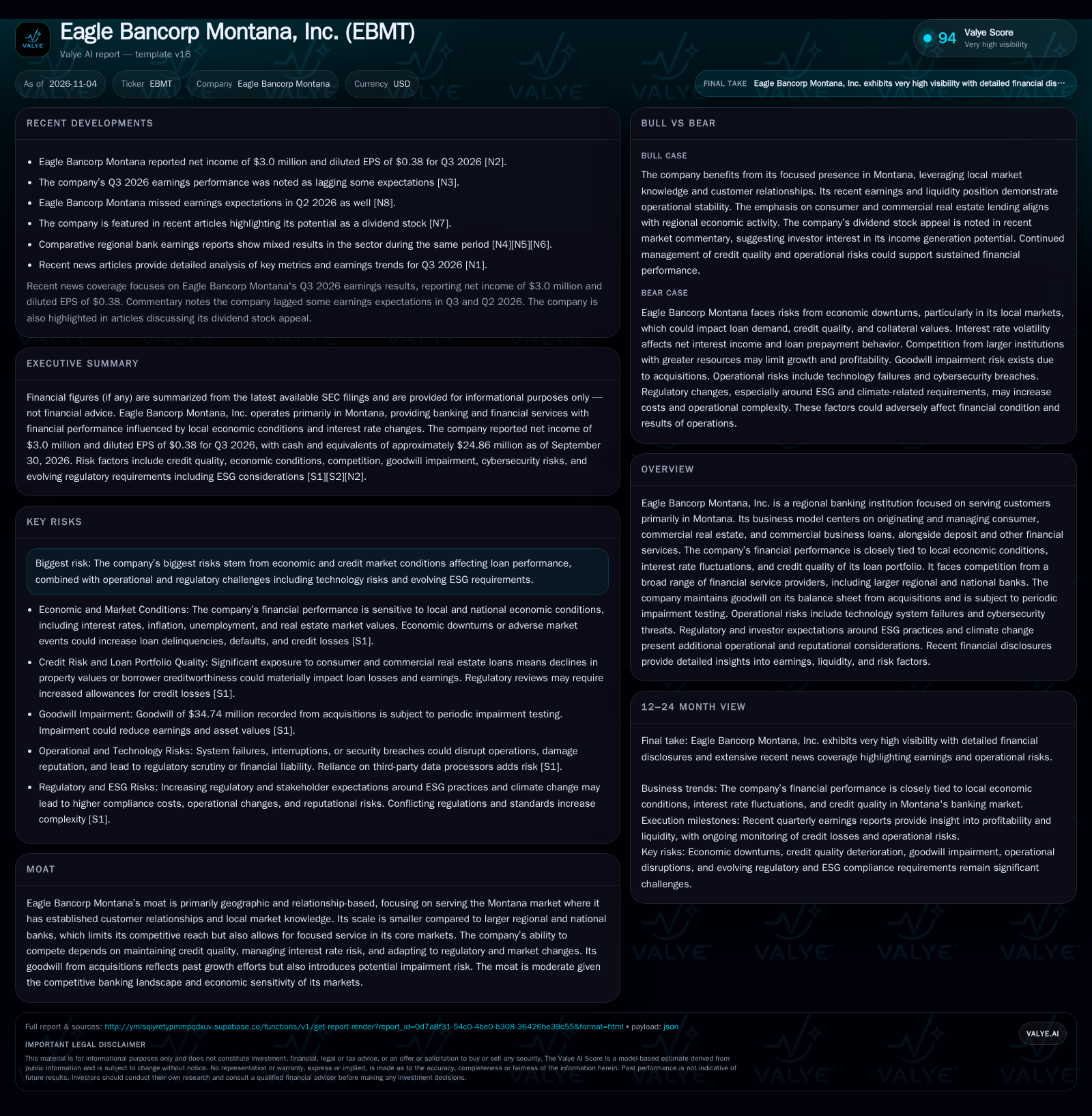
Eagle Bancorp Montana reported Q3 2026 net income of $3.0 million and diluted EPS of $0.38, but earnings missed expectations for the second straight quarter. With $24.86 million in cash and equivalents as of September 30, 2026, the bank’s performance remains tightly linked to Montana’s economic health, credit quality, and interest rate trends. The company’s customer relationships and local market knowledge provide some insulation, but competitive and regulatory pressures are mounting. The key question is whether Eagle can preserve margins and asset quality if local or national economic conditions deteriorate further.
Eagle Bancorp Montana, a regional lender rooted in Montana, finds itself at a crossroads. Recent quarters have shown earnings below analyst expectations, as the bank navigates a challenging environment shaped by shifting interest rates, heightened competition, and evolving regulatory demands. While its localized strategy and customer relationships offer some resilience, the company’s future trajectory hinges on its ability to manage credit risk, maintain profitability, and adapt to both economic and operational uncertainties. The next year will be a test of whether Eagle’s regional focus is a shield or a constraint as competitive and macroeconomic forces accelerate.
Earnings Misses Highlight Margin Compression and Sensitivity to Local Conditions
Eagle Bancorp Montana reported net income of $3.0 million and diluted EPS of $0.38 for Q3 2026, with liquidity of $24.86 million in cash and equivalents as of September 30, 2026 [S2] [N2]. These figures were below analyst expectations for the second consecutive quarter, reflecting a period of earnings softness [N3] [N8]. This shortfall matters because it signals either margin compression, credit costs, or both—factors that are often amplified in regional banks with concentrated geographic exposures. The company’s financial results remain highly sensitive to interest rate changes, the credit quality of its loan portfolio, and real estate market conditions in Montana [S1]. In this context, even modest shifts in local economic sentiment or asset quality can have outsized impacts on profitability and capital planning.
Loan Mix, Net Interest Margins, and the Levers of Regional Bank Profitability
Eagle Bancorp Montana’s business model is built around originating and managing consumer, commercial real estate, and commercial business loans, funded primarily by local deposits [S1]. The core revenue driver is net interest income—the spread between interest earned on loans/securities and interest paid on deposits and borrowings. In a rising rate environment, banks often benefit from wider net interest margins (NIM), but only if loan yields outpace the repricing of deposits and borrowing costs. The risk is that competition for deposits forces up funding costs faster than asset yields can adjust, squeezing NIM and profitability.
Fixed costs—branch infrastructure, compliance, technology, and personnel—tend to be high relative to the scale of regional banks. This creates operating leverage, meaning incremental loan growth or deposit inflows can boost profits, but volume declines or margin compression can quickly erode returns. Credit losses are another swing factor: heavy exposure to local real estate and commercial borrowers leaves the bank vulnerable to downturns in Montana’s economy. Additionally, $34.74 million in goodwill on the balance sheet adds potential non-cash impairment risk if acquisition assumptions are no longer supported by future earnings [S1].
Capital and funding needs are relatively modest for a bank of this size, but regulatory requirements and stress scenarios (such as a spike in loan losses or deposit outflows) could quickly change the picture. Without diversified fee income or national scale, the economics are fundamentally tied to local loan demand, credit performance, and cost discipline.
Local Relationships as a Buffer—But Not a Fortress—Against Larger Rivals
Eagle Bancorp Montana’s primary competitive advantage lies in its deep local knowledge, customer relationships, and community presence within Montana. This enables more tailored lending decisions and potentially higher customer retention compared to national or super-regional banks, which may lack local nuance. However, the moat is moderate at best: larger banks, credit unions, and fintechs bring greater product breadth, digital capabilities, and pricing leverage [S1].
Brokerage firms and non-bank lenders are increasingly encroaching on traditional banking territory, especially in commercial and mortgage segments. Larger competitors can undercut pricing, absorb regulatory costs more efficiently, and offer advanced digital experiences that regional banks may struggle to match. Eagle’s focus on Montana keeps it close to its customers but also limits its ability to diversify away from regional economic shocks or rapidly scale new product offerings.
Switching costs in banking are historically low for transactional accounts but can be higher for small business and commercial clients with integrated lending and treasury relationships. Still, price-sensitive or digitally savvy customers may be tempted by better rates or user experiences elsewhere, especially as technology adoption accelerates.
If Credit Quality Holds and Rate Dynamics Stabilize, Core Banking Profits Could Recover
The most favorable outcome for Eagle Bancorp Montana would be a stabilization or modest improvement in Montana’s economy, coupled with a benign credit environment and a plateauing of funding costs. In this scenario, net interest margins could recover as loan yields reset higher and deposit repricing slows. If local real estate and commercial business conditions remain robust, credit losses would stay low, supporting steady earnings and capital retention.
Evidence to confirm this pathway would include a return to meeting or exceeding analyst EPS estimates, stable or improving NIM, and low non-performing loan ratios (if disclosed). Additional signs would be growth in core deposits without aggressive rate competition, and no material increase in loan loss provisions. If management can also hold the line on operating costs and avoid goodwill impairment, the bank could resume incremental growth and possibly regain market confidence.
Earnings Fluctuate as Regional Banks Absorb Rate and Credit Volatility
The most plausible near-term outcome is continued earnings volatility as Eagle Bancorp Montana manages through interest rate and credit cycle crosscurrents. Loan demand and credit quality are likely to be uneven, reflecting both local economic fluctuations and broader macro trends. Net interest margin pressure may persist if deposit costs remain elevated and loan pricing is slow to adjust, especially in a competitive market.
Incremental credit deterioration—either from consumer or commercial portfolios—could require higher provisions, while cost pressures from regulatory compliance and technology investments may limit expense flexibility. The company’s liquidity, while sufficient for ongoing operations, does not provide significant strategic optionality for large-scale investments or defensive moves. Confirmation of this scenario would include continued lumpy earnings, ongoing scrutiny of asset quality metrics, and management commentary focused on cost control and credit vigilance.
Sharp Local Downturn or Asset Quality Shock Could Trigger Earnings and Capital Stress
An adverse scenario would be triggered by a significant downturn in Montana’s local economy—such as a sharp drop in real estate values, rising unemployment, or a major sector-specific slowdown. This could drive up loan delinquencies, defaults, and credit losses, leading to higher provisions and possible capital erosion. Prolonged net interest margin compression, if deposit costs outpace asset yields, would further compound profitability challenges.
In this environment, the risk of goodwill impairment would rise, as lower earning power could force non-cash writedowns that further depress reported results. Regulatory scrutiny might intensify, requiring more conservative lending or higher capital buffers. Confirmation would come from a spike in non-performing assets, rising charge-offs, a material EPS miss, or disclosure of goodwill impairment testing outcomes.
Benchmarks to Gauge Eagle Bancorp Montana’s Resilience and Strategic Flexibility
Quarterly net interest margin trends—directional changes would signal either stabilizing profitability or continued margin pressure.
Non-performing loan and charge-off rates (if disclosed)—increases would indicate rising credit risk and potential for higher provisions.
Deposit growth versus cost of funds—a useful metric would be the rate at which the bank can retain or grow deposits without aggressively raising rates.
Quarterly loan loss provisions—spikes may signal deteriorating credit quality or management caution.
Goodwill impairment testing results—any impairment would directly reduce reported earnings and signal reassessment of acquisition value.
Management guidance on operating expenses—escalating costs could erode operating leverage and constrain profitability.
Regulatory or ESG compliance disclosures—new requirements could increase non-interest expense or operational complexity.
Earnings performance versus analyst estimates—continued misses would reinforce the need for strategic or operational changes.
Disclaimer: This is research-only, informational analysis and not investment advice. It may include AI-generated interpretation and general industry context. Always verify important details using primary sources.

Comments