
Navient in 2026: Cost-Cutting, Regulatory Exposure, and the Dynamics of Education Loan Servicing
Navient’s focus on operational efficiency and cost reduction comes as federal education loan servicing faces regulatory uncertainty and shifting consumer dynamics.
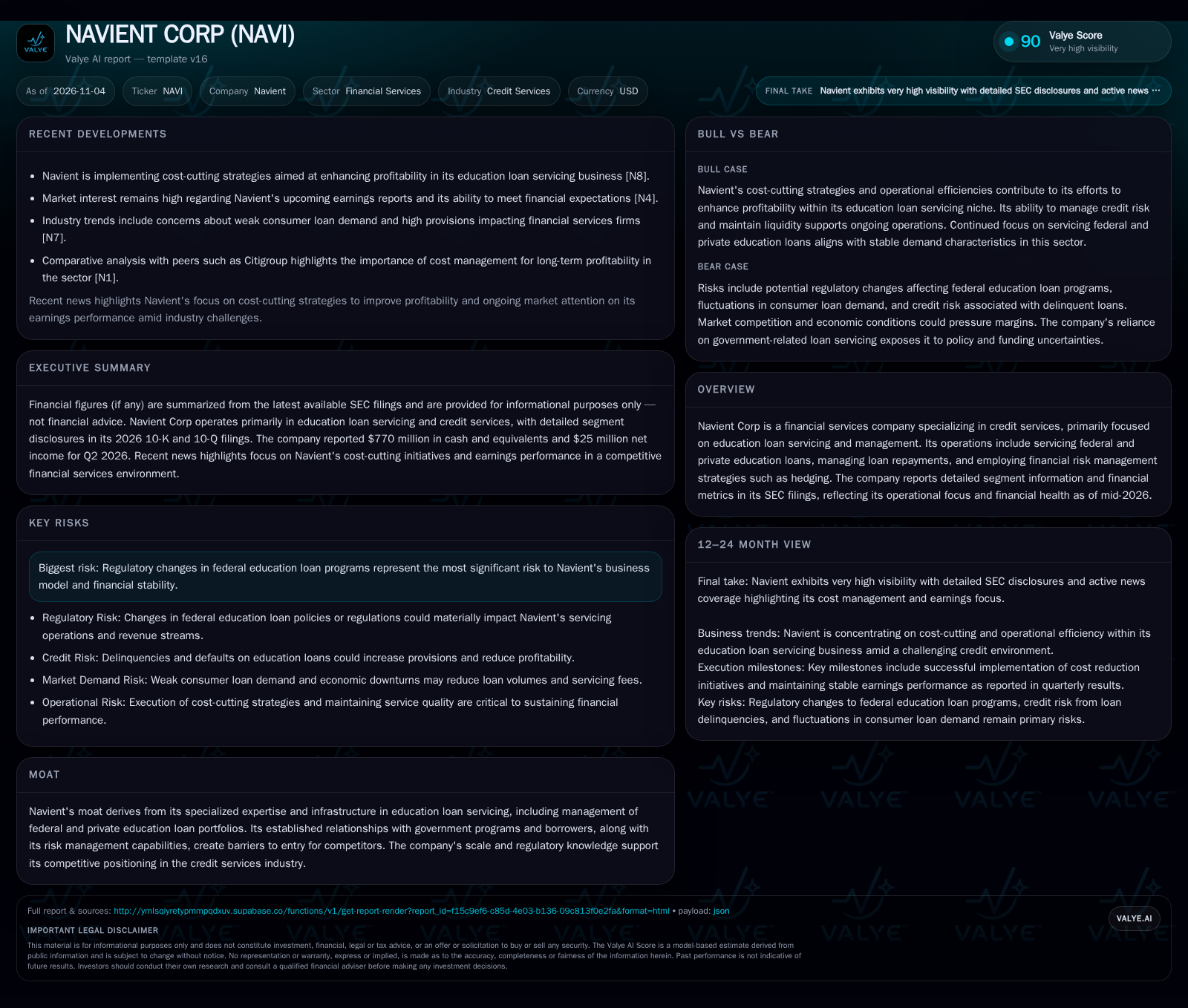
Navient’s Q2 2026 results show positive net income and strong cash reserves, reflecting cost-cutting efforts amid a challenging environment for education loan servicing. The business remains exposed to regulatory and credit risks, with future performance tied to execution on operational efficiency and adaptation to potential changes in federal loan policy. Competitive advantages stem from scale, expertise, and established government relationships, but industry shifts could test these moats.
Navient’s business is at an inflection point in late 2026, as management intensifies cost-cutting measures to offset margin pressures in the education loan servicing sector. Navient’s future performance will depend on its ability to execute efficiency initiatives, manage credit risk, and adapt to any policy changes that could reshape the economics of education lending.
Recent Results Highlight Profitability Amid Strategic Cost Reductions
As of June 30, 2026, Navient reported $25 million in net income for the quarter and held $770 million in cash and equivalents [S2]. These results come as the company implements a series of cost-cutting measures aimed at improving profitability in its core education loan servicing operations [N8]. The market remains focused on whether Navient can sustain or improve this earnings trajectory, particularly as regulatory and credit risks loom [N4]. The company reported cash and liquidity metrics for the period; these figures do not by themselves establish operating runway, investment capacity, financial flexibility, or financing capacity.
How Navient’s Operating Model Converts Scale and Risk Management into Earnings
Navient’s revenue model is anchored in servicing fees from both federal and private education loans, with additional income from asset management and collections [S1]. The business is highly sensitive to loan volumes, delinquency trends, and contractual terms with government entities. Fee revenue is typically volume-driven, and margins depend on the efficiency of servicing operations and the cost of managing delinquencies. Fixed costs are significant due to regulatory compliance requirements and IT infrastructure for large-scale loan portfolios, but variable costs—especially those tied to collections and customer service—can be flexed through cost-cutting initiatives.
The company uses derivatives and hedging strategies to manage interest rate risk, which can affect earnings volatility, especially as funding costs fluctuate [S1]. Capital needs are substantial, given the need to maintain liquidity buffers and regulatory capital. Operating leverage is present, but can be muted by the necessity to invest in compliance, technology, and risk management, limiting the degree to which incremental revenue growth translates into profit expansion. Cost control has become a key lever for margin improvement, as evidenced by recent strategic shifts [N8].
The interplay between Navient’s operating leverage and regulatory compliance costs warrants deeper consideration. While scale provides a cost advantage, the fixed nature of compliance expenditures means that any contraction in loan volumes could disproportionately pressure margins. Conversely, if regulatory requirements intensify, incremental compliance costs might outpace revenue growth, compressing profitability despite operational efficiencies. Therefore, the company’s ability to innovate in compliance technology and automate routine processes could be a critical determinant of sustainable margin expansion. This dynamic underscores that cost-cutting alone may not suffice; strategic investments in scalable compliance infrastructure could be necessary to balance risk and efficiency.
Defending a Niche: Scale, Regulatory Know-How, and the Challenge of Substitution
Navient’s competitive position rests on its scale, specialized expertise in servicing complex education loan portfolios, and deeply embedded relationships with federal programs and institutional lenders [S1]. These attributes create barriers to entry for smaller firms or new entrants, as regulatory compliance and technology integration are both costly and nontrivial. However, the risk of regulatory change—such as the potential for the federal government to consolidate or in-source servicing—creates a persistent threat to the business model.
Competition comes from other specialized servicers, large diversified financial institutions, and, potentially, technology-driven entrants offering alternative repayment or refinancing models. Substitution risk is mitigated by the complexity and regulatory requirements of federal loan servicing, but ongoing innovation in fintech and policy-driven shifts could erode Navient’s moat over time. The company’s ability to maintain strong borrower relationships and compliance track record will likely determine its resilience as the sector evolves.
The durability of Navient’s competitive moat also depends on its adaptability to technological disruption within the loan servicing industry. Emerging fintech entrants may leverage advanced data analytics, machine learning, and digital customer engagement platforms to offer more personalized and cost-effective servicing solutions. While Navient’s regulatory expertise and established government relationships create entry barriers, failure to integrate cutting-edge technology could erode customer satisfaction and operational efficiency over time. Hence, the company’s strategic focus on technology modernization and borrower experience enhancement could be pivotal in sustaining its market position against both traditional competitors and agile fintech challengers.
If Cost Discipline and Policy Stability Hold, Margin Expansion Could Follow
A favorable scenario for Navient would see cost-cutting initiatives translating into sustained margin improvement, while federal education loan policies remain stable and loan volumes do not materially decline. In this environment, the company could leverage its scale and operational platform to drive incremental profit growth, especially if delinquency rates remain controlled and funding costs are managed through effective hedging.
Evidence supporting this scenario would include continued quarterly net income growth, improving operating margins, and stable or rising servicing fee revenue. Confirmation would also come from regulatory updates that preserve the current structure of federal loan servicing contracts, as well as evidence of market share retention or gains in private loan servicing. Watch for management commentary on efficiency targets being met and absence of major regulatory disruptions.
Moreover, if federal education loan policies evolve to incentivize borrower retention or repayment acceleration, Navient could benefit from increased servicing fee revenue tied to performance-based contracts. Such policy frameworks might reward servicers for reducing delinquency rates or improving borrower outcomes, effectively aligning incentives between the government and servicers. In this context, Navient’s operational improvements and risk management capabilities could translate into differentiated service quality and higher profitability. However, this upside depends on the company’s ability to meet or exceed performance benchmarks, requiring ongoing investment in predictive analytics and borrower engagement strategies.
Operational Efficiency Offsets Headwinds, But Regulatory Uncertainty Caps Upside
The most plausible near-term outcome is that Navient’s cost-cutting efforts partially offset ongoing margin pressures from credit risk and muted loan growth. The company continues to report positive earnings and maintains substantial liquidity, but growth is modest as regulatory uncertainty overhangs the federal loan servicing market. Loan volumes may remain steady or contract slightly, and delinquency management is an ongoing operational focus.
Evidence of this scenario would include quarterly results showing stable but unspectacular net income, incremental improvements in expense ratios, and limited volatility in servicing revenue. Regulatory signals may remain mixed, with no immediate overhaul of federal programs but persistent policy debate. Confirmation would come from management reiterating guidance, continued focus on efficiency, and absence of significant contract losses.
In a scenario of regulatory ambiguity, Navient’s operational resilience will likely hinge on its flexibility to reallocate resources between federal and private loan servicing portfolios. Private loan servicing may offer higher margins but also entails greater credit risk and market competition. Balancing these trade-offs requires nuanced risk assessment and portfolio management capabilities. Additionally, the company’s capacity to maintain cost discipline while investing selectively in growth initiatives could determine whether it preserves shareholder value amid a stagnant or contracting market. This balance between efficiency and strategic agility is essential for navigating the sector’s structural uncertainties.
Policy Shocks or Credit Deterioration Could Trigger Margin Compression and Volatility
In a negative scenario, regulatory changes—such as restructuring or in-sourcing of federal education loan servicing—could materially reduce Navient’s addressable market or disrupt existing revenue streams. Alternatively, a spike in consumer loan delinquencies, driven by economic downturn or changes in borrower relief programs, could increase credit costs and erode profitability.
Evidence for this outcome would include regulatory announcements affecting federal loan servicing contracts, sharp increases in provision for loan losses, and declines in servicing revenue or operating margins. Early warning signs may appear in management guidance revisions, loss of major servicing contracts, or adverse trends in borrower performance metrics.
Milestones and Metrics That Will Define Navient’s Strategic Outcome
Quarterly net income and operating margin trends, as reported in SEC filings, will indicate whether cost-cutting efforts are translating into sustainable profitability.
Changes in servicing fee revenue, especially segmented by federal versus private loans if disclosed, would clarify the impact of market and regulatory dynamics on core business lines.
Updates on regulatory policy related to federal education loan programs—such as new servicing contract awards, renewals, or structural changes—will be critical for assessing future revenue visibility.
Delinquency and default rates in the company’s loan portfolios, if disclosed, would provide early signals of credit risk and potential pressure on earnings.
Progress toward stated cost-reduction targets, as articulated in management commentary or filings, would help test the effectiveness of efficiency initiatives.
Market share or contract wins/losses in both federal and private loan servicing, if disclosed, would indicate competitive positioning in a shifting industry landscape.
Disclaimer: This is research-only, informational analysis and not investment advice. It may include AI-generated interpretation and general industry context. Always verify important details using primary sources.

Comments