
Caris Life Sciences: AI-Driven Oncology Diagnostics Confronts Validation, Adoption, and Margin Stakes
Caris Life Sciences leverages a reported liquidity position and a proprietary AI-powered molecular diagnostics platform to pursue leadership in oncology precision medicine, but faces headwinds from shifting earnings expectations, competitive innovation, and hurdles to clinical adoption.
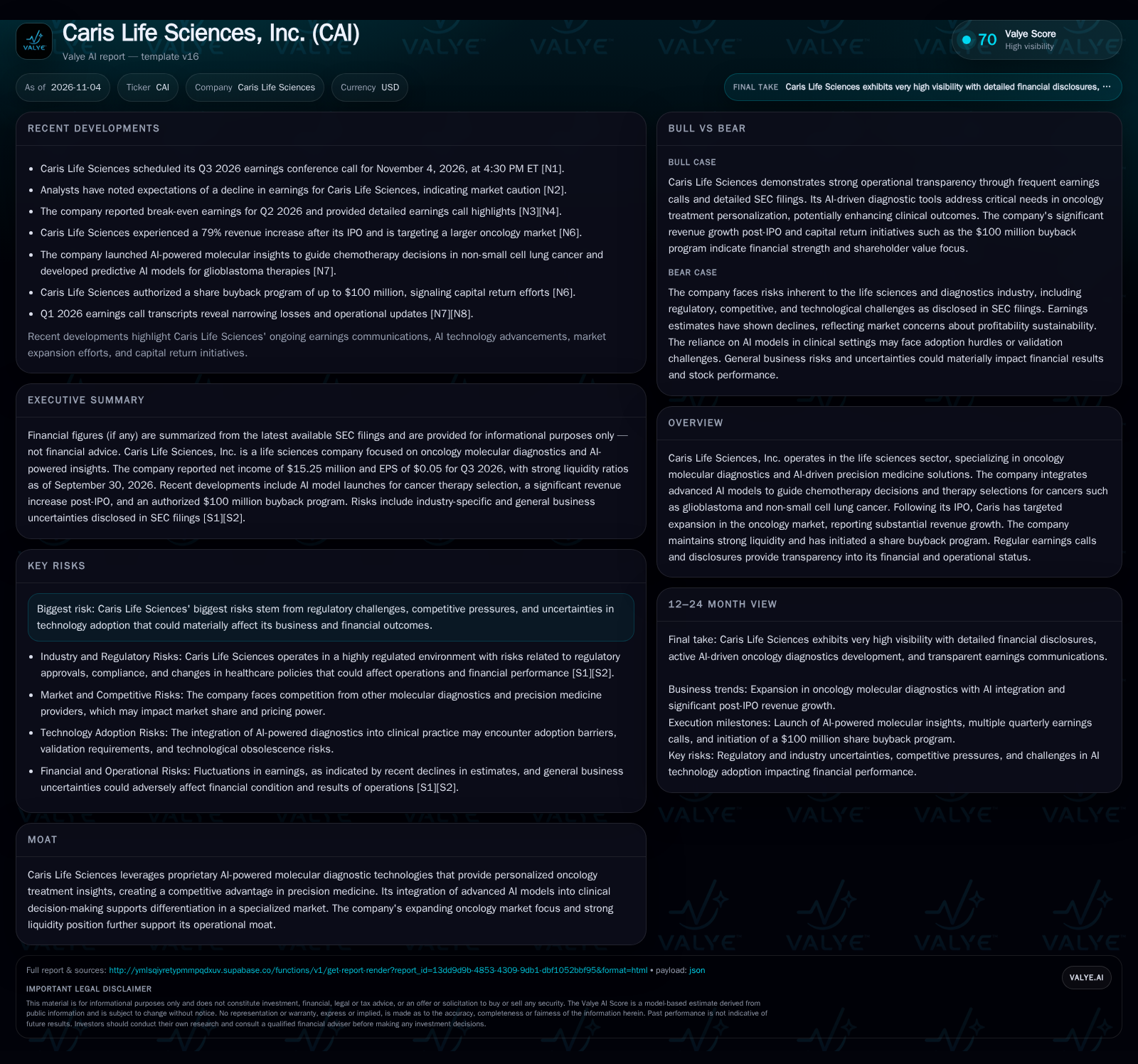
Caris Life Sciences reported a net income of $15.25 million for Q3 2026 and holds over $820 million in cash and equivalents with a current ratio of 6.71, signaling reported liquidity position [S2]. The company’s AI-powered molecular diagnostics—such as Caris Detect for multi-cancer early detection—target the expanding oncology market, but recent analyst estimates signal caution as earnings expectations have declined [N2]. Success hinges on clinical adoption of its proprietary platforms, continued validation of AI models, and competitive differentiation in a crowded precision medicine landscape.
Caris Life Sciences occupies a high-stakes frontier in oncology diagnostics, combining advanced molecular profiling with proprietary AI/ML algorithms to deliver highly personalized cancer insights. With the launch of its Caris Detect multi-cancer early detection test and a broad portfolio spanning tissue and blood-based diagnostics, Caris is positioned for impact—but must navigate regulatory, validation, and competitive challenges to sustain both growth and margin expansion.
Current Financial Strength and Strategic Diagnostic Launches
Caris Life Sciences reported net income of $15.25 million for the quarter ending September 30, 2026, with basic and diluted EPS of $0.05, marking a shift to profitability [S2]. The company’s liquidity is notably robust, with $820 million in cash and equivalents, $102 million in short-term investments, and a current ratio of 6.71 [S2]. This cushion enables sustained R&D and commercialization efforts without near-term funding pressure. Operationally, Caris has launched Caris Detect, an AI-driven multi-cancer early detection test, and expanded its molecular profiling platforms to include both tissue and blood-based solutions [S2] [N7]. However, analysts have flagged a decline in earnings estimates, reflecting market uncertainty around the durability of Caris’s recent financial performance [N2]. These developments highlight both the company’s near-term potential financial flexibility and the ongoing challenge of translating technological innovation into sustained commercial momentum.
Revenue Streams, Margin Dynamics, and Scale Economics in Precision Diagnostics
Caris generates revenue primarily from its portfolio of molecular profiling solutions, including tissue-based (WES/WTS) and blood-based (WGS) diagnostics. Commercial mechanics in this segment typically involve a mix of direct billing to healthcare providers, reimbursement from third-party payers, and partnerships with biopharma for companion diagnostics and clinical trial support. The economics of molecular diagnostics are characterized by high fixed costs (R&D, data infrastructure, regulatory compliance) and variable costs linked to test volumes and consumables. As test volumes scale, fixed cost leverage can drive margin expansion—provided that reimbursement rates and clinical adoption keep pace.
The launch of AI-powered products such as Caris Detect introduces both upside and complexity to the margin profile. On one hand, proprietary algorithms and large clinico-genomic datasets can differentiate the offering, potentially supporting premium pricing and recurring revenue if tests become standard of care. On the other, widespread adoption depends on validation in clinical settings, payer acceptance, and demonstration of cost-effectiveness relative to established diagnostics. If Caris can secure broad reimbursement and drive test volumes across oncology indications, operating leverage could be substantial. However, the need for ongoing clinical studies, regulatory submissions, and salesforce expansion could keep near-term margins volatile.
Defending a Moat in the AI-Driven Oncology Diagnostics Landscape
Caris’s competitive position rests on the integration of proprietary AI/ML algorithms with one of the largest clinico-genomic oncology datasets, enabling differentiated insights for therapy selection and early detection. The company faces competition from established molecular diagnostics firms, emerging digital pathology players, and large reference labs expanding into precision medicine. Advantages may include the breadth and depth of its dataset, the technical performance of its AI models, and its ability to deliver actionable, clinically validated reports to oncologists.
Counterforces include the rapid pace of technological innovation, with rivals investing heavily in multi-cancer early detection (MCED), minimal residual disease (MRD) tracking, and real-world evidence platforms. Payer scrutiny on test utility, pricing pressure from hospital systems, and the risk of technological obsolescence further challenge sustainable differentiation. Switching costs in diagnostics can be moderate if clinical utility and reimbursement are proven, but customer loyalty is not guaranteed in the absence of large-scale longitudinal outcomes data. The question is whether Caris’s proprietary algorithms and platform approach can stay ahead of both incumbent and startup competitors as the field evolves.
AI Validation and Clinical Integration Drive Transformative Growth
A favorable scenario for Caris would see rapid clinical adoption of its AI-powered diagnostics, with Caris Detect and related platforms becoming widely used for early cancer detection and therapy guidance. Successful demonstration of superior clinical outcomes—supported by peer-reviewed studies and real-world evidence—could drive payer coverage and premium reimbursement, expanding addressable market share. As more oncologists and biopharma partners integrate Caris’s solutions into routine practice and drug development, test volumes could scale rapidly, unlocking operating leverage and margin expansion.
Confirmation of this scenario would come from accelerating revenue growth, broadening payer coverage decisions, high-profile clinical collaborations, and consistent positive data from validation studies. Sustained profitability and upward revisions to earnings guidance would further support the bull case.
Navigating the Adoption Curve with Moderate Growth and Margin Fluctuations
The most plausible intermediate outcome is that Caris achieves incremental adoption of its molecular diagnostics, with growth driven by expansion into new oncology indications and gradual acceptance of AI-powered tools by clinicians and payers. Revenue continues to grow, but at a pace tempered by ongoing validation requirements, payer negotiations, and competitive pricing pressure. Operating margins fluctuate as R&D and commercial investments remain elevated relative to scale, and earnings remain sensitive to reimbursement decisions and regulatory timelines.
This scenario would be confirmed by steady—but not accelerating—test volume growth, periodic new payer contracts, and a mix of positive and neutral clinical validation results. Margins may improve gradually but remain below those of established diagnostics market leaders, reflecting continued investment in platform development.
Validation Delays and Competitive Pressures Erode Momentum
In a negative scenario, Caris’s AI-powered diagnostics face delays in clinical validation or fail to demonstrate sufficient incremental benefit over existing tests, limiting payer coverage and slowing adoption. Increased competition from both established players and well-funded startups puts pressure on pricing and erodes market share. Regulatory setbacks, such as delayed approvals or shifting guidelines, further undermine growth prospects. As a result, revenue growth stalls, margins compress, and the company is forced to scale back R&D or commercial initiatives despite its reported cash position.
This scenario would be signaled by flat or declining test volumes, negative reimbursement decisions, high-profile competitor wins, and downward revisions to earnings guidance. Persistent analyst skepticism and widening losses would reinforce the bear case.
Milestones That Will Clarify Caris’s Trajectory in Precision Oncology
Quarterly test volume growth by product line, if disclosed, will help assess adoption velocity across Caris’s platforms.
Updates on payer coverage and reimbursement rates for Caris Detect and other AI-powered diagnostics would help gauge commercial traction.
Clinical validation study outcomes—especially peer-reviewed, prospective trials—would provide evidence for or against the clinical utility of the company’s offerings.
Expansion or renewal of biopharma partnerships and academic collaborations would signal continued relevance and platform integration.
Gross margin trends and R&D expense ratios will indicate the pace of operating leverage and investment intensity.
Regulatory milestones, such as FDA approvals or new guideline inclusions, would materially impact addressable market size and speed of adoption.
Management commentary on competitive wins or losses, as well as new product launches, would clarify Caris’s positioning in the evolving diagnostics landscape.
Analyst earnings revisions and management guidance updates will provide early signals of changing market sentiment and operational performance.
Disclaimer: This is research-only, informational analysis and not investment advice. It may include AI-generated interpretation and general industry context. Always verify important details using primary sources.

Comments