
Newbury Street II Acquisition Corp: The Mechanics and Stakes of the FORT Robotics Business Combination
Newbury Street II Acquisition Corp (NTWO), a 2024-formed SPAC, is advancing toward a merger with FORT Robotics. With $181.8 million held in trust and no operating revenues to date, the company faces classic SPAC challenges: redemption risk, financing hurdles, dilution, and execution within a fixed window.
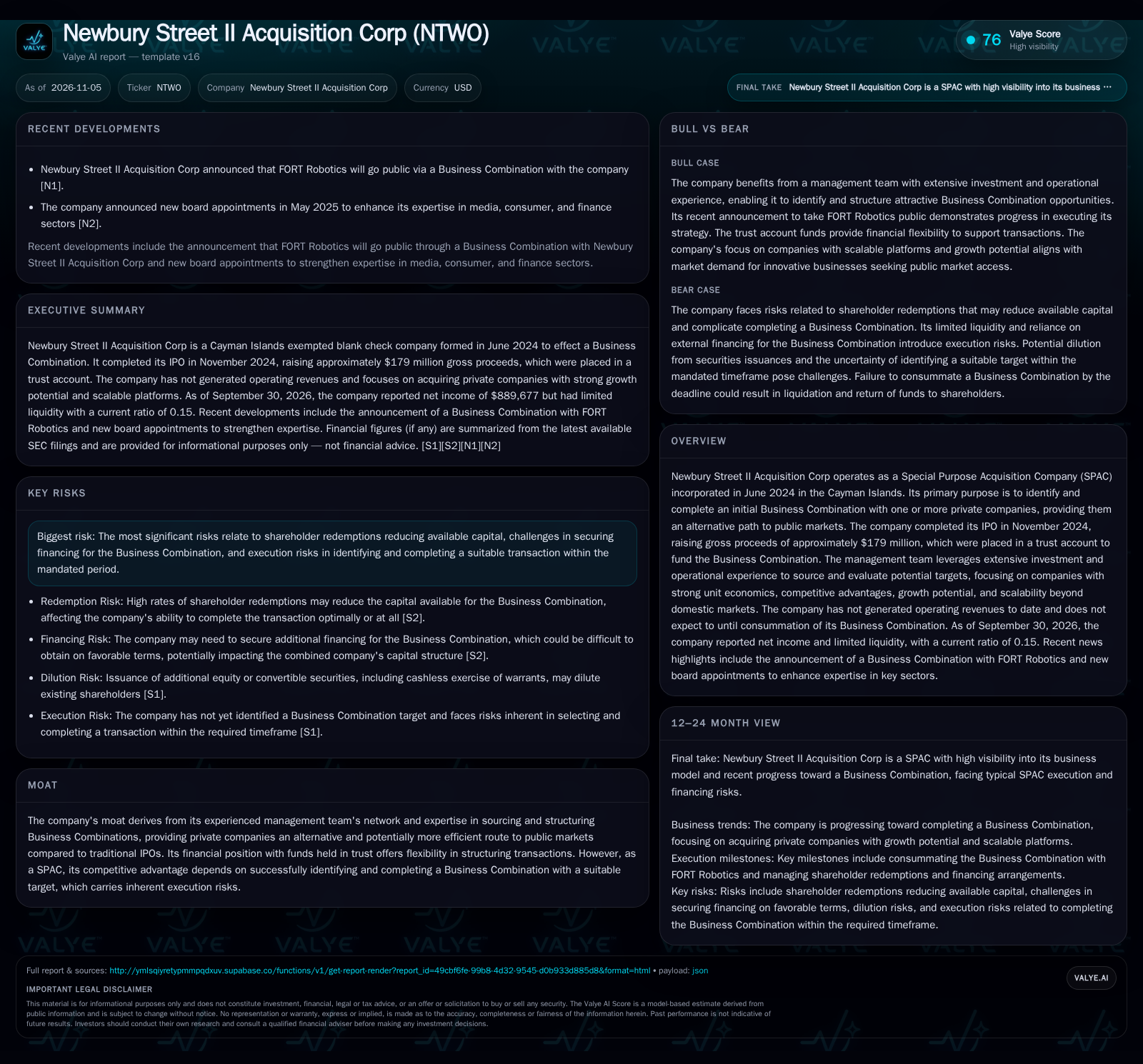
Newbury Street II Acquisition Corp is a Cayman Islands-based SPAC that completed its IPO in November 2024, raising approximately $179 million for a future business combination. As of late 2026, it has announced a merger with FORT Robotics but holds limited working liquidity outside its trust account. The company’s success now hinges on minimizing shareholder redemptions, securing additional financing if needed, and efficiently executing the merger—outcomes that will determine value creation and the viability of the combined entity. [S1] [S2] [N1]
Newbury Street II Acquisition Corp (NTWO) epitomizes the SPAC lifecycle: a Cayman Islands entity formed in June 2024, capitalized via a $179 million IPO, and now progressing toward a business combination with FORT Robotics. As is typical for SPACs, NTWO has generated no operating revenue and its liquidity outside the trust account is minimal, with a current ratio of 0.15 as of September 2026. The announced merger with FORT Robotics is a pivotal inflection point, but success hinges on mitigating redemption risk, securing any required transaction financing, and managing dilution—classic hurdles that will ultimately define shareholder value and the future of the combined entity. [S1] [S2] [N1]
Progress Toward the FORT Robotics Merger and Liquidity Realities
Newbury Street II Acquisition Corp, incorporated in June 2024 as a Cayman Islands SPAC, completed its IPO in November 2024, raising $172.5 million from public units and $6.48 million from private placement units, all placed in a trust account dedicated to a business combination. As of December 31, 2025, the trust held approximately $181.8 million. The company recently announced a business combination with FORT Robotics, marking the transition from SPAC capital formation to transaction execution. The success of this combination, and the degree to which NTWO can retain capital post-redemptions and secure additional financing if needed, will determine the economic viability and strategic direction of the merged entity. [S1] [S2] [N1]
SPAC Economics: Trust Structure, Dilution, and the Cost of Closing
The core economics of Newbury Street II Acquisition Corp are typical for SPACs: sponsor capital and IPO proceeds are placed in a trust account, invested in short-term, low-risk instruments, and are only released upon completion of a qualifying business combination. Until then, the SPAC earns nominal interest income and covers minimal expenses, resulting in reported net income that is largely a function of interest earned versus public company costs. The IPO structure creates two distinct capital pools: the trust (reserved for the acquisition) and a minimal operating account (from which public company and diligence expenses are paid).
Upon announcing a business combination, the trust is used to fund the transaction, subject to shareholder redemptions—investors may elect to redeem their shares for a pro rata portion of the trust, often leading to significant capital outflows if the deal is not perceived as attractive. To close the transaction, SPACs may need to raise additional PIPE (private investment in public equity) financing, often at terms less favorable than the IPO, introducing dilution risk for existing holders. Warrants and founder shares further complicate the post-merger cap table, with the potential for substantial dilution if these convert into ordinary shares. The operating leverage post-combination will depend entirely on the target’s business model; for FORT Robotics, the economics will hinge on its revenue growth, gross margins, and ability to scale cost structure relative to the capital raised.
SPACs as Public Market Gateways: Differentiation and Pressures
NTWO’s competitive advantage resides primarily in its management team’s ability to source, structure, and close an attractive business combination—leveraging networks, reputation, and sector expertise. The recent addition of board members with backgrounds in media, consumer, and finance suggests a deliberate effort to broaden deal-sourcing capabilities. However, the SPAC landscape remains intensely competitive: dozens of blank check companies vie for a finite pool of high-quality targets, driving up valuations and increasing the risk of overpaying or settling for less compelling assets.
SPACs face competition not only from each other but also from traditional IPOs, direct listings, and late-stage private funding rounds. For private companies, the SPAC route offers speed, certainty of capital (assuming low redemptions), and the ability to negotiate terms, but the stigma of high-redemption SPAC deals and post-merger underperformance can weigh on target willingness and public investor enthusiasm. Ultimately, NTWO’s edge depends on its ability to close the FORT Robotics deal on terms that retain enough capital for growth and create a compelling post-merger equity story.
What Success Would Look Like: Low Redemptions, Accretive Merger, and Platform Scalability
In the most favorable scenario, NTWO’s merger with FORT Robotics is met with low shareholder redemptions, preserving the bulk of the $181.8 million trust, and any required PIPE financing is secured on terms that minimize dilution. FORT Robotics, as a newly public entity, leverages the capital infusion to accelerate revenue growth and scale its platform, validating the SPAC’s selection criteria of strong unit economics and competitive positioning. Public market investors respond positively, leading to sustained trading above the trust redemption price, and the combined company demonstrates operating leverage as it grows.
Confirmation of this scenario would include public disclosure of low redemption rates, successful PIPE closing without excessive discounts, and early evidence of FORT Robotics’ ability to deploy capital for high-return growth initiatives. Strong post-close trading, positive analyst coverage, and the announcement of strategic customer wins or partnerships would further support the upside case.
Typical SPAC Outcomes: Moderate Redemptions, Dilution, and Execution Risk
The most plausible scenario reflects the median SPAC experience: a significant but not catastrophic portion of shareholders elect to redeem, reducing the cash available at closing and necessitating a PIPE or other external financing at less favorable terms. Some dilution is incurred both from new financing and the conversion of warrants and founder shares. The FORT Robotics transaction closes successfully, but the combined company faces near-term pressure to validate its growth narrative and achieve operational milestones under the scrutiny of public markets.
Evidence for this scenario would include post-merger filings detailing the redemption rate, size and pricing of any PIPE, and an updated pro forma capital structure. Early post-close trading may exhibit volatility, with the stock price hovering near the trust redemption value as the market digests execution risk and awaits financial results from the new entity. The pace at which FORT Robotics delivers customer traction, revenue growth, and margin improvement would be critical to determining whether the combined company can break out from the typical SPAC overhang.
When Execution or Market Sentiment Derails the Business Combination
The adverse scenario is defined by high shareholder redemptions, eroding the trust pool to a level insufficient to meet the transaction’s capital needs. If PIPE or alternative financing cannot be raised on viable terms, the merger may be renegotiated, downsized, or abandoned altogether. Even if the deal closes, excessive dilution from securities issuances or a weak market reception could result in sub-trust trading and the erosion of public shareholder value.
This scenario would be confirmed by disclosures of redemption rates exceeding typical SPAC averages, delayed or failed PIPE financings, and negative market reaction post-close. If the transaction cannot be completed within the SPAC’s mandated window, NTWO would be forced to liquidate and return remaining trust funds to shareholders, resulting in a loss of sponsor capital and the opportunity cost for all parties involved.
Milestones and Metrics That Will Determine the FORT Robotics Merger Outcome
Shareholder redemption rate at the time of the FORT Robotics merger vote—if disclosed, this will determine available cash for the combined entity and indicate market confidence.
Terms, size, and investor composition of any PIPE or alternative financing arranged to support the merger—details would help assess dilution and investor appetite.
Final pro forma capital structure and dilution from warrants, founder shares, and any bridge financing—would clarify post-close ownership and incentives.
Timing and completion of the FORT Robotics merger—delays or renegotiations would signal execution risk or adverse market feedback.
Initial post-merger trading price relative to trust redemption value—persistent sub-trust trading would indicate skepticism about the combined company’s prospects.
Early operating results and disclosures from FORT Robotics—revenue growth, customer wins, and margin trends would validate or challenge the growth narrative.
Any changes to board or management composition post-close—would signal sponsor/target alignment and governance priorities.
Public communications about strategic partnerships, customer contracts, or technology milestones—would help test the scalability and competitive position of FORT Robotics.
Disclaimer: This is research-only, informational analysis and not investment advice. It may include AI-generated interpretation and general industry context. Always verify important details using primary sources.

Comments