
Stabilis Solutions: LNG Infrastructure Ambitions Meet Execution and Financing Crossroads
With a material expansion plan centered on the Galveston LNG facility and long-term marine bunkering contracts, Stabilis Solutions is pivoting to serve growing demand for cleaner fuels in North America. The company's future now hinges on securing customer offtake and project financing, as it navigates concentrated customer risk and evolving competitive and regulatory landscapes.
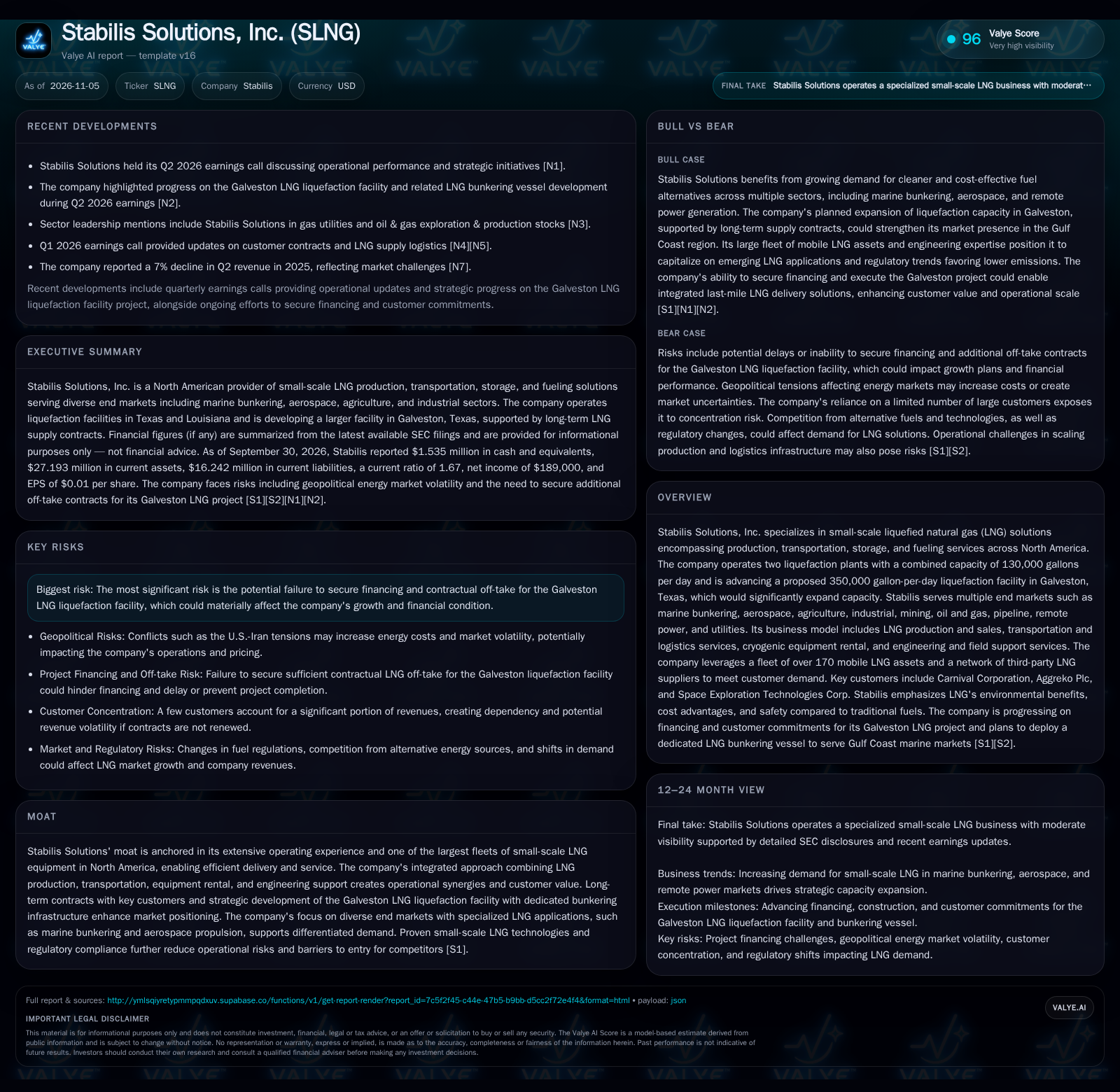
Stabilis Solutions is betting on a step-change in capacity and market reach through its planned Galveston LNG liquefaction facility, backed by two ten-year bunkering agreements. The project’s success depends on additional offtake and financing, amid customer concentration and geopolitical risks. Execution of this capital-intensive expansion will determine whether Stabilis can scale from niche LNG service provider to a more integrated Gulf Coast marine fuel supplier. [S1] [S2]
Stabilis Solutions stands at a strategic crossroads as it pursues a major capacity expansion in North American small-scale LNG. While its core business—supplying LNG production, logistics, and engineering services—remains anchored by two operating plants and a sizable equipment fleet, the company’s proposed Galveston facility marks a bold bet on the future of marine bunkering and industrial fuel switching. With two ten-year contracts in hand but much of the project’s offtake and funding still in negotiation, Stabilis’ ability to secure capital and customer commitments will define its next growth chapter. The stakes are heightened by concentrated customer exposure, volatile energy markets, and the shifting economics of alternative fuels. [S1] [S2]
Financing, Customer Contracts, and the Galveston LNG Project: The Current State
Stabilis Solutions currently operates two small-scale LNG liquefiers with a combined capacity of 130,000 gallons per day and manages one of the largest mobile LNG equipment fleets in North America. The company is advancing a proposed 350,000 gallon-per-day LNG liquefaction facility in Galveston, Texas, which would nearly quadruple its production capacity and solidify its presence in the Gulf Coast marine bunkering market. As of September 30, 2026, Stabilis reported $1.535 million in cash and equivalents, $27.193 million in current assets, and $16.242 million in current liabilities, yielding a current ratio of 1.67. Net income for the first nine months of 2026 was $189,000. Notably, the company has executed two ten-year LNG supply agreements with cruise vessel operators (commencing in 2027) to support the Galveston project, but still requires additional offtake contracts and $350-400 million in project financing to proceed. [S1] [S2]
LNG Production, Logistics, and Capital Intensity: How Stabilis Makes—and Could Scale—Money
Stabilis’ revenue streams are diversified across LNG production and sales, transportation and logistics, equipment rental, and engineering services. The company’s core economics are driven by the spread between LNG production costs (including feedstock, energy, and fixed plant expenses) and contract or spot sales to industrial and marine customers. Small-scale LNG is typically a higher-margin, service-intensive business compared to commodity-scale LNG export, but it also involves significant fixed costs: plant operations, fleet maintenance, and regulatory compliance. The planned Galveston facility represents a material step up in fixed capital requirements, with an estimated $350-400 million investment needed for plant construction and a dedicated Jones Act-compliant bunkering vessel. This introduces a new layer of operating leverage—potentially boosting margins and returns if capacity is sold out, but exposing the business to downside if demand falls short or contracts are not secured. The company’s current cash position is minimal relative to expansion needs, so external debt or equity capital will be required. If successful, the Galveston facility could enable Stabilis to capture a larger share of the growing Gulf Coast marine LNG bunkering market and achieve scale-driven cost advantages.
Fleet Scale, Customer Relationships, and the LNG Value Chain: Assessing Defensible Advantages
Stabilis’ principal competitive strengths are its integrated service offering and its large fleet of mobile LNG storage and vaporization assets, which enable tailored solutions for a diverse set of industrial and marine customers. The company’s experience in engineering and field support, as well as long-standing relationships with key customers like Carnival, Aggreko, and SpaceX, provide a degree of stickiness and credibility in a technically demanding market. However, Stabilis faces several counterforces: customer concentration risk (with the top three customers each accounting for more than 10% of 2025 revenues), competition from both larger LNG producers and alternative fuel providers (such as methanol, ammonia, or electrification in certain segments), and regulatory uncertainty around emissions standards. The Galveston project, if realized, could establish a localized supply advantage for marine LNG bunkering in the Gulf Coast, but the company’s ability to maintain pricing power and utilization rates will be tested as the market matures and as substitutes become more viable.
Securing Offtake and Capital: Pathways to Transformational Scale
In a favorable scenario, Stabilis successfully secures additional long-term offtake agreements for the Galveston facility, enabling it to raise the required $350-400 million in project financing. Construction proceeds on schedule, with the plant and dedicated bunkering vessel commissioned as planned. The company leverages its first-mover advantage and existing customer relationships to capture a significant share of Gulf Coast marine LNG demand, as cruise and cargo operators shift away from higher-emission fuels. Operating leverage from the larger asset base drives margin expansion, while Stabilis’ engineering and logistics capabilities support further penetration into industrial and remote power markets. Evidence confirming this scenario would include announcements of new multi-year offtake contracts, finalized financing arrangements, construction milestones met on time, and rising LNG throughput and utilization rates post-commissioning.
Incremental Progress and Execution Risk: A Probable Middle Outcome
The most plausible trajectory is one in which Stabilis makes incremental progress on Galveston project development but faces delays or staged execution due to the challenges of securing full financing and offtake commitments. The company continues to operate its existing plants and fleet with modest growth, while the Galveston facility moves forward in phases as customer demand and capital become available. Customer concentration remains an ongoing risk, but the company’s diversified end-market exposure (marine, industrial, remote power) provides some buffer. The LNG market continues to grow, but competition from alternative fuels and regulatory shifts slow the pace of adoption. Evidence supporting this scenario would be partial financing announcements, phased construction updates, continued reliance on a handful of large customers, and steady—rather than explosive—growth in reported LNG volumes and revenues.
Project Financing Shortfall and Market Disruption: What Could Derail the Expansion
In an adverse scenario, Stabilis is unable to secure sufficient offtake agreements to support debt or equity financing for the Galveston LNG facility. Construction is delayed or indefinitely postponed, resulting in sunk development costs and lost momentum. Customer concentration risk materializes, with one or more major customers reducing volumes or terminating contracts. At the same time, geopolitical volatility or regulatory changes negatively impact LNG demand or input costs, making the economics of small-scale LNG less attractive relative to emerging alternatives. Confirmation of this scenario would include public disclosures of failed financing rounds, impairment charges or write-downs of capitalized project costs, declining revenue from key customers, and negative cash flow trends.
Milestones That Will Clarify Stabilis’ LNG Expansion Thesis
Announcements of additional long-term LNG offtake contracts for the Galveston facility, especially with customers outside the current top three, would help test demand depth and revenue visibility.
Formal project financing commitments or debt/equity offerings sufficient to cover the $350-400 million capital requirement for Galveston would signal execution momentum.
Construction milestones for the Galveston plant and bunkering vessel, including groundbreaking, major equipment orders, and commissioning dates, if disclosed, would indicate project progress.
Utilization rates and throughput volumes at existing liquefaction plants, as rising utilization would suggest demand strength and operating leverage.
Revenue concentration trends—specifically, whether new customer wins reduce reliance on Carnival, Aggreko, and SpaceX.
Changes in regulatory or emissions standards impacting the economics of LNG versus alternative fuels in Stabilis’ core markets.
Disclosure of project cost overruns, delays, or impairment charges related to capitalized Galveston expenses would be material downside signals.
Disclaimer: This is research-only, informational analysis and not investment advice. It may include AI-generated interpretation and general industry context. Always verify important details using primary sources.

Comments