
Service Properties Trust: Assessing Net Lease Strength and Hotel Segment Dynamics in Today’s REIT Market
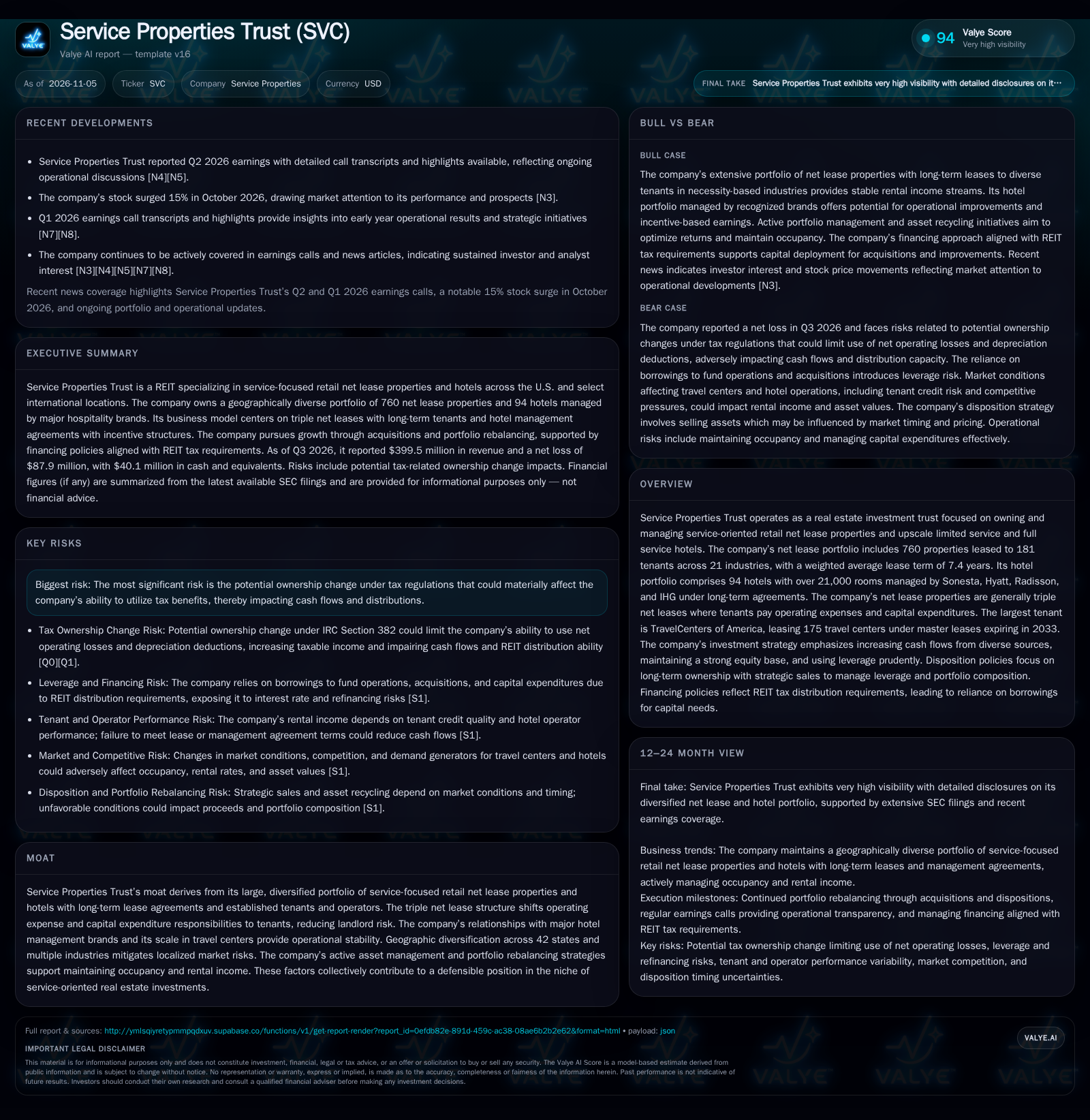
Service Properties Trust’s hybrid portfolio of net lease properties and hotels offers income diversity and long-term lease visibility, but recent losses, leverage dependence, and tax-related risks shape a complex risk-reward profile. Sustainable cash flows hinge on tenant resilience, hotel operator performance, and active portfolio management.
Service Properties Trust combines a large, diverse net lease portfolio with significant hotel holdings, anchored by long-term leases and management agreements.
Service Properties Trust (SVC) stands out among REITs for its hybrid approach, blending a sprawling portfolio of service-oriented net lease retail properties with a substantial hotel footprint. The company’s reliance on long-term, triple net leases delivers revenue visibility and risk transfer, while its hotel assets introduce operational variability and upside potential through incentive-based management agreements. The next phase for SVC will test its ability to balance cash flow stability from net leases against the volatility and capital needs of its hotel segment, all while managing leverage and navigating a changing regulatory and macroeconomic environment.
Recent Portfolio Trends and Performance Drivers
As of September 30, 2026, Service Properties Trust reported revenue of $399.5 million and a net loss of $87.9 million, with cash and equivalents at $40.1 million [S2]. The company’s property portfolio comprises 760 net lease retail properties with a weighted average lease term of 7.4 years, and 94 hotels managed by major brands such as Sonesta, Hyatt, Radisson, and IHG [S1]. The net lease assets are largely structured as triple net leases, passing operating and capital expense obligations to tenants, and the largest tenant—TravelCenters of America—holds master leases expiring in 2033 with a limited guaranty from BP [S1]. The company reported cash and liquidity metrics for the period; these figures do not by themselves establish operating runway, investment capacity, financial flexibility, or financing capacity. [N3]
SVC’s Hybrid Approach to Cash Flow Generation and Capital Management
Service Properties Trust’s economics are shaped by its dual exposure to net lease retail and hotels. The triple net lease structure is designed to provide predictable, inflation-protected rental streams because tenants bear most property-level costs and some leases include CPI or percentage rent escalations [S1]. This model offers high operating leverage: while fixed costs are relatively low, revenue is highly dependent on tenant solvency and occupancy. The hotel segment, managed under long-term agreements with base fees (3–5% of gross revenues) and incentive fees above EBITDA thresholds, introduces more variable cash flows and requires ongoing capital expenditures. SVC funds hotel improvements directly, often with escrow requirements, which adds to capital intensity but can preserve asset quality [S1].
The REIT structure mandates distribution of at least 90% of taxable income, so SVC relies on external borrowings to fund acquisitions, major renovations, and working capital needs [S1]. This leverage amplifies both upside in robust environments and downside in periods of earnings pressure or capital market disruption. The absence of convertible mortgages or joint ventures as of late 2025 signals a relatively straightforward capital stack, but also means less flexibility to absorb shocks from underperforming assets or market downturns.
The Role of Diversification, Scale, and Triple Net Leases in SVC’s Market Position
SVC’s competitive position is anchored by its size, tenant diversity, and the stability conferred by long-term, triple net lease contracts. The portfolio’s geographic and industry spread—spanning 42 states and 21 industries—mitigates concentration risk and local demand shocks [S1]. Its largest tenant, TravelCenters of America, is a critical part of the U.S. trucking and travel infrastructure, offering some insulation from pure retail volatility. The triple net structure further reduces landlord exposure to expense inflation, a key advantage relative to gross lease or self-operated models.
However, SVC’s hotel assets expose it to greater volatility and competitive intensity. Hotel performance hinges on operator quality, brand strength, and macro demand swings—factors largely outside SVC’s direct control. Competing REITs in net lease and hospitality (such as those focused solely on necessity retail, industrial, or pure lodging assets) may have lower volatility or more focused capital allocation. SVC’s hybrid model creates defensive breadth but could dilute returns if asset-specific headwinds emerge or if capital is not dynamically reallocated.
Capturing Value from Tenant Stability and Hotel Segment Rebound
SVC’s upside scenario centers on robust tenant performance in net lease assets and a cyclical rebound in hotel operations. If TravelCenters of America and other major tenants maintain high occupancy and rent coverage, SVC’s base rental income could remain stable or grow through contractual escalations. Meanwhile, a recovery in business and leisure travel would lift hotel revenues, driving higher base and incentive fees under management agreements.
Active portfolio management—timely asset sales, selective acquisitions, and disciplined capital recycling—could further enhance returns. Confirmation of this scenario would include rising occupancy and rent collection rates (if disclosed), sequential improvement in hotel RevPAR and EBITDA, and evidence of successful asset dispositions at premium valuations. A reversal of recent net losses and growing distributable cash flow, enabling higher or sustained REIT distributions, would be strong positive signals.
Stable Lease Revenues Versus Hotel Segment Fluctuations and Leverage Considerations
The most plausible trajectory is that SVC’s net lease portfolio continues to provide a steady income backbone, while hotel earnings remain variable and sensitive to economic and travel sector trends. The triple net portfolio’s long lease terms and tenant diversity could buffer against moderate tenant distress, but hotel performance is likely to remain mixed due to potential regional demand disparities and operator execution risk.
Ongoing capital expenditures on hotels and the need to maintain or improve assets could pressure free cash flow, especially given REIT distribution requirements and the company’s reliance on external financing. Asset sales and portfolio rebalancing may provide some liquidity and risk mitigation, but proceeds are subject to market timing and pricing. Confirmation of this base case would be stable or gradually improving rent receipts, modest hotel earnings growth, and a managed debt profile without significant covenant breaches or refinancing stress.
Risks from Tenant Challenges, Hotel Performance, and Tax Limitations
The adverse scenario materializes if tenant credit quality deteriorates—particularly among large anchors like TravelCenters of America—or if a macro downturn triggers widespread rent deferrals or lease renegotiations. This would erode the predictability of net lease income and strain SVC’s ability to cover fixed obligations. Simultaneously, if hotel operators underperform due to weak demand or operational missteps, incentive fees could evaporate and base revenues decline, while capital expenditure needs persist.
A further risk is regulatory: a change in SVC’s ownership structure under IRC Section 382 could limit its use of net operating losses and depreciation deductions, increasing cash tax obligations and constraining distributions [S1]. In this scenario, liquidity could become acutely strained, forcing asset sales at unfavorable prices or dilutive equity issuance.
Criteria for Evaluating SVC’s Financial Stability and Growth Potential
Occupancy and rent collection rates across the net lease portfolio (if disclosed) would provide a direct measure of tenant health and rental income stability.
Hotel segment performance metrics—such as RevPAR, occupancy, and segment EBITDA—would help gauge the trajectory of variable earnings and management fee income.
Debt maturity schedules, leverage ratios, and any refinancing activity should be monitored to assess interest rate risk and refinancing vulnerability.
Execution of asset dispositions or acquisitions, including realized sale prices versus book values, would indicate the effectiveness of portfolio rebalancing and capital recycling.
Updates on potential ownership changes or Section 382 events, and their impact on tax shield utilization and REIT distribution capacity, are critical for cash flow forecasting.
Any major changes in tenant composition—especially regarding the largest anchor tenants—or renegotiation of master leases would signal shifts in income visibility and risk.
Disclaimer: This is research-only, informational analysis and not investment advice. It may include AI-generated interpretation and general industry context. Always verify important details using primary sources.

Comments