
Stoneridge Refocuses on Smart Vehicle Electronics: Strategic Realignment, Margin Mechanics, and the Stakes of Cyclicality
After divesting its Control Devices segment, Stoneridge leans into advanced electronics for vehicle intelligence and safety. The company’s pivot heightens both growth potential and exposure to cyclical swings, with recent operating losses underscoring the need for disciplined execution and successful smart-product adoption.
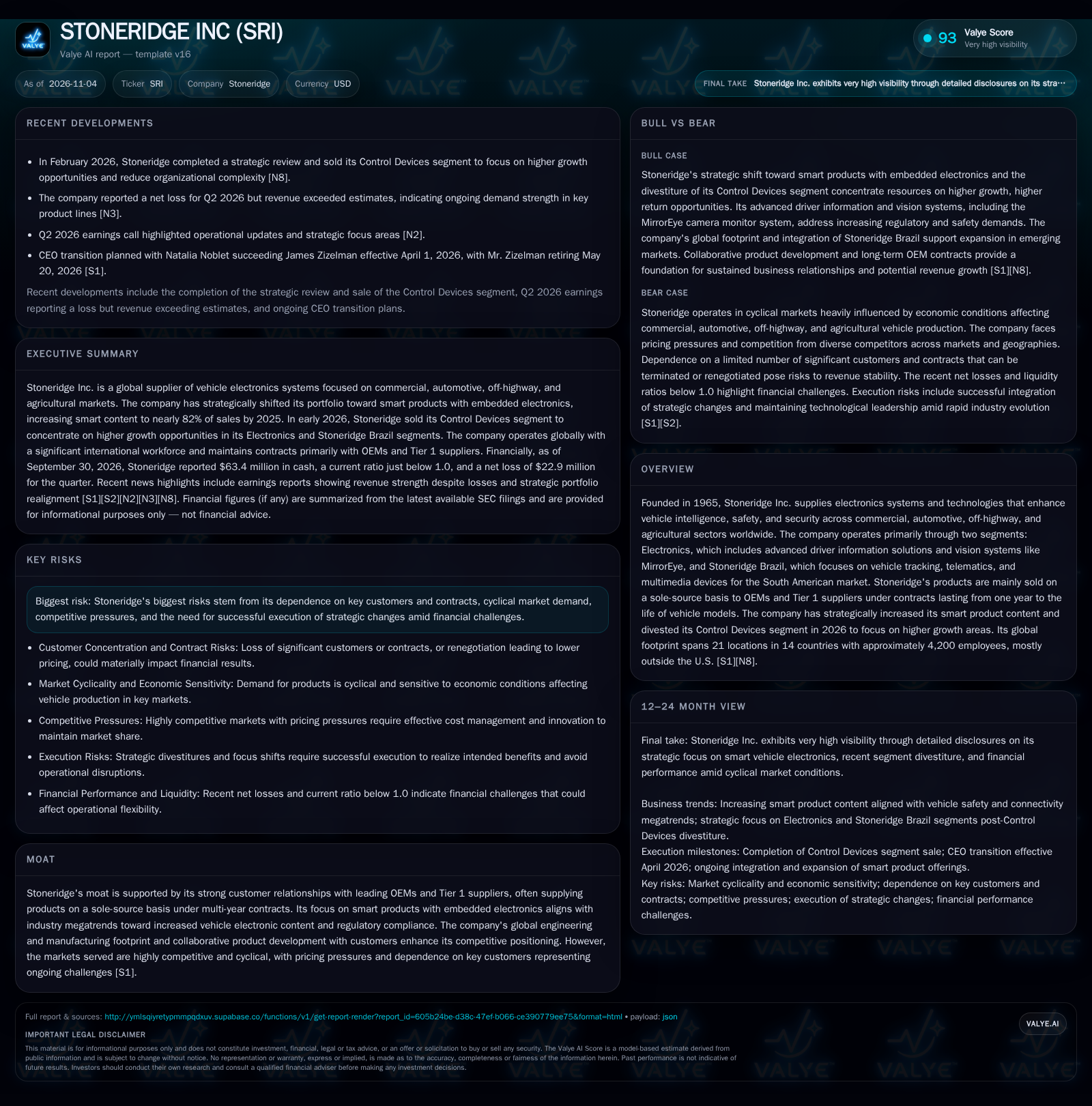
Stoneridge’s post-divestiture portfolio now centers on electronics and telematics for commercial and automotive vehicles, with smart content approaching 82% of sales. The company’s fortunes hinge on the pace of smart system adoption, execution of its streamlined strategy, and resilience to market cycles as it navigates leadership transition and competitive pressures. [S1] [S2] [N8]
Stoneridge Inc. has undergone a pivotal strategic transformation in 2026, shedding its legacy Control Devices segment to zero in on high-growth vehicle electronics and telematics. This sharper focus positions the company to capitalize on the automotive sector’s move toward smarter, safer, and more connected vehicles, with smart products now making up the vast majority of sales. As Stoneridge transitions leadership and leans into its new identity, the core question is whether this streamlined approach can deliver sustainable, profitable growth in the face of persistent industry volatility and fierce competition.
Strategic Divestiture and Smart Product Pivot Define Stoneridge’s 2026 Operating Landscape
In February 2026, Stoneridge completed the sale of its Control Devices segment, a move intended to sharpen its focus on higher-growth, higher-return opportunities within its Electronics and Stoneridge Brazil segments. This realignment follows a multi-year drive to increase the share of smart products with embedded electronics, which now account for nearly 82% of sales, up from just over 50% a decade ago. The company’s revenue model is built on supplying advanced driver information, vision systems, and telematics to OEMs and Tier 1 suppliers, often on a sole-source basis with contracts typically running the life of a vehicle model. The company reported a current ratio of 0.96 for the period. The period is further marked by a planned CEO transition, with Natalia Noblet set to succeed James Zizelman in April 2026. [S1] [S2] [N8]
How Stoneridge’s Revenue Model and Cost Structure May Shape Post-Divestiture Economics
Stoneridge’s core business now revolves around supplying electronics systems for vehicle intelligence, safety, and connectivity, predominantly to OEMs and Tier 1 suppliers. Pricing is typically negotiated at the outset of a vehicle model’s production cycle, and contracts can last from one to seven years. These arrangements can provide a degree of revenue visibility and volume stability, but also expose Stoneridge to pressures if volumes fall or customers renegotiate terms mid-cycle.
The shift toward smart products with embedded electronics likely increases both the average selling price and the complexity of Stoneridge’s offerings. This can enhance margins if the company maintains technological differentiation and integration value, but it also raises R&D and support costs. The Electronics segment, with its focus on advanced driver information and vision systems, is capital-intensive in development but can benefit from operating leverage if adoption expands across multiple vehicle platforms.
The Stoneridge Brazil segment, serving a diverse set of automotive and commercial vehicle markets in South America, may have a different margin profile due to regional pricing and cost structures, as well as higher second-half demand seasonality. The company reported cash and liquidity metrics for the period; these figures do not by themselves establish operating runway, investment capacity, financial flexibility, or financing capacity. [S1] [S2]
Technological Innovation and Sole-Source Relationships: Double-Edged Swords in a Fragmented Market
Stoneridge’s competitive stance relies on its ability to supply technologically advanced, often sole-sourced products to a concentrated base of OEM and Tier 1 customers. This can provide a temporary moat through product integration, switching costs, and contractual stickiness. However, the commercial vehicle electronics space is highly fragmented, with global, regional, and niche competitors vying for program wins based on innovation, quality, price, and delivery.
The company’s pivot toward smart products aligns with industry megatrends—such as regulatory mandates for safety systems, increased vehicle intelligence, and the digitalization of fleets. However, these megatrends also attract larger electronics players, software-centric upstarts, and traditional automotive suppliers investing heavily in similar technologies. The risk is that technological lead times may shrink, and pricing power may erode if customers gain credible alternative suppliers.
Stoneridge’s geographic diversity and engineering resources spread across 14 countries provide scale and customer proximity, but also complicate cost control and execution. The company’s historical reliance on a handful of major customers increases vulnerability to contract losses, renegotiations, or shifting OEM sourcing strategies. [S1]
If Smart System Adoption Accelerates, Operating Leverage and Margin Expansion Could Follow
A favorable scenario for Stoneridge unfolds if the industry’s adoption of advanced smart electronics and vision systems outpaces expectations, particularly as regulatory and safety demands intensify for commercial and off-highway vehicles. Under this outcome, Stoneridge’s deepening smart product mix, coupled with its sole-source customer relationships and long-term contracts, could drive sustained top-line growth, improved gross margins, and stronger operating leverage as R&D spending is amortized over larger volumes.
Confirmation of this scenario would come from sequential revenue growth in the Electronics segment outpacing industry vehicle production trends, margin expansion despite increased R&D, and evidence of Stoneridge winning new or expanded sole-source contracts with global OEMs. Additional validation would be margin improvement in Stoneridge Brazil as telematics and multimedia adoption accelerate in South American markets.
Falsification would be signaled by stagnating or declining Electronics segment revenue despite industry growth, margin compression due to pricing pressure or cost overruns, or an inability to secure new program wins in the face of heightened competition.
Stoneridge’s Most Likely Trajectory: Growth Constrained by Cyclicality and Execution Demands
The most plausible medium-term outcome is that Stoneridge achieves moderate revenue growth in its Electronics and Stoneridge Brazil segments, in line with underlying vehicle production trends and gradual smart system adoption. Margin improvement may be incremental, as the company continues to absorb higher R&D and SG&A expenses associated with next-generation product launches and global operations.
Successful execution of the streamlined strategy and integration of the new leadership team are prerequisites for stabilizing results. Industry cyclicality remains a constant challenge, with demand and visibility fluctuating based on macroeconomic and sector-specific factors.
Evidence supporting this scenario would include steady—but not accelerating—growth in segment revenues, flat or slightly improving margins, and working capital management that keeps liquidity in check. Falsification would come from accelerating losses, contract attrition, or evidence of execution missteps during the CEO handoff.
How Market Cycles and Customer Concentration Could Trigger a Profitability Squeeze
A negative scenario would see Stoneridge’s financial position deteriorate further due to a combination of macroeconomic downturn, sharp cyclical declines in commercial or off-highway vehicle production, or the loss of a major OEM or Tier 1 contract. Given the company’s reliance on a concentrated customer base and sole-source awards, even a single contract loss or renegotiation could have outsized impact on revenue and fixed-cost absorption.
In this scenario, margin pressure would intensify as volumes contract and Stoneridge struggles to flex its cost base quickly enough. Working capital strains could mount, potentially leading to tighter liquidity and reduced investment capacity. The CEO transition could exacerbate operational disruption or delay needed restructuring actions.
Confirmation would come from declining segment revenues outpacing industry contraction, rising net losses quarter over quarter, or disclosure of major contract losses. Falsification would require evidence that Stoneridge is winning new business at a pace sufficient to offset cyclical headwinds and customer churn.
Milestones and Metrics That Will Reveal Whether Stoneridge’s Strategic Shift Delivers
Electronics segment revenue growth relative to global commercial and off-highway vehicle production trends.
Gross and operating margin trajectory in both Electronics and Stoneridge Brazil, especially as new smart products scale.
Sole-source contract wins, renewals, or losses with major OEM and Tier 1 customers—if disclosed.
Working capital and liquidity management, including trends in the current and cash ratios over the next several quarters.
R&D and SG&A spending as a percentage of revenue, to gauge scalability of the new product portfolio.
Integration and performance of Stoneridge Brazil as telematics and multimedia adoption shift market dynamics.
Execution milestones during the CEO transition, including any leadership attrition or strategic pivots.
Evidence of successful new product launches, especially those addressing regulatory or safety-driven demand.
Disclaimer: This is research-only, informational analysis and not investment advice. It may include AI-generated interpretation and general industry context. Always verify important details using primary sources.

Comments