
Western Union in 2026: Mergers, Digital Adaptation, and the Stakes of Competitive Reinvention
As Western Union advances its proposed acquisition of Intermex and renews critical retail partnerships, the company faces mounting pressure from digital disruptors, evolving regulations, and shifting consumer behaviors.
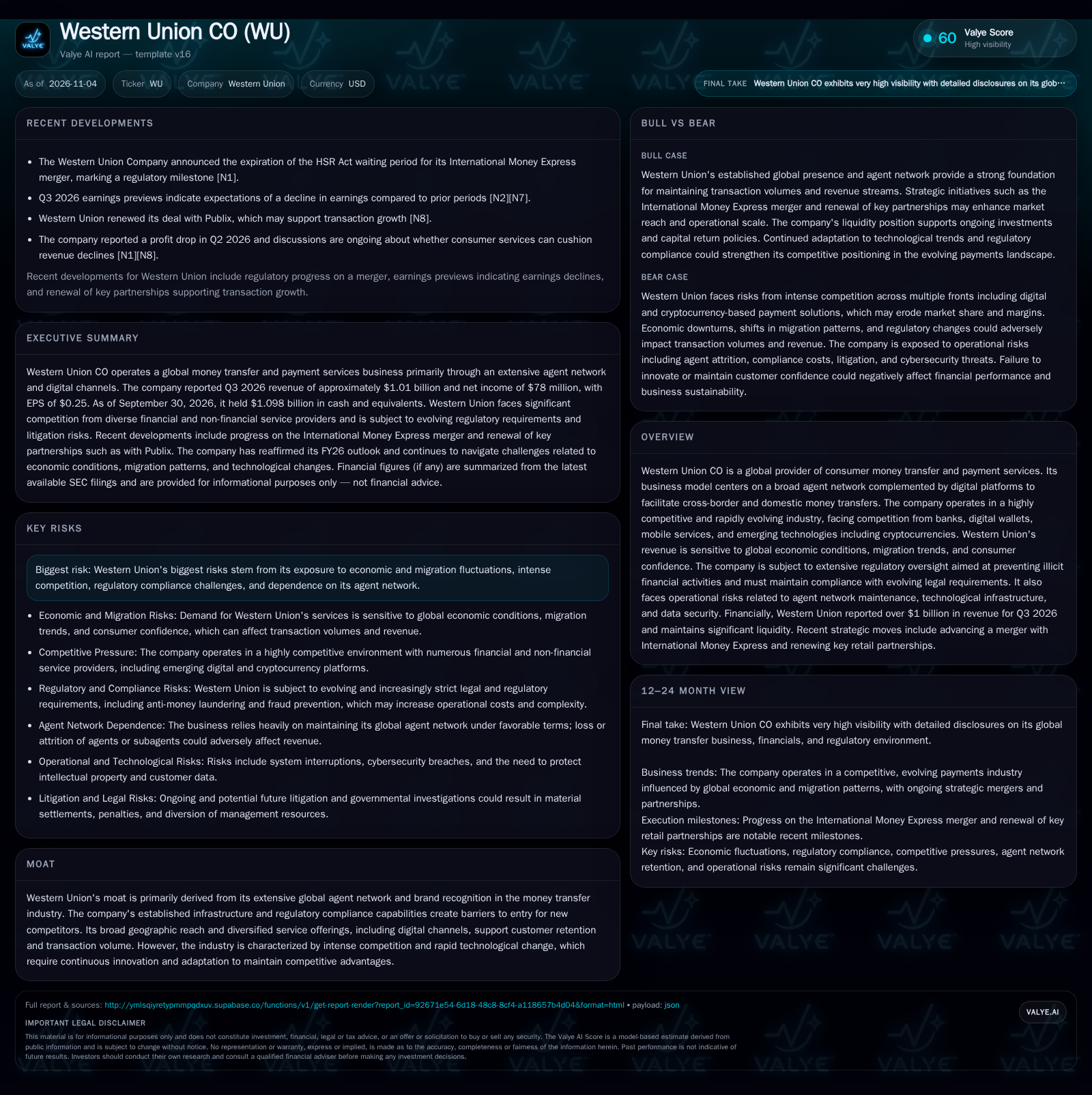
Western Union is navigating a pivotal phase marked by a pending Intermex merger, renewed retail alliances, and expectations of near-term earnings decline. Its ability to leverage a strong agent network and liquidity will be tested by digital competition, regulatory scrutiny, and the need for technological reinvention. The outcome hinges on successful integration, digital growth, and maintaining transaction relevance in a rapidly shifting payments landscape. [S2] [N2] [N7] [N8]
Western Union stands at a strategic crossroads as it pursues the acquisition of International Money Express (Intermex) and renews critical partnerships like Publix, all while navigating a backdrop of anticipated earnings declines and mounting competitive pressures. With $1.098 billion in cash and equivalents as of September 30, 2026, the company has the resources to invest and adapt, but faces existential questions about its relevance and resilience in a payments landscape increasingly dominated by digital and fintech challengers. The coming quarters will reveal whether Western Union can convert its legacy strengths into durable, future-ready advantages—or whether structural headwinds will erode its position.
Strategic Moves and Earnings Headwinds Define the Present
Western Union’s most material recent developments include the pending $500 million cash acquisition of International Money Express (Intermex), which remains in regulatory limbo after California authorities suspended approval in August 2026. The merger agreement faces a termination deadline of November 10, 2026, injecting near-term uncertainty into Western Union’s growth strategy and regional expansion plans. [S2] [N1]
On the operating front, Western Union renewed its partnership with Publix, a major U.S. supermarket chain, suggesting efforts to sustain or grow transaction volumes in key domestic corridors. This comes at a time when Q3 2026 earnings are expected to decline compared to prior periods, reflecting margin and/or volume pressures from intensifying competition and changing consumer preferences. [N2] [N7] [N8]
How Transaction Volumes, Digital Migration, and Cost Structure Shape Profitability
Western Union’s core revenue engine is the facilitation of cross-border and domestic money transfers, historically driven by a vast global network of retail agents and, increasingly, by digital channels. The company earns fees on each transaction, often with additional foreign exchange margins, making transaction volume and mix (retail vs. digital, high-value vs. low-value corridors) central to revenue growth and margin stability.
The business model exhibits moderate operating leverage: while the agent network and compliance infrastructure represent substantial fixed costs, variable costs scale with transaction volumes. As digital transactions grow, the potential for higher gross margins exists—digital channels can reduce agent commissions and retail overhead—yet customer acquisition costs and price competition from digital-native rivals may compress net margins if not offset by scale or loyalty gains.
Capital needs are shaped by regulatory compliance, technology investment, and, in the near term, integration costs if the Intermex merger is consummated. The $500 million Intermex acquisition, alongside the need to maintain agent relationships and digital R&D, could pressure free cash flow absent a lift in volumes or a step-change in digital profitability.
Legacy Network Versus Digital Disruptors: Where the Moat Holds and Where It Frays
Western Union’s primary competitive advantage is its extensive global agent network and strong brand recognition, especially in cash-centric remittance corridors underserved by traditional banks. This physical presence supports customer trust and regulatory compliance in regions where digital adoption is uneven.
However, the competitive landscape is rapidly shifting. Digital-first money transfer platforms, mobile wallets, and cryptocurrency-based remittance solutions are capturing share in both developed and emerging markets by offering lower fees, faster settlement, and app-based convenience. Banks and fintechs are targeting higher-value corridors and digitally savvy migrant populations, challenging Western Union’s relevance among younger and urban consumers.
The critical question is whether Western Union can leverage its network to transition legacy customers to digital channels—and whether it can retain enough volume and pricing power to offset the margin erosion from digital competition. The pending Intermex acquisition, if completed, may provide additional scale and access to U.S.-Latin America corridors, but integration and differentiation in a commoditizing market remain major hurdles.
What a Successful Transformation Would Look Like
A favorable scenario would see Western Union close the Intermex deal on schedule, quickly integrating operations to expand its footprint and defend share in the U.S.-to-Latin America remittance corridor. The combined entity could realize cost synergies, broaden agent coverage, and use cross-selling to lift transaction volumes.
Simultaneously, Western Union would accelerate digital adoption among its legacy customer base, leveraging its brand and compliance reputation to win trust among users wary of pure-play fintechs. If digital transaction mix rises meaningfully and customer acquisition costs are controlled, operating margins could stabilize or expand—even as the industry overall shifts toward lower average pricing.
Evidence confirming this scenario would include: closing of the Intermex merger, disclosed synergies or transaction growth in combined markets, rising share of digital-originated transfers, and stabilization or improvement in segment margins despite ongoing competition.
Incremental Adaptation Amid Persistent Headwinds
The most plausible outcome is that Western Union continues to experience moderate volume and margin pressure as it adapts incrementally to digital trends. The Intermex merger may remain delayed or ultimately fail to close, limiting immediate scale benefits. Retail partnerships like Publix help stem transaction declines in some corridors, but do not fully offset competitive encroachment from digital-native rivals.
Digital adoption rises, but at a pace matched by price competition, keeping margin expansion elusive. Fixed costs related to compliance, technology, and network maintenance persist, and the company’s ability to flex down costs in response to lower volumes is limited. Regulatory scrutiny and compliance investments remain a drag on profitability, especially if global remittance flows are dampened by macroeconomic or migration volatility.
This scenario would be confirmed by continued year-over-year earnings declines, modest digital growth, stable or slightly shrinking market share, and ongoing—but not transformative—partnership and product announcements.
If Digital Entrants Accelerate Share Loss and Regulatory Risks Materialize
In an adverse scenario, Western Union is unable to close the Intermex merger, forfeiting potential scale and leaving it vulnerable in key corridors. Digital-native competitors further accelerate share gains, both in urban markets and, increasingly, in traditionally cash-heavy regions as smartphone penetration rises and regulatory frameworks evolve to support fintechs.
Price wars and customer churn compress Western Union’s fee and FX margins, while fixed compliance and agent network costs prove sticky. If retail partnerships do not deliver transaction growth, and agent attrition rises, the company could face a negative operating leverage spiral. Regulatory or legal setbacks—such as penalties or costly compliance mandates—would further erode profitability and cash reserves, potentially forcing cutbacks or asset sales.
Evidence supporting this downside includes: formal termination of the Intermex merger, rapid sequential declines in transaction volumes or revenue, margin compression outpacing cost cuts, and any major regulatory or legal hits impacting cash flow.
Milestones That Will Reveal the Durability of Western Union’s Competitive Edge
Regulatory decisions regarding the Intermex merger—particularly the reinstatement or denial of California's DFPI approval—will determine whether Western Union can access new scale and regional synergies. [S2] [N1]
Quarterly trends in transaction volumes and revenue by channel (retail vs. digital), if disclosed, would clarify whether digital migration is offsetting declines in legacy segments.
Updates on agent network size, retention rates, and new partnership signings or renewals will signal the health of Western Union’s core distribution model.
Disclosed digital customer acquisition costs and active user metrics, if available, would help assess the economics of digital channel growth.
Any announced cost synergies or integration milestones post-Intermex merger (if completed) would validate the strategic rationale and execution risk.
Geographic breakdowns of remittance flows, especially in key corridors where competition is intensifying, would provide early warning of share loss or resilience.
Legal and regulatory disclosures—including any settlements, fines, or new compliance mandates—may materially affect operating costs and risk profile.
Margin trends at the segment level (Consumer Money Transfer vs. Consumer Services), if reported, would indicate underlying profitability shifts amid changing mix.
Disclaimer: This is research-only, informational analysis and not investment advice. It may include AI-generated interpretation and general industry context. Always verify important details using primary sources.

Comments