
Outset Medical in Late 2026: Regulatory Scrutiny, Liquidity, and the Stakes of Dialysis Innovation
Outset Medical’s Tablo Hemodialysis System promises operational simplicity and care-setting flexibility, but recent FDA observations, persistent net losses, and intensifying competition from established dialysis giants shape a business model where regulatory execution and market adoption are pivotal.
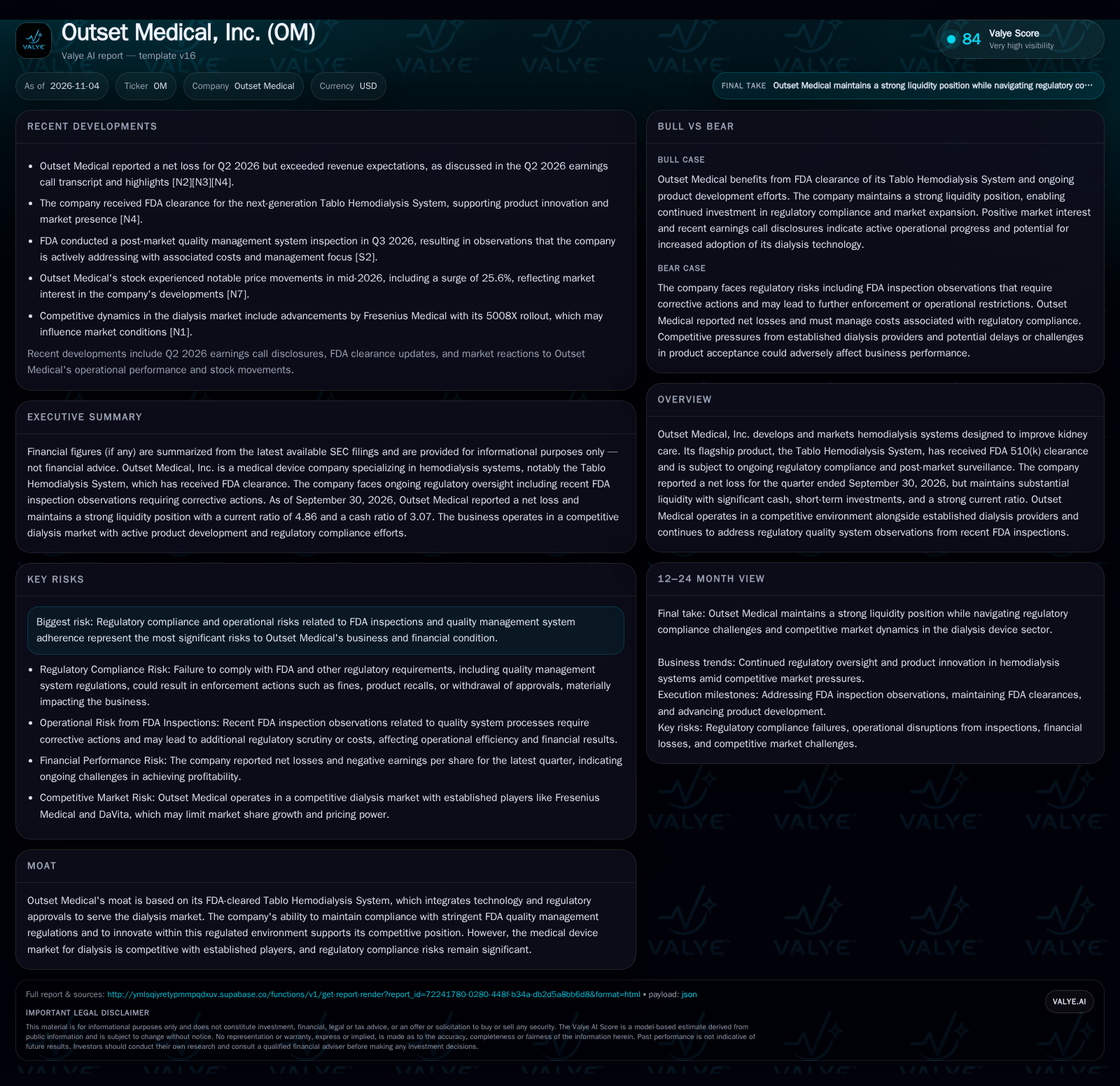
Outset Medical’s reported liquidity position and differentiated Tablo system provide a platform for growth, but recent FDA inspection findings, ongoing net losses, and entrenched competition set a high bar for sustained adoption and profitability. The next phase hinges on regulatory remediation, operational performance, and evidence of durable demand for its dialysis technology. [S2] [N2] [N1]
Outset Medical’s Tablo Hemodialysis System targets one of healthcare’s most entrenched pain points: the complexity, cost, and inflexibility of traditional dialysis delivery. As of late 2026, the company’s regulatory and operational landscape is in flux. While Outset enjoys substantial liquidity and a differentiated, FDA-cleared platform, it faces heightened regulatory scrutiny after a recent FDA inspection flagged quality management issues. Persistent net losses and intensifying competition from dialysis incumbents mean the next twelve months will test whether Outset can translate technological promise into sustained commercial traction and operational discipline. [S2] [N1]
Regulatory Hurdles and Financial Profile Define the Present Moment
The most material developments for Outset Medical as of September 2026 are the Q3 FDA Form 483 observations, the company's ongoing net losses, and its reported liquidity position. The FDA inspection highlighted deficiencies in quality system processes, including complaint handling and corrective actions, which the company is actively addressing with additional costs and management focus. This regulatory scrutiny introduces uncertainty about potential enforcement or operational impact. Financially, Outset reported a net loss of $14.7 million for Q3 2026 and holds an accumulated deficit of $1.2 billion, while negative cash flow from operations persists. The company reported cash and liquidity metrics for the period; these figures do not by themselves establish operating runway, investment capacity, financial flexibility, or financing capacity. These dynamics set the stage for a business model that must prove both regulatory reliability and market adoption to move toward profitability. [S2]
How Tablo Could Change Dialysis Economics—And What Must Go Right
Outset Medical’s Tablo system is designed to streamline dialysis delivery across care settings, potentially reducing labor, infrastructure, and patient burden compared to legacy machines. The business model likely combines capital sales of devices with recurring revenue streams from consumables, service contracts, and possibly data or software subscriptions, though the precise commercial split is not disclosed. If Tablo delivers operational efficiency and enables more frequent or decentralized dialysis, it could unlock savings for providers and payers—key adoption drivers in a cost-sensitive healthcare environment.
However, the economics are challenged by high fixed costs, ongoing R&D and regulatory compliance expenses, and the need for scale to achieve positive operating leverage. Regulatory compliance costs have increased with the recent FDA observations, and remediation will consume both cash and management bandwidth. The company’s persistent net losses and negative operating cash flow underscore that current revenues do not yet offset fixed cost absorption. Ultimately, profitable growth will require not only expanding the installed base but also achieving high utilization rates, reliable consumable pull-through, and minimal regulatory disruption.
Incumbents, Substitution Threats, and the Challenge of Building a Moat
Outset Medical operates in a dialysis equipment market dominated by established players like Fresenius Medical and DaVita, both of whom have deep provider relationships, global distribution, and are advancing their own device platforms and integrated services. Fresenius’s 5008X rollout exemplifies how incumbents are not standing still, but rather innovating in response to shifting reimbursement and care delivery models. Outset’s differentiation lies in Tablo’s portability, all-in-one design, and digital integration, which could appeal to providers seeking to decentralize or simplify care.
However, the market is slow to switch due to high capital costs, entrenched protocols, and regulatory conservatism. Switching costs for providers include not only equipment but also staff retraining, process changes, and workflow integration. Substitution risk from alternative dialysis modalities, such as peritoneal dialysis or wearable devices, remains real but is not yet a dominant displacement force. Outset’s moat depends on demonstrating sustained clinical and economic value, maintaining regulatory compliance, and building a critical mass of installed units that drive recurring revenue and customer lock-in.
If Compliance Is Restored and Adoption Accelerates, Operating Leverage Could Emerge
In a favorable scenario, Outset Medical successfully addresses the FDA’s quality system observations without major enforcement actions or product disruptions. The company leverages its liquidity to invest in remediation, salesforce expansion, and provider education, while new clinical data and user testimonials drive accelerated adoption of Tablo across hospital, clinic, and home settings. As the installed base grows, recurring revenues from consumables and services improve gross margins and begin to cover fixed costs, moving the company toward operating profitability.
Evidence supporting this scenario would include: rapid closure of FDA compliance gaps, absence of new regulatory findings, sequential growth in device placements and consumable sales, and a narrowing of net losses or inflection to positive operating cash flow. Confirmation would also come from new provider contracts, expanded reimbursement coverage, and improving gross margin as scale and utilization increase.
Commercial Progress Continues, But Regulatory Overhang and Losses Persist
The most plausible near-term outcome is that Outset Medical remediates FDA findings over several quarters, with ongoing oversight and some incremental cost drag. Commercial adoption of Tablo continues to expand, but at a measured pace due to hospital and clinic budget constraints, lengthy sales cycles, and provider caution amid regulatory uncertainty.
This scenario would be confirmed by continued, though moderate, growth in installed base and recurring revenue, stable or slightly improving gross margins, and regular regulatory updates that show progress but not yet full closure. Net losses and negative cash flow would gradually narrow, but profitability would remain out of reach until adoption accelerates and regulatory risk recedes.
Regulatory Setbacks or Commercial Stall Could Trigger a Strategic Reset
In an adverse scenario, Outset Medical’s remediation efforts fail to fully address FDA concerns, resulting in additional regulatory actions such as product holds, fines, or mandated recalls. This would disrupt both existing customers and pipeline sales, eroding provider confidence and increasing operational costs. Simultaneously, commercial adoption could stall if providers opt for incumbent solutions or if reimbursement uncertainty persists.
Evidence for this scenario would include: escalation of FDA scrutiny or penalties, publicized product issues or recalls, sharp declines in new placements or consumable sales, and accelerated cash burn. A significant drop in liquidity or breach of debt covenants could prompt restructuring, asset sales, or strategic alternatives.
Milestones That Will Test Outset Medical’s Ability to Deliver on Its Promise
Resolution status and timeline of FDA Form 483 observations and any subsequent regulatory communications.
Sequential growth in Tablo system placements across hospital, clinic, and home settings—if disclosed.
Trends in recurring revenue from consumables and service contracts; a useful metric would be consumables pull-through per installed unit.
Gross margin progression, especially as remediation costs normalize and scale effects materialize.
Operating cash flow trends and the rate of cash burn relative to prior quarters.
Updates on payer reimbursement coverage and new provider contracts, which would indicate commercial traction.
Competitive responses from Fresenius Medical, DaVita, and other device makers—including pricing, new product launches, or bundled service offerings.
Any changes to debt covenants, liquidity access, or capital-raising activities, given ongoing net losses.
Disclaimer: This is research-only, informational analysis and not investment advice. It may include AI-generated interpretation and general industry context. Always verify important details using primary sources.

Comments