
Datadog’s 2026 Inflection: Subscription Momentum, Usage Volatility, and the Stakes of Enterprise Monitoring Expansion
Datadog’s 35% year-over-year revenue surge in Q3 2026 highlights robust subscription demand, but a usage pullback from its largest AI-native customer signals revenue sensitivity to consumption patterns. With a cash-rich balance sheet and sustained investment in product and sales, the company’s challenge is translating rapid top-line growth into durable, less volatile profitability amid intensifying competition and evolving IT spending dynamics.
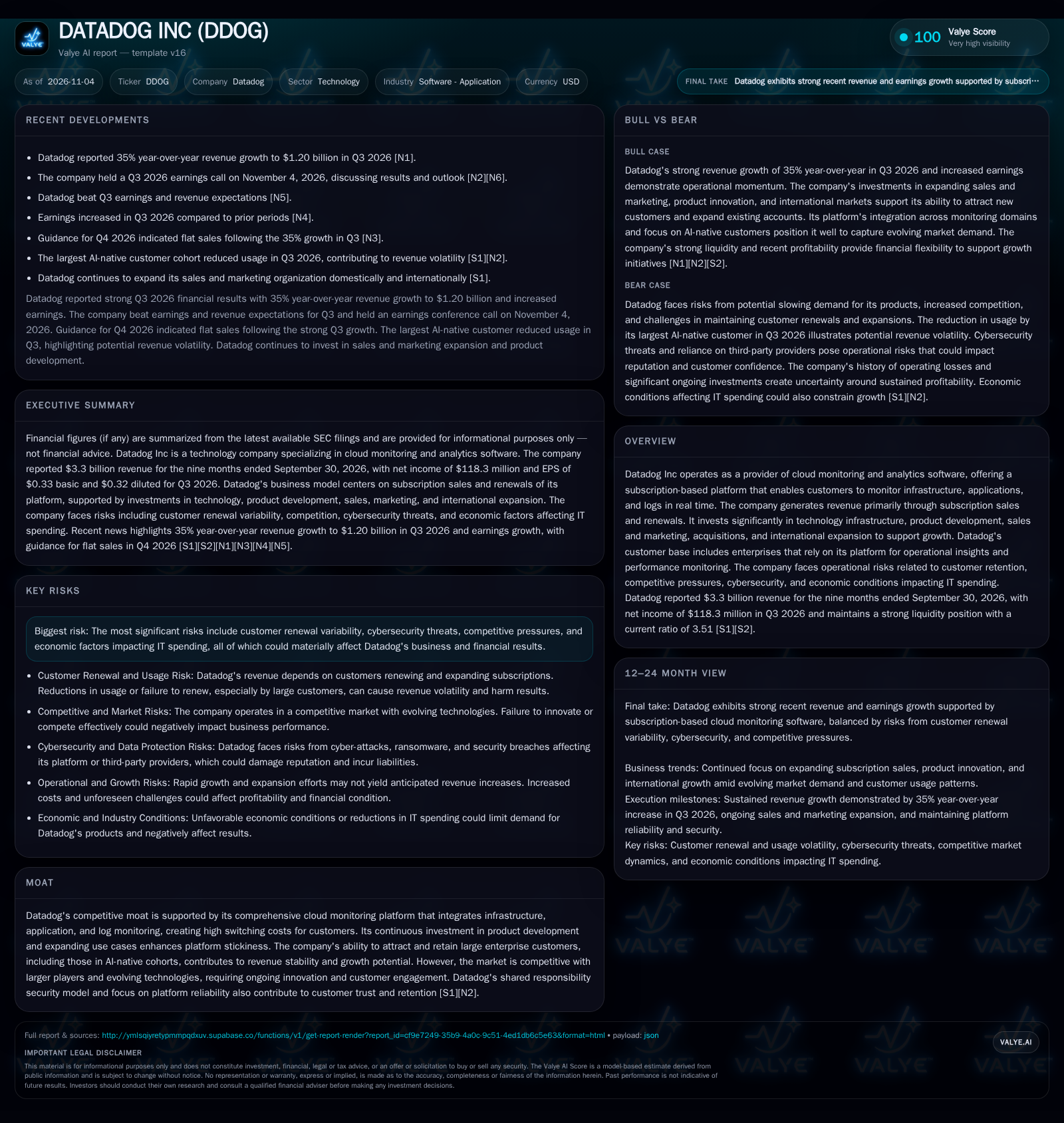
Datadog posted $1.2 billion in Q3 2026 revenue—up 35% year-over-year—driven by ongoing customer acquisition and expansion. However, usage reductions by its largest AI-native customer exposed revenue volatility risks. The company maintains a reported current ratio and positive net income, but faces the task of sustaining growth as the market matures and competition intensifies. Monitoring renewal rates, large customer concentration, and product adoption will be central to validating the durability of its recent gains. [S1] [S2] [N1] [N2]
Datadog’s recent financial performance underscores both the promise and fragility of high-growth SaaS models in the enterprise IT stack. The company’s 35% year-over-year revenue increase in Q3 2026 and continued profitability reflect strong demand for cloud monitoring and analytics, driven by expanding customer adoption and upsell. Yet, a notable reduction in usage by its largest AI-native customer this quarter illustrates the platform’s sensitivity to consumption changes among major accounts—a dynamic that could amplify volatility as the business scales.
2026 Snapshot: Growth, Profitability, and Customer Usage Volatility
Datadog reported $1.2 billion in Q3 2026 revenue—a 35% year-over-year increase—demonstrating continued momentum in subscription sales and customer expansion. The company also delivered net income of $118.3 million for the quarter, with basic EPS of $0.33 and diluted EPS of $0.32. Notably, the company’s largest AI-native customer reduced their usage during the quarter, introducing volatility into overall revenue growth despite the headline gains. Datadog ended September 2026 with $881.2 million in cash and a current ratio of 3.51, underscoring a reported liquidity position. These developments highlight both Datadog’s capacity for rapid top-line growth and the underlying risks tied to customer concentration and consumption-based revenue. [S1] [S2] [N1] [N2]
How Datadog Turns Adoption Into Revenue: Subscription Dynamics and Cost Structure
Datadog’s core business model is built on recurring subscription revenue for its cloud monitoring and analytics platform, with customers paying for ongoing access to infrastructure, application, and log data monitoring. Revenue scales with both the number of customers and the breadth of features or usage tiers adopted, and, for some customers, actual resource consumption. This hybrid of seat-based and usage-based pricing can drive strong net revenue retention when customers expand adoption, but also introduces volatility when large accounts reduce usage or optimize spend.
The company’s cost structure is characterized by substantial investments in technology and infrastructure—necessary for real-time data ingestion, storage, and analytics at scale—as well as significant outlays for sales, marketing, and ongoing product development. These costs are partly fixed, particularly in R&D and platform infrastructure, creating potential for operating leverage as revenue grows. However, as Datadog expands internationally and chases new verticals, sales and marketing expenses may scale nearly in tandem with revenue for periods, especially if acquisition costs rise in a competitive environment.
Capital needs remain moderate relative to revenue, given the SaaS model’s working-capital lightness, but Datadog’s rapid investment in platform breadth and global sales suggests ongoing pressure to reinvest much of its operating cash flow. The company’s history of pre-2023 operating losses also suggests that sustained profitability is not yet a given if growth slows or costs rise disproportionately. [S1] [S2]
Defending Share in a Crowded Observability Landscape
Datadog’s competitive position hinges on its integrated platform, which spans infrastructure, application, and log monitoring—functions that, when unified, can create switching frictions and embed the platform deep within customer IT workflows. This integration potentially raises customer retention and upsell rates, especially as enterprises consolidate point solutions for operational simplicity.
Competition, however, is intense and evolving. The company faces established cloud providers offering native monitoring, legacy application performance monitoring (APM) vendors, and a wave of newer entrants targeting AI-native observability and security integration. As monitoring and observability tools become more commoditized, differentiation increasingly depends on feature velocity, ecosystem integrations, and the ability to address emerging workloads (e.g., AI/ML pipelines, container orchestration, and edge computing).
Switching costs are meaningful but not insurmountable—particularly for large, sophisticated customers who can leverage alternatives or negotiate on price. Datadog’s ongoing investment in expanding platform breadth and international reach is designed to sustain relevance, but the company must balance innovation velocity with the risk of overextension, especially as global macro conditions pressure IT budgets. [S1]
What Could Drive Durable Outperformance: Expansion, Retention, and Platform Stickiness
A favorable scenario for Datadog would see continued strong adoption by new customers, deepening penetration among existing accounts, and high renewal rates, particularly among enterprise and AI-native cohorts. Under this chain, the company leverages its integrated platform to become the default observability layer for cloud-native infrastructure, making it increasingly difficult for customers to replace or consolidate away from Datadog.
Operating leverage could emerge if revenue growth outpaces incremental sales and infrastructure costs, driving sustained margin expansion. This scenario would be confirmed by sequential growth in multi-product adoption rates, rising net revenue retention, and stable or increasing gross margins even as Datadog expands internationally.
Evidence supporting this upside would include a rebound in usage from large customers following temporary pullbacks, continued beats on both revenue and earnings expectations, and management guidance pointing to accelerating renewal or expansion rates. Third-party industry reports showing increased market share or customer satisfaction relative to peers would further validate this scenario. [N1] [N4] [N5]
Maturing Growth and Volatility: The Most Likely Path Forward
The most plausible trajectory for Datadog is a moderation of growth rates as the company scales, with periodic volatility driven by large customer usage swings and macro-driven IT budget fluctuations. While Datadog’s platform breadth and product innovation should support ongoing customer acquisition and expansion, the outsized impact of a few major accounts—illustrated by the Q3 2026 usage reduction—suggests that quarterly growth may become lumpier as the business matures.
Profitability is likely to be sustained in the near term, given the company’s recent positive net income and reported liquidity position. However, operating margins could fluctuate as Datadog continues to invest heavily in sales, marketing, and technology to defend share and pursue new geographies or verticals. The company’s ability to maintain high renewal rates and expand its footprint within existing customers will be central to validating the durability of its model.
This scenario would be confirmed by continued revenue growth above industry averages, but with more pronounced quarter-to-quarter swings, and management guidance that sets tempered expectations for near-term expansion—such as the flat Q4 2026 sales outlook following Q3’s surge. [S1] [N3] [N2]
When Growth Engines Stall: Customer Churn, Compression, and Margin Pressure
A negative chain of events could unfold if Datadog experiences sustained reductions in usage or non-renewals among its largest customers—particularly those in fast-growing but volatile AI-native verticals. This could result in abrupt revenue deceleration, amplified by the company’s exposure to usage-based pricing and concentration among top accounts.
Competitive encroachment by hyperscale cloud providers or aggressive pricing by next-generation monitoring vendors could pressure new business acquisition and force Datadog to increase spending on customer retention and innovation, eroding margins. Additionally, macroeconomic downturns that prompt IT budget cuts could disproportionately impact discretionary monitoring spend, slowing both new bookings and expansion within the installed base.
Confirmation of this scenario would include sequential revenue declines or flatlining in key quarters, rising customer churn or contraction rates if disclosed, and management commentary highlighting increased price competition or elongated enterprise sales cycles. Unexpected cybersecurity incidents or platform outages could further damage customer confidence and accelerate churn. [S1] [N2]
Benchmarks for Testing Datadog’s Growth Quality and Revenue Durability
Quarterly net revenue retention rates, if disclosed, would help clarify whether expansion within existing customers is offsetting churn and usage reductions.
Trends in large customer concentration—particularly the proportion of revenue from top ten or AI-native accounts—would indicate Datadog’s exposure to volatility from major clients.
Multi-product adoption rates and the percentage of customers using three or more modules would provide insight into platform stickiness and upsell success.
Gross and operating margin trends relative to revenue growth would help test for emerging operating leverage or margin compression as the company scales.
International revenue growth rates, if available, would show whether Datadog’s expansion efforts are yielding incremental gains or diluting margins.
Sales and marketing expense as a percentage of revenue, and its trend over time, would indicate acquisition efficiency and the cost of defending share.
Incidence of major security breaches or platform reliability issues, as reported, could materially affect customer trust and renewal rates.
Management guidance on renewal rates, expansion rates, or pipeline health in earnings calls would provide real-time signals about the health of Datadog’s growth engine.
Disclaimer: This is research-only, informational analysis and not investment advice. It may include AI-generated interpretation and general industry context. Always verify important details using primary sources.

Comments