
Encore Capital Group in 2026: Portfolio Supply, Regulatory Crosswinds, and the Mechanics of Debt Recovery Returns
Encore Capital’s record collections and robust U.S. portfolio supply underscore its scale-driven edge, but competitive pricing in Europe and regulatory uncertainties challenge capital deployment and future margins. As the cycle turns, the durability of Encore’s proprietary models and its ability to redeploy capital efficiently will determine whether recent earnings momentum can be sustained.
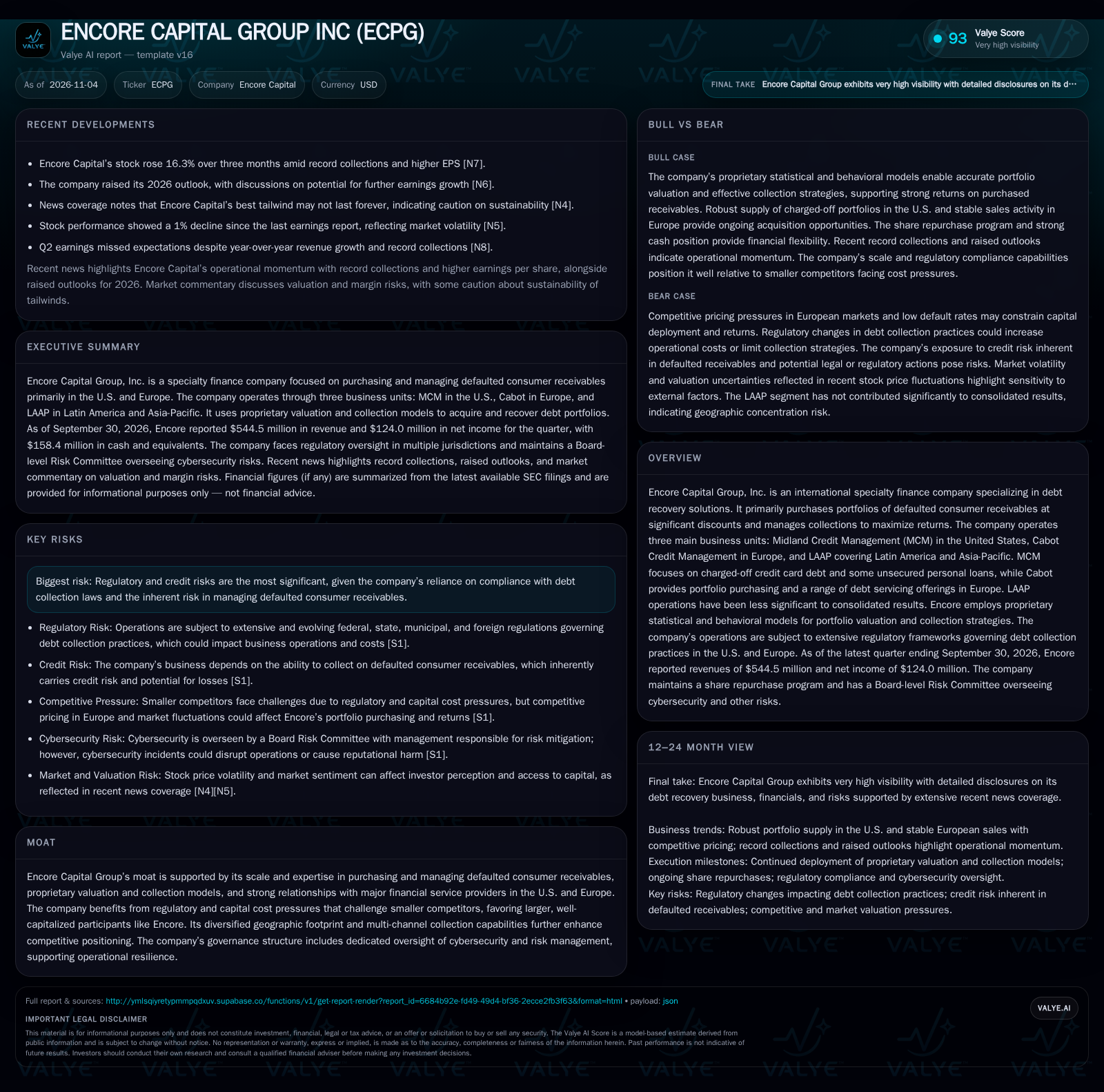
Encore Capital reported record U.S. collections and raised its 2026 outlook, benefiting from a robust supply of charged-off receivables. However, competitive pressures in Europe and evolving regulatory landscapes may constrain future returns and capital deployment. The sustainability of Encore’s current tailwinds and the effectiveness of its proprietary collection models are central to the investment thesis. [S1] [S2] [N4] [N6] [N7]
Encore Capital Group, a global leader in debt recovery, is riding high on record U.S. collections and a raised 2026 outlook. Its scale, proprietary analytics, and robust U.S. portfolio supply have driven recent earnings and stock gains. Yet, beneath the strong headline figures, Encore faces margin pressures in Europe, regulatory crosswinds, and the perennial challenge of extracting returns from defaulted receivables as market cycles shift. The next phase will test whether its operational models and capital discipline can sustain outperformance as tailwinds ebb.
Record U.S. Collections and Raised Outlook: What’s Driving Encore’s 2026 Momentum?
Encore Capital reported $1.949 billion in U.S. collections for 2025, with $1.272 billion derived from call center and digital channels and $663 million from legal collections. Portfolio purchases in the U.S. reached $1.174 billion, while Europe saw $234 million in new portfolios acquired. As of September 30, 2026, Encore posted $544.5 million in revenue and $124.0 million in net income for the trailing quarter, alongside $158.4 million in cash and equivalents. The company’s share price rose 16.3% over three months on the back of record collections and higher EPS, prompting a raised 2026 outlook. However, news coverage notes that the favorable conditions fueling record recoveries may not be permanent, highlighting questions about the sustainability of these tailwinds and future margin dynamics. [S1] [S2] [N4] [N6] [N7]
How Encore’s Debt Recovery Model Translates Portfolio Purchases into Cash Flow
Encore’s core business model involves purchasing portfolios of defaulted consumer receivables—primarily charged-off credit card debt—in the U.S. and Europe at steep discounts, then deploying a mix of call center, digital, legal, and third-party agency channels to recover as much as possible. The economics hinge on acquiring portfolios at prices low enough to generate attractive returns after collection costs, legal expenses, and overhead. In the U.S., robust supply and forward flow agreements enable Encore to deploy capital consistently, with proprietary statistical and behavioral models refining bid prices and collection strategies.
Variable costs—such as agent compensation, legal fees, and technology—scale with collection activity, while fixed costs include infrastructure for analytics, compliance, and regulatory management. When portfolio supply is strong and collection rates are high, Encore’s operating leverage can drive significant profit expansion. However, capital must be continually redeployed as older portfolios mature and collections diminish, creating a need for disciplined portfolio pricing and risk assessment. In Europe, competitive pricing and low default rates compress margins and can lead to underutilization of available capital, highlighting the importance of market selection and cost discipline.
The company’s share repurchase program, funded by cash or credit facility draws, provides a lever for capital allocation but competes with portfolio purchasing for available liquidity. Regulatory compliance costs are material and rising, especially as jurisdictions tighten rules on debt collection practices. Thus, Encore’s ability to sustain returns is highly sensitive to the mix of available portfolios, collection effectiveness, regulatory cost trends, and capital allocation discipline. [S1]
Scale, Analytics, and Regulation: Encore’s Competitive Edge and Its Limits
Encore’s scale, proprietary analytics, and regulatory infrastructure provide significant advantages over smaller debt buyers, especially in the U.S. market where portfolio supply is robust and compliance requirements are stringent. The company’s established relationships with major banks and credit issuers enable it to secure forward flow agreements for fresh portfolios, a critical source of recurring deal flow that smaller players often cannot match.
However, in Europe, competitive pricing and stagnant consumer lending volumes have created a tougher landscape. While Cabot Credit Management is among the largest players in the region, the crowded market and low default rates mean that capital deployment opportunities are less attractive, and returns are more dependent on operational efficiency rather than scale alone. Regulatory and capital cost pressures have pushed many small competitors out, but they have also intensified competition among larger, well-capitalized firms. Substitution risk from alternative collection models (e.g., digital-only recovery, fintech-driven solutions) remains modest for now but could rise if technology or regulatory shifts alter the economics of traditional collections.
Encore’s multi-channel collection approach and cross-jurisdictional compliance capabilities are strengths, but its ability to maintain a moat depends on continued investment in analytics, regulatory agility, and cost control as market conditions evolve. [S1]
If Portfolio Supply and Collection Efficiency Remain Strong, Earnings Upside Could Persist
Encore’s most favorable scenario would see continued robust supply of charged-off portfolios in the U.S., stable pricing discipline, and sustained improvements in collection efficiency through analytics and digital channel investments. If regulatory changes remain manageable and consumer default rates rise modestly—expanding the pool of available receivables—Encore could deploy more capital at attractive returns, driving further earnings growth and supporting ongoing share repurchases.
Confirmation for this scenario would include: ongoing record or near-record collections, expanding net income and EPS, rising portfolio purchases without a material decline in yield, and evidence that regulatory costs are not eroding margins. Additional upside could come from successful adaptation to digital-first collections, further cost reductions, or strategic expansion in underpenetrated markets if LAAP operations begin to scale.
Falsification would occur if portfolio supply tightens, collection effectiveness deteriorates, or regulatory costs rise faster than revenue growth—any of which would compress margins and undercut the earnings trajectory. [S1] [N6] [N7]
Sustained U.S. Strength Offsets European Margin Pressure, Yielding Stable Returns
The most plausible path is that Encore continues to benefit from robust U.S. portfolio supply and steady collection performance, with the MCM unit anchoring consolidated results. European operations remain challenged by competitive pricing and low default rates, limiting capital deployment and compressing margins, but not materially dragging on overall performance. Regulatory costs rise gradually but are offset by operational efficiencies and disciplined portfolio pricing.
In this scenario, Encore’s earnings and cash flow remain solid but are unlikely to accelerate meaningfully without a structural shift in European market dynamics or a step-change in collection technology. Confirmation would be evidenced by consistent quarterly collections, stable to modestly growing revenues, and continued but not accelerating share repurchases. Falsification would be signaled by a sharp drop in U.S. portfolio supply, regulatory shocks, or a sudden rise in cost-to-collect ratios. [S1] [N4] [N8]
Margin Erosion from Regulatory Shocks or Portfolio Supply Contraction
A negative scenario could materialize if regulatory changes—such as stricter debt collection laws or caps on recoverable charges—raise compliance costs or restrict collection practices in Encore’s core markets. Alternatively, a cyclical downturn in consumer lending or a sharp drop in default rates could contract the supply of portfolios available at attractive prices, forcing Encore to deploy capital in less favorable markets or at lower returns.
This scenario would be confirmed by declining portfolio purchases, falling yields on new investments, rising cost-to-collect ratios, or material legal/regulatory expenses impacting net income. Additional warning signs include negative operating leverage (costs rising faster than collections), underperformance of the LAAP segment, or evidence of technological substitution reducing the efficacy of traditional recovery channels.
Falsification would require regulatory stability, sustained portfolio supply, and evidence that Encore can flex costs or redeploy capital efficiently as market conditions change. [S1] [N4]
Milestones That Will Test Encore’s Debt Recovery Thesis in the Next Cycle
U.S. portfolio purchase volume and pricing trends—any sharp contraction or jump in acquisition cost would materially impact future collection yields. [S1]
Quarterly collection effectiveness by channel (call center, digital, legal)—a decline in digital or legal recoveries could signal operational headwinds. [S1]
Regulatory or legal developments in the U.S. and Europe—new rules impacting collection methods or recoverable amounts would test Encore’s cost structure and compliance agility. [S1]
Cost-to-collect ratio, if disclosed—rising costs relative to collections would suggest margin compression.
Share repurchase cadence and funding source—shifts toward credit-funded buybacks could indicate reduced capital deployment opportunities or changing capital allocation priorities. [S1]
Performance and scale of LAAP operations—a useful metric would be revenue or collections contribution, as growth here could diversify risk.
Quarterly updates on net income and EPS trajectory—stagnation or reversal would challenge the current outlook. [S2]
Market commentary on default rate trends and consumer lending volumes—external signals of a changing supply environment would help test the durability of Encore’s earnings base. [N4] [N6]
Disclaimer: This is research-only, informational analysis and not investment advice. It may include AI-generated interpretation and general industry context. Always verify important details using primary sources.

Comments