
Silvaco’s AI-Driven Semiconductor Design Ambitions: Can Integration and Innovation Outpace Scale Pressures?
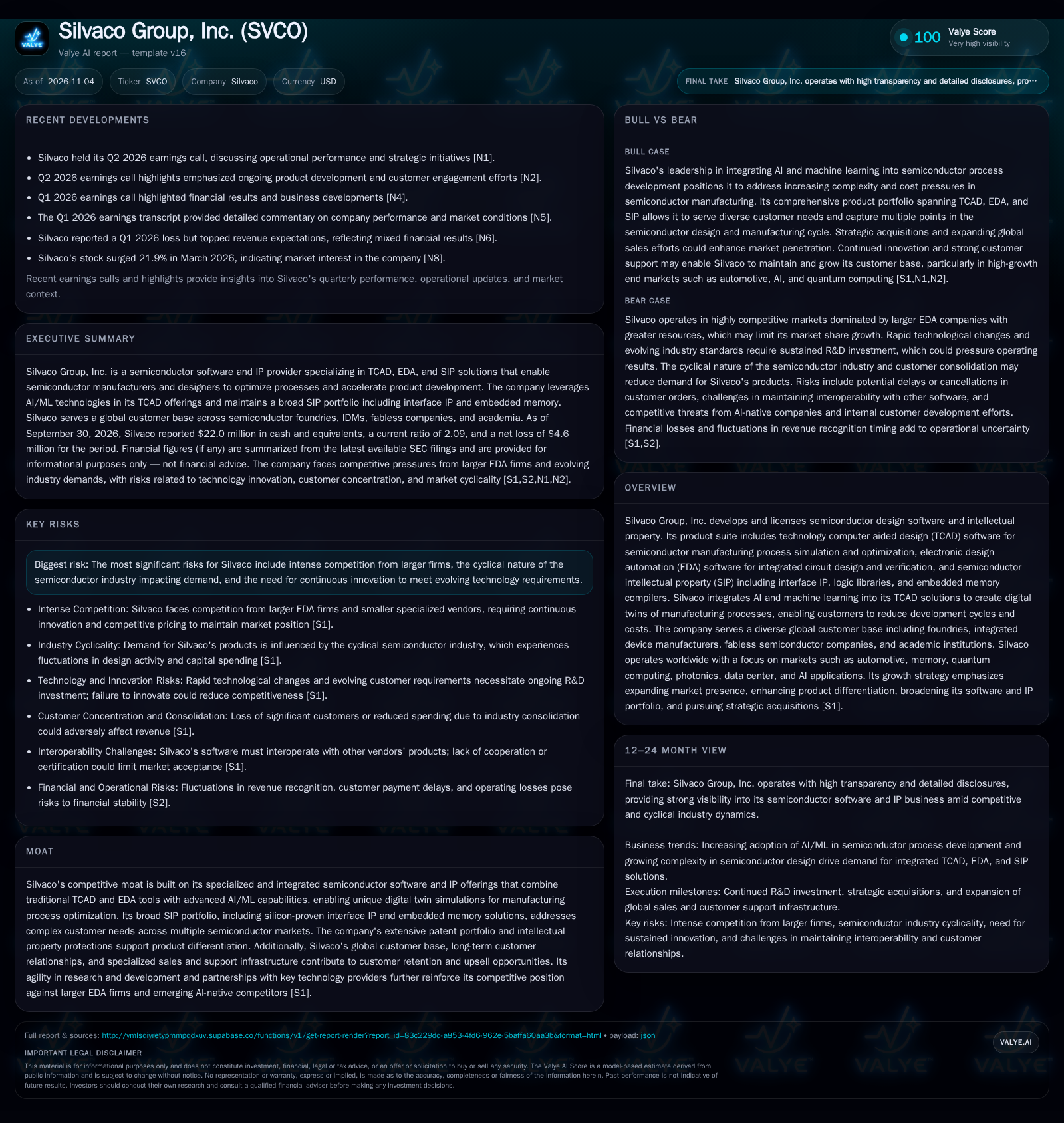
Silvaco Group, Inc. is positioning itself as a differentiated semiconductor design and manufacturing software provider by integrating AI/ML into its TCAD and EDA offerings and expanding its SIP portfolio. With a global customer base and robust patent assets, Silvaco faces the dual pressures of rapid technological change and heavyweight competition, while recent financials highlight ongoing investment, operational losses, and the need for continued innovation and market penetration.
Silvaco leverages advanced AI/ML in TCAD and EDA software to enable digital twin simulations and semiconductor process optimization, serving over 800 global customers. The company’s future hinges on successful R&D execution, customer expansion, and maintaining interoperability in a fast-evolving market landscape. [S1] [S2]
Silvaco Group, Inc. occupies a critical niche at the intersection of semiconductor design, manufacturing, and intellectual property, offering a suite of TCAD, EDA, and SIP solutions to a global customer base. The company’s strategic thrust into AI/ML-enhanced digital twin simulations aims to address escalating complexity and cost in chip development. However, despite a broad patent portfolio and ongoing R&D investment, Silvaco’s recent net loss and the scale gap versus industry giants highlight the execution risks and structural challenges of winning in a rapidly consolidating and technologically demanding market.
Where Silvaco Stands: Financial Snapshot and Strategic Focus
The company reported cash and liquidity metrics for the period; these figures do not by themselves establish operating runway, investment capacity, financial flexibility, or financing capacity. The company posted a net loss of $4.6 million for the period, with negative EPS of -$0.14, reflecting the high R&D and operational spending required to compete in the semiconductor software and IP market [S2].
The company’s technology portfolio covers TCAD, EDA, and SIP, with AI/ML integration as a flagship differentiator. Silvaco serves over 800 customers globally, including more than 200 academic institutions, and draws 54% of its revenue from Asia — underscoring both the geographic breadth and exposure to regional semiconductor cycles [S1].
Recent operational updates point to ongoing product development and customer engagement, but the company’s ability to convert innovation into profitable growth remains unproven in the face of intense competition and industry cyclicality [N1] [N2].
How Silvaco’s Business Model Seeks Leverage in a High-Fixed-Cost Arena
Silvaco’s core revenue streams are built around software licensing (TCAD, EDA) and semiconductor IP (SIP). Software contracts are typically structured as one- or three-year licenses, with sales cycles and deal size varying considerably by product complexity and customer type [S1]. The economics of this model feature high initial development costs (notably in R&D and engineering), relatively low marginal distribution costs, and the potential for high operating leverage if customer adoption scales.
The integration of AI/ML into its TCAD offering is designed to create process optimization tools that reduce customer development cycles and wafer costs. If successful, this could justify premium pricing or increase customer stickiness, but the company faces the challenge of convincing conservative semiconductor manufacturers to adopt new workflows and digital twin methodologies.
Intellectual property licensing (SIP) provides another revenue layer, with interface IP, logic libraries, and memory compilers that can be embedded in customer designs. SIP economics can be attractive due to royalty streams and reuse, but depend on both the ongoing relevance of Silvaco’s IP and its integration within broader customer projects.
Ongoing R&D investment is critical — both as a competitive necessity and as a drain on near-term profitability. The company’s cost structure is thus heavily weighted toward fixed personnel and development costs, with limited ability to flex spending in the short term without endangering future product viability. Capital needs are moderate for a software/IP business, but persistent operating losses and the need to fund innovation could eventually pressure the balance sheet if revenue growth does not accelerate.
Defending a Niche: Silvaco’s Differentiators and the Shadow of Scale
Silvaco competes directly with EDA giants such as Synopsys, Siemens EDA, and Cadence, as well as with smaller specialist vendors and, in some cases, internal customer development teams [S1]. The primary axes of competition are technology leadership, integration across the semiconductor design/manufacturing flow, product efficiency, and customer support.
Silvaco’s differentiation hinges on its AI/ML-enabled TCAD solutions and its broad SIP portfolio, including silicon-proven interface IP and memory compilers. The company’s patent portfolio (47 issued U.S. patents and multiple international filings) provides some technology moat, but likely does not confer the same breadth of lock-in as the entrenched ecosystems of its largest competitors.
The direct sales model, with specialized account managers and field application engineers, supports high-touch engagement but may limit scalability versus the global reach and integration depth of larger EDA providers.
Switching costs in EDA and SIP can be significant due to workflow integration and verification requirements, but large customers often maintain multi-vendor relationships to avoid lock-in and ensure toolchain flexibility. Silvaco’s ability to maintain interoperability and certification with other vendors’ products is therefore critical — both as a competitive requirement and as a risk if ecosystem standards evolve away from Silvaco’s strengths.
AI-Driven Adoption and Strategic Expansion Fuel Profitable Growth
The bullish scenario for Silvaco centers on accelerated adoption of its AI/ML-driven TCAD and EDA tools as semiconductor manufacturers confront mounting complexity, cost, and time-to-market pressures. If digital twin simulations and FTCO™ solutions are embraced as industry standards, Silvaco could command premium pricing, increase share of customer wallets, and embed itself more deeply in customer workflows.
Expansion into high-growth verticals — particularly automotive, AI, and quantum computing — could drive both volume and pricing leverage, especially if SIP offerings become design-critical. Strategic acquisitions and successful integration of new technologies may further broaden the company’s portfolio and market reach.
Proof points for this scenario would include: multi-year customer wins or renewals with leading foundries or fabless companies, evidence of standardization around Silvaco’s digital twin tools, SIP royalty growth, and a visible turn to operating profitability. Accelerating revenue from regions outside Asia, or significant penetration into new verticals, would also confirm the thesis.
Incremental Share Gains in a Competitive, Cyclical Market
The most plausible outlook is that Silvaco achieves modest revenue growth by leveraging its differentiated features in AI/ML and SIP, but remains constrained by the scale and integration advantages of larger EDA vendors. The company retains key accounts and attracts new customers in emerging markets, but must continually invest in R&D to keep pace with evolving standards and customer requirements.
Operating losses persist in the near term as R&D and customer support remain elevated relative to revenue growth, though cost discipline and incremental operating leverage may narrow the gap. The geographic revenue mix remains Asia-heavy, exposing the company to regional semiconductor cycles and policy risk.
Key confirming evidence would be: steady but unspectacular customer and revenue growth, maintenance of current gross margin and operating expense ratios, ongoing product releases or upgrades, and stable renewal rates if disclosed. Falsifying evidence would include material customer churn, inability to maintain interoperability, or a sharp contraction in SIP licensing activity.
Competitive Displacement and Innovation Stalls Trigger Margin Compression
In a negative scenario, Silvaco is squeezed by both ends: larger EDA players accelerate innovation or bundle competing AI/ML tools, while new entrants or internal customer development erode pricing power and relevance. The company’s R&D investments fail to yield differentiated products, and customers consolidate spending with larger, ecosystem-integrated suppliers.
Revenue stalls or declines, especially if semiconductor industry demand softens or Asia’s weighting exposes Silvaco to regional downturns or regulatory shocks. SIP royalties may come under pressure if interface standards evolve or if customers migrate to open-source or in-house IP. Operating losses widen, eventually leading to balance sheet strain and the need to raise capital or restructure.
Evidence supporting this scenario would include: declining customer count or revenue concentration, persistent or worsening operating losses, delays in product launches, loss of interoperability certifications, or a shrinking patent/IP pipeline. Sudden changes in regional policy or technology standards could also accelerate downside risks.
Milestones That Will Shape Silvaco’s Competitive Fate
Growth in total customer count and share of wallet among existing customers, particularly wins with top-tier foundries, IDMs, or leading fabless companies, if disclosed.
Adoption rates of AI/ML-enabled TCAD and EDA solutions, especially evidence of digital twin tools becoming standard within customer R&D workflows.
Renewal rates and contract duration for software licenses, as these would indicate customer stickiness and recurring revenue visibility.
Gross margin trends and the ratio of R&D spending to revenue, as a measure of operating leverage and innovation efficiency.
Progress in expanding SIP royalty streams and securing design wins in high-growth verticals such as automotive, AI, and quantum computing.
Interoperability milestones — certifications, partnerships, or integration agreements with other EDA vendors and key ecosystem players.
Geographic revenue mix shifts, particularly any material change in Asia versus Americas or Europe exposure.
Patent portfolio expansion and evidence of IP defense or monetization — new grants, litigation outcomes, or licensing deals.
Disclaimer: This is research-only, informational analysis and not investment advice. It may include AI-generated interpretation and general industry context. Always verify important details using primary sources.

Comments