
CompX International: Margin Expansion, Segment Breadth, and the Stakes of Industrial Volatility
CompX International’s 2025 rebound in margins and sales reflects effective mix management and demand from government and marine customers, but ongoing PFAS litigation and raw material cost volatility underscore persistent operational and legal risks. How sustainable are current margins, and can CompX defend its niche against cyclical and regulatory headwinds?
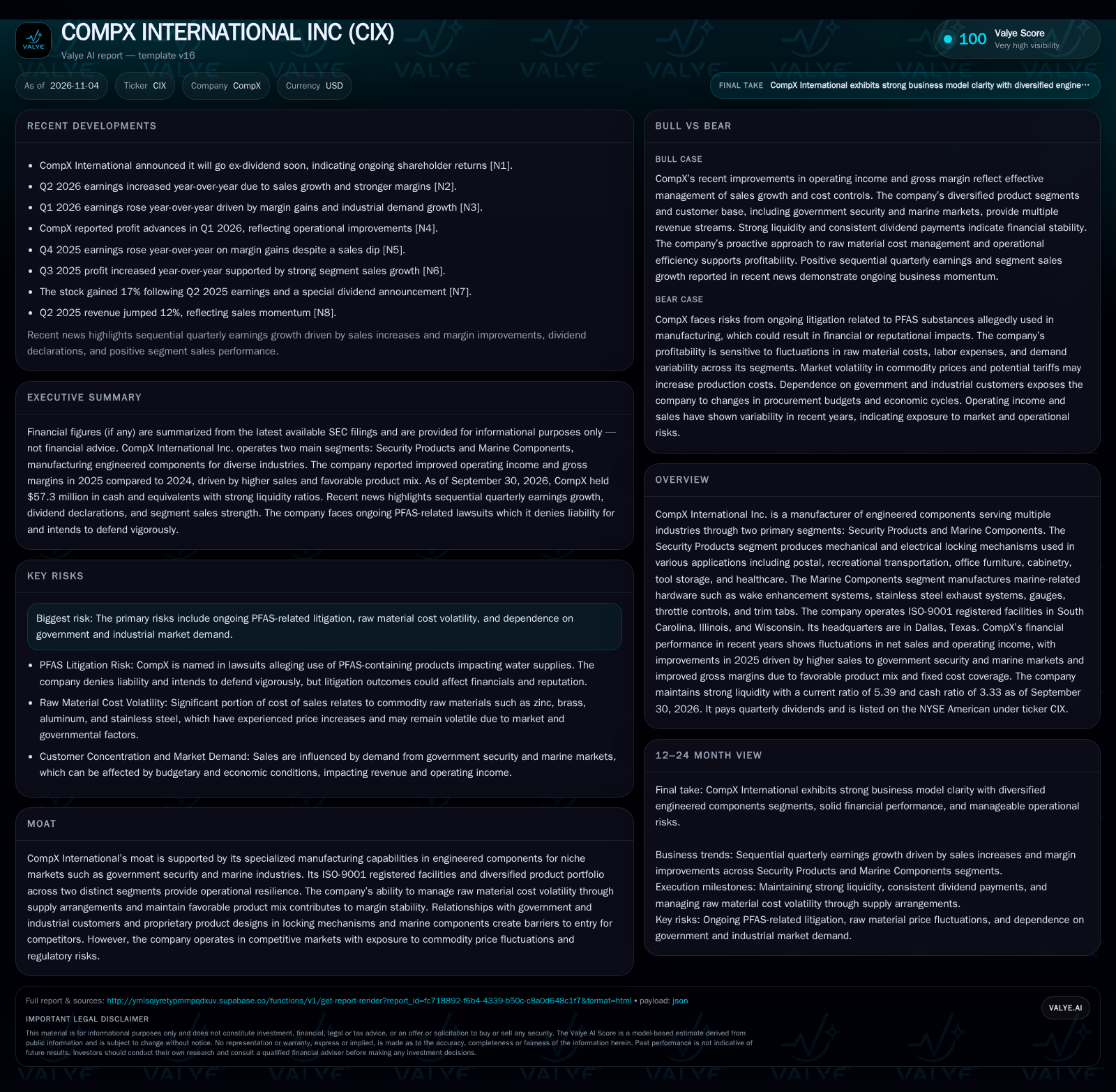
CompX International improved its operating income and gross margin in 2025, benefiting from favorable product mix and higher sales to government and marine markets. Despite reported liquidity position and continued dividends, the company faces PFAS-related litigation and ongoing exposure to volatile raw material costs. The key question is whether operational discipline and segment diversification can offset these structural and external risks as market cycles evolve. [S2]
CompX International enters late 2026 with a stronger margin profile and improved sales momentum, particularly in its Security Products segment, following a year of operational gains and favorable product mix. Yet, these advances are set against a backdrop of unresolved legal exposure from PFAS-related lawsuits and persistent volatility in raw material costs—conditions that could challenge the durability of recent profit gains. Investors and analysts must weigh the company’s operational discipline and diversified segment strategy against the unpredictable forces of input inflation, cyclical demand, and regulatory scrutiny.
Recent Margin Gains and Legal Overhang Define the 2026 Snapshot
CompX International reported net sales of $158.3 million in 2025, representing an 8% increase over 2024, though still trailing 2023 levels. Gross margin improved to 30.4% in 2025, up from 28.3% the prior year, attributed to a more favorable customer and product mix as well as increased coverage of fixed manufacturing costs. Operating income rose to $22.6 million in 2025, up from $17.0 million in 2024. The Security Products segment saw a 5% sales increase, with government and gas station security demand partially offsetting softness in healthcare, transportation, and tool storage. However, the company remains entangled in litigation concerning alleged PFAS contamination, which it denies but has not resolved. As of September 30, 2026, CompX held $57.3 million in cash and reported liquidity-ratio trends of 5.39. Quarterly dividends continued, most recently at $0.30 per share. [S2]
How Product Mix, Cost Structure, and Input Volatility Shape Profitability
CompX’s economics hinge on leveraging its engineered manufacturing capacity across two distinct product lines: Security Products and Marine Components. The company’s operating leverage is evident—gross margin improvements in 2025 reflect not only better pricing or volume, but also the ability to spread fixed costs over a stronger sales base and tilt towards higher-margin segments or customers. However, with raw materials representing 43% of cost of sales (and commodity-linked materials 14%), input cost swings can rapidly compress margins. CompX’s practice of using short-term supply arrangements may blunt sudden price spikes, but does not fully insulate against longer-term inflation or supply shocks.
Variable costs—primarily materials and labor—remain a key swing factor. Employee-related expenses edged higher in 2025, underscoring wage pressure seen across industrials. The cited source reports dividend-related activity; that disclosure alone does not establish dividend-policy continuity, management confidence, or a material constraint on capital flexibility. The company’s ability to flex production and manage mix will likely determine the persistence of recent margin gains, especially if end-market demand becomes less favorable.
Segment Diversification and Niche Engineering as Barriers—in a Crowded Field
CompX operates in specialized but competitive industrial segments. The Security Products business leverages proprietary mechanical and electronic locking technologies, serving customers with high reliability requirements—government, institutional, and regulated industries. ISO-9001 certification and customized solutions create switching frictions for certain customers, but these advantages are not absolute: alternative suppliers, new entrants with digital security innovations, and broader access to global manufacturing could pressure both price and share.
The Marine Components segment targets performance-focused recreational markets, where brand reputation and product integration matter, but where demand can be cyclical and sensitive to discretionary spending. In both segments, large customers such as government agencies or OEMs wield significant negotiating power. While CompX’s breadth can smooth out demand shocks in any one end market, it also exposes the company to a patchwork of procurement cycles and price-sensitive buyers. Competitors range from diversified industrial conglomerates to specialized component manufacturers, with the threat of technology substitution (e.g., biometric or IoT-enabled security) looming over traditional mechanical product lines.
Margin Resilience and Regulatory Clarity Could Unlock Further Upside
If CompX continues to optimize product mix towards higher-value customers—such as government security contracts and premium marine components—while managing input costs through hedging or supply chain initiatives, gross margins could remain elevated or even expand. Operational leverage would allow a disproportionate share of incremental sales to fall to the bottom line, particularly if wage and overhead increases are contained. A positive resolution or dismissal of PFAS-related litigation would remove a significant overhang, potentially freeing up capital for reinvestment or larger dividends.
Confirmation for this scenario would come from: sustained or rising gross margins above 30%; evidence of multi-year or recurring contracts with government or industrial clients; continued upward sales momentum in both segments; and public disclosure of litigation settlements without material financial impact. Additional upside could materialize if CompX successfully introduces new proprietary products that create higher switching costs or tap into new regulatory-driven demand in security or marine markets.
Operational Discipline Meets Cyclical and Legal Headwinds
The most plausible trajectory is one of modest sales growth and margin stability, punctuated by ongoing volatility in raw material costs and periodic swings in segment demand. CompX’s operational discipline—tight cost control, active management of product mix, and selective raw material supply agreements—should support gross margins near current levels, barring a sharp commodity or wage shock. Legal expenses tied to PFAS litigation may persist, but absent a major adverse ruling, are likely manageable relative to operating income.
Falsification would come from a sudden drop in margins, a major legal settlement or judgment, or a visible loss of share in core segments.
Litigation, Commodity Spikes, or End-Market Weakness Could Rapidly Compress Earnings
Simultaneously, a spike in raw material prices (especially if global or regulatory disruptions persist) could compress gross margins below the threshold needed to cover fixed costs, particularly if volume softens in key segments. Prolonged weakness in government or marine demand, whether due to macroeconomic or policy shifts, would further compound pressure.
Downside evidence would include: legal disclosures indicating material financial exposure or negative verdicts; raw material cost as a percent of sales rising sharply; gross margins falling below 28%; or unexpected cuts to the dividend. Additionally, customer losses to new competitors or technology-driven substitution would signal increased fragility in the business model.
What Will Determine the Durability of CompX’s Margins and Segment Strength?
Quarterly gross margin trends—especially the ability to sustain or expand margins above 30% despite input and wage pressures.
Net sales growth in Security Products and Marine Components, with breakdowns by end-market if disclosed, to assess demand resilience and mix evolution.
Legal disclosures regarding the status, cost, or resolution of PFAS-related lawsuits, and any associated cash or reserve impacts.
Raw material costs as a percentage of sales, and any new supply agreements or hedging strategies to address commodity volatility.
Evidence of new product launches or major contract wins, especially in government security or marine performance applications.
Customer retention rates or contract renewal disclosures, if available, to signal switching cost and competitive resilience.
Updates on capital expenditures and manufacturing capacity investments, which would indicate confidence in future demand and margin sustainability.
Disclaimer: This is research-only, informational analysis and not investment advice. It may include AI-generated interpretation and general industry context. Always verify important details using primary sources.

Comments