
Materion’s Diversified Engine: Earnings Momentum, Segment Breadth, and the Stakes of Industrial Cyclicality
Materion’s record Q3 2026 performance and raised outlook highlight the power of its broad industrial portfolio, but a reported cash ratio flags short-term liquidity sensitivity. The company’s future will hinge on its ability to sustain innovation and margin discipline across volatile end-markets.
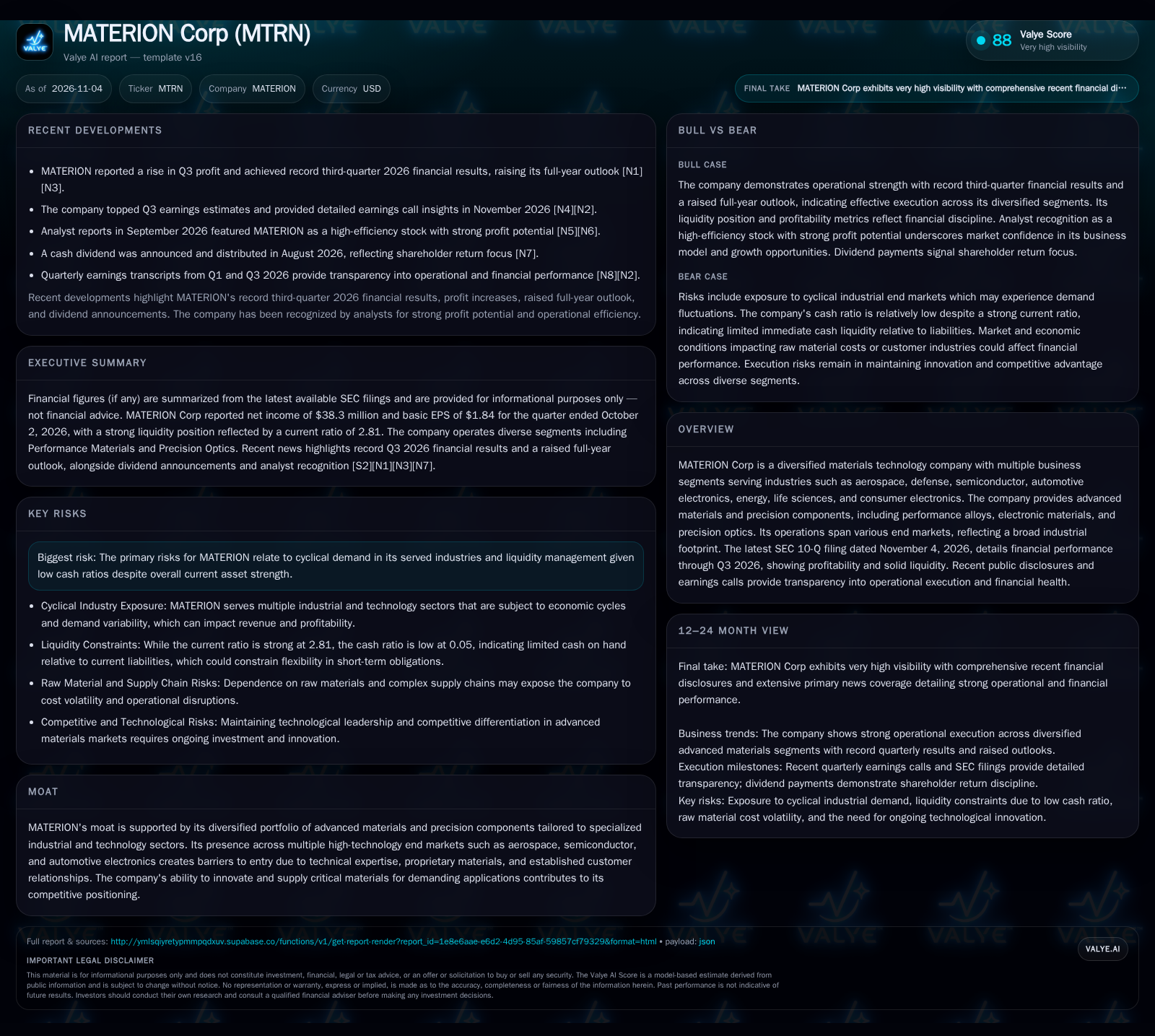
Materion posted record Q3 2026 results, exceeded earnings expectations, and raised its full-year outlook.Its broad exposure to advanced industrial and technology sectors supported profitability, though a reported cash ratio underscores the importance of operational cash flow management. Future performance will depend on maintaining competitive differentiation and navigating end-market cycles. [S2] [N1] [N3] [N4]
Materion Corp’s third-quarter 2026 performance stands out for its record profitability and a raised outlook, reflecting the company’s ability to execute across a wide range of advanced materials and technology-driven end markets. However, the combination of a reported current ratio and a reported cash ratio introduces a nuanced liquidity picture, raising questions about short-term cash management even as earnings momentum builds. With exposure to cyclical industries, Materion’s future trajectory will depend on its ability to balance innovation-driven differentiation with margin discipline and agile financial stewardship.
Earnings Outperformance and Liquidity Profile: The Latest Quarter in Focus
Materion reported net income of $38.3 million in Q3 2026, with basic earnings per share of $1.84 and diluted EPS of $1.81, surpassing consensus estimates for the quarter. This performance coincided with a record third-quarter result and led management to raise the company’s full-year outlook, as reflected in recent news and earnings call coverage. The company reported a current ratio of 2.81 for the period. Segment breadth remains a defining feature, with operations spanning aerospace, defense, semiconductors, automotive electronics, energy, and life sciences. [S2] [N1] [N3] [N4]
How Materion’s Portfolio Converts Industrial Demand into Profits
Materion’s business model is anchored in supplying advanced materials and precision components to a variety of high-value, technology-driven industries. The economics of such a portfolio typically hinge on a blend of volume-driven sales to cyclical industrial customers and value-added, higher-margin offerings for specialized applications—such as precision optics or electronic materials for semiconductors and aerospace. Pricing power can be stronger in segments where proprietary processes, technical expertise, or customer qualification cycles create switching frictions, but is likely more limited in commoditized or contract-driven end markets.
Revenue mix across segments may allow Materion to offset downturns in one vertical with strength in another, but this same diversification introduces complexity in managing cost structures, inventory, and capital allocation. The company’s operating leverage is potentially significant: high fixed costs in manufacturing facilities and R&D can amplify profit swings as volumes change. The cited source reports dividend-related activity; that disclosure alone does not establish dividend-policy continuity, management confidence, or a material constraint on capital flexibility. [S2] [N7]
The capital intensity of advanced materials production—ranging from raw material procurement to specialized fabrication—means that ongoing investment is needed for both capacity and innovation. Access to credit, efficient inventory turns, and tight cost controls may determine whether Materion can sustain margin expansion through the cycle.
The interplay between Materion’s capital allocation strategy and its industrial portfolio diversification is critical for sustaining long-term profitability. Given the capital-intensive nature of advanced materials manufacturing, prioritizing investments that yield the highest incremental returns—whether through capacity expansion, process automation, or R&D breakthroughs—becomes essential. This prioritization is especially important when end markets exhibit asynchronous cycles, requiring the company to dynamically shift resources to growth areas while managing legacy assets in slower segments.
Defensible Niches and the Challenge of Technological Imitation
Materion’s competitive positioning rests on its ability to serve specialized needs in multiple high-technology end markets. Barriers to entry include proprietary material science, complex manufacturing processes, and long-standing customer relationships in sectors such as aerospace, semiconductors, and automotive electronics. These factors can create contractual or qualification-based switching costs, making it harder for new entrants or generic competitors to displace Materion in critical applications.
However, the company faces persistent counterforces. Larger diversified materials and specialty chemical companies, as well as vertically integrated technology OEMs, represent formidable competitors. Technological substitution—such as new composite materials or alternative electronic substrates—could erode share in established segments if Materion does not keep pace with R&D. Furthermore, some segments are exposed to price competition or cyclical procurement patterns, especially where materials are less differentiated or customers have significant bargaining power. The ability to maintain a moat will depend on continuous innovation, customer stickiness, and the agility to pivot as technology and end-market priorities evolve.
Margin Expansion and Cash Flow Resilience in a Multi-Segment Growth Cycle
The most favorable scenario for Materion involves a synchronous upswing across several of its core end markets—particularly semiconductors, aerospace, and energy—driven by structural demand for advanced materials in next-generation devices, electrification, and defense modernization. Successful new product introductions or process innovations that enhance pricing power and customer lock-in would further support margin expansion.
Confirmation of this scenario would come from continued outperformance against earnings guidance, sequential improvements in operating cash flow, and evidence of market share gains or new multi-year contracts in strategic end markets. Increases in dividend payouts or strategic reinvestment without corresponding liquidity stress would also signal underlying business strength. Conversely, if cash flow conversion lags profit growth or if end-market momentum stalls, the thesis would be weakened.
Navigating Cyclicality: Stable Execution with Selective Margin Pressure
A plausible middle path sees Materion delivering steady, if not spectacular, performance by leveraging its diversified industrial exposure. In this outcome, strength in one or two end markets—such as ongoing semiconductor demand or stable aerospace orders—offsets softness in more cyclical or commoditized segments. Margins may fluctuate modestly as input costs and customer procurement cycles shift, but operational discipline and cost management keep profitability within a consistent range.
Evidence of successful cost pass-through or supply chain resilience in the face of raw material volatility would further support the base case. However, a sharp reversal in one or more major end markets, or visible strain on short-term liquidity, would challenge the stability of this scenario.
Liquidity Pinch Meets End-Market Downturn: Risk of Operational Disruption
The adverse scenario is defined by a simultaneous downturn in multiple key customer industries—such as a cyclical semiconductor correction combined with aerospace or automotive demand softness—leading to declining volumes and compressed margins.Under these conditions, Materion’s reported cash ratio could quickly become problematic if operating cash flow deteriorates or if inventory and receivables rise.
This scenario would be confirmed by declining revenue, margin compression, negative or sharply reduced operating cash flow, and the need for external financing or asset sales. Dividend suspension, layoffs, or plant rationalizations would further signal stress. If Materion is unable to adjust cost structures or secure additional liquidity, operational disruption and long-term competitive damage could result.
Signals That Will Shape Materion’s Margin and Liquidity Trajectory
Segment-level revenue and margin performance: Disaggregated results, if disclosed, would clarify which end markets are driving growth or margin pressure and test the portfolio’s diversification thesis.
Raw material cost pass-through: Evidence of successful cost recovery in pricing, especially during periods of input volatility, would help gauge margin resilience.
Customer concentration and contract renewal rates: If disclosed, these metrics would illuminate potential vulnerability to large account losses or pricing renegotiations.
Capital expenditure discipline and R&D investment: Trends in capex and innovation spending would signal whether Materion is balancing near-term cash needs with long-term competitive positioning.
Access to and terms of external financing: Any new credit arrangements or changes to borrowing costs would be a direct indicator of liquidity risk or flexibility.
Disclaimer: This is research-only, informational analysis and not investment advice. It may include AI-generated interpretation and general industry context. Always verify important details using primary sources.

Comments