
Kennametal’s Rebound: Margin Expansion, End-Market Diversification, and the Stakes of Industrial Cyclicality
Kennametal’s 2026–27 surge in sales and profitability reflects robust end-market demand, margin expansion, and regional growth, but exposes the company to cyclical risks and cost pressures that will test its ability to sustain recent gains.
Kennametal has delivered exceptional top- and bottom-line growth, driven by broad-based end-market and geographic strength, alongside material margin improvement and an upgraded FY27 outlook. However, its reliance on cyclical industrials, cost inflation, and restructuring needs mean that sustaining this trajectory will require continued execution and vigilance.
Kennametal Inc’s latest results underscore a dramatic financial turnaround, with double-digit sales growth, sharply higher margins, and record quarterly profitability. This surge is broad-based, spanning major geographies and key industrial end markets such as aerospace, energy, and earthworks. Yet, beneath these headline numbers lie persistent risks: Kennametal’s exposure to cyclical demand, rising operating and restructuring costs, and the unpredictable nature of global industrial supply chains. The question for investors is whether this momentum is sustainable—or if it represents a high-water mark in an inherently volatile sector.
Dramatic Top- and Bottom-Line Growth Defines 2026–27 Performance
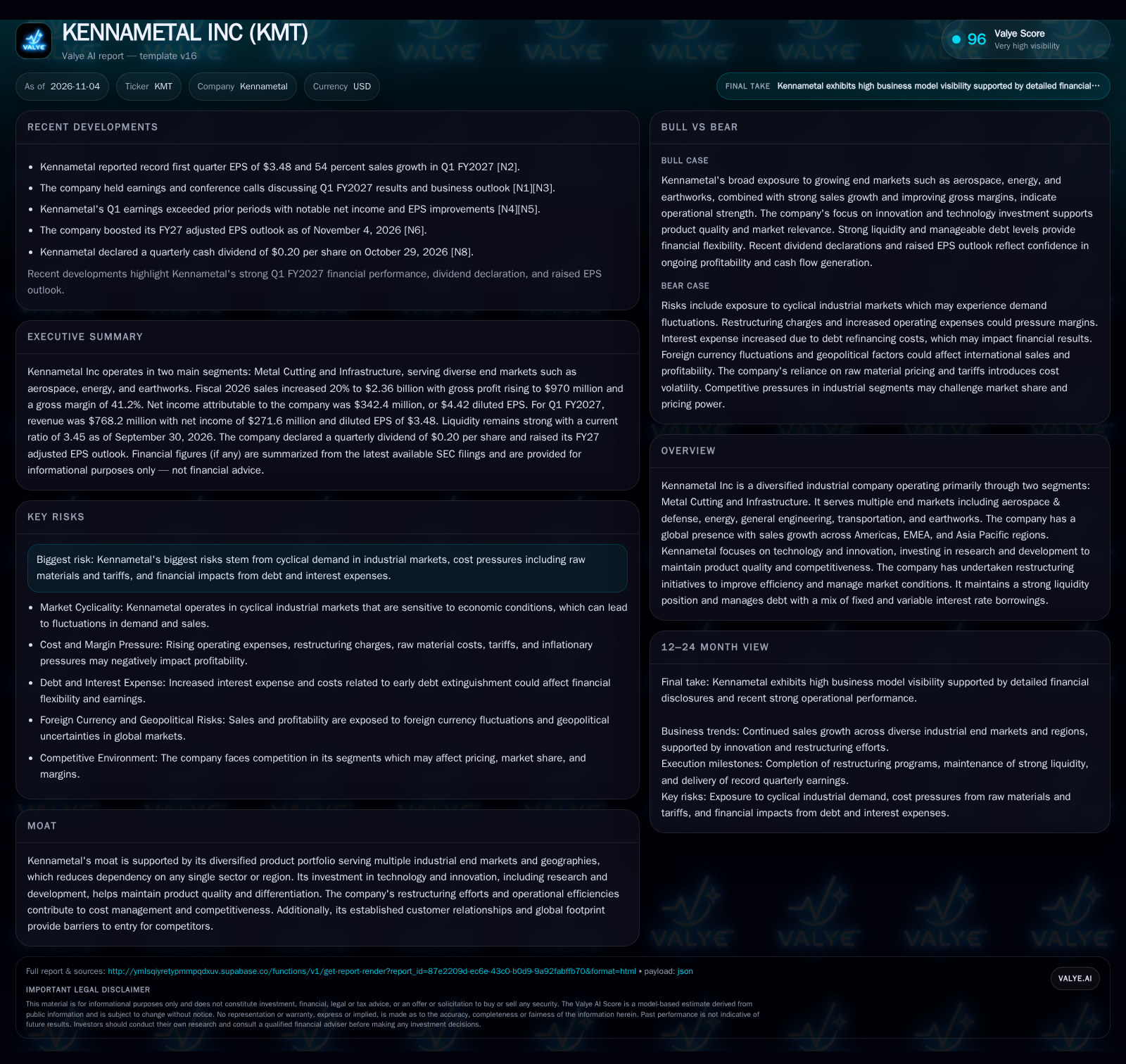
Kennametal reported $2.36 billion in sales for fiscal 2026, a 20% year-over-year increase, with growth driven by both organic demand and favorable currency effects [S1]. Gross profit rose to $970 million, pushing gross margin from 30.4% to 41.2%, while net income surged to $342.4 million ($4.42 EPS) from $93.1 million ($1.20 EPS) the prior year [S1]. The first quarter of FY2027 continued this trend, with $768.2 million in revenue and $271.6 million in net income, resulting in record quarterly EPS [S2] [N2]. These gains were widespread: end-market sales growth ranged from 5% in transportation to 39% in earthworks, and regional growth was robust across the Americas (25%), EMEA (14%), and Asia Pacific (15%) [S1]. Kennametal has also raised its FY27 adjusted EPS outlook, signaling management’s expectation of continued outperformance [N6].
Margin Expansion, Operating Leverage, and the Cost Structure Puzzle
Kennametal’s business model is built around supplying high-value metal cutting tools and wear-resistant solutions to industrial customers, with economics shaped by a mix of volume, pricing, and product mix across cyclical end markets. The sharp increase in gross margin to 41.2% suggests a combination of higher pricing, improved product mix (potentially toward higher-value aerospace and energy applications), and operational efficiencies, possibly from recent restructuring initiatives [S1]. Operating expenses grew 11% to $479 million, including $43.2 million for R&D, indicating continued investment in innovation but also underlying inflationary pressures [S1]. Restructuring and debt refinancing costs added further expense, with interest expense rising to $28.6 million [S1]. The company’s fixed-cost base creates operating leverage in upcycles, but also exposes it to margin compression in downturns. Capital needs are ongoing for R&D, manufacturing upgrades, and working capital, especially given Kennametal’s global footprint and end-market diversity.
A deeper analysis of Kennametal’s margin expansion reveals the critical interplay between product segmentation and pricing power. Higher-value aerospace and energy segments typically command premium pricing due to stringent quality and performance requirements, which can insulate margins against raw material cost volatility. However, this advantage is contingent on maintaining technological leadership and meeting evolving customer specifications. Conversely, earthworks and transportation markets may exert downward pricing pressure during cyclical downturns, amplifying margin volatility. The company’s ability to flex its product mix toward resilient segments during industry cycles will be a key determinant of sustained margin improvement. Additionally, operational efficiencies gained from automation and lean manufacturing could mitigate inflationary impacts, but require upfront capital and effective change management to realize full benefits.
How Diversification and Innovation Buffer Industrial Competition—But Not Entirely
Kennametal’s competitive positioning derives from its broad product portfolio, spanning both Metal Cutting and Infrastructure segments, and its exposure to diverse end markets and geographies [S1]. This reduces reliance on any single sector or region, buffering against isolated downturns. Its ongoing investment in R&D ($43.2 million in 2026) supports product differentiation and quality, which can help sustain pricing and customer loyalty—critical in markets where switching costs are moderate but not insurmountable. However, the company operates in highly competitive, price-sensitive industrial segments, facing rivals from global toolmakers to specialized niche suppliers. Technology substitution (e.g., additive manufacturing, advanced composites) and customer insourcing are ongoing threats. While Kennametal’s restructuring and efficiency gains provide near-term cost advantages, these are not inherently durable, and long-term differentiation will depend on sustained innovation and customer integration.
Kennametal’s diversification strategy not only reduces risk but also demands complex coordination across disparate markets and regulatory environments. Managing this complexity requires robust supply chain integration and agile product development cycles to respond swiftly to shifting customer demands. The company’s R&D investments must balance incremental improvements with breakthrough innovations to stay ahead of competitors leveraging emerging technologies such as additive manufacturing or advanced ceramics. Moreover, customer relationships in industrial sectors often hinge on service quality and technical support, areas where Kennametal can differentiate but which also increase operating costs. The sustainability of competitive advantages will therefore depend on the firm’s capacity to continuously innovate while optimizing cost structures and deepening customer engagement in a fragmented and competitive landscape.
Sustained End-Market Expansion Unlocks Multi-Year Margin Upside
The bull case hinges on continued strength across aerospace, energy, and earthworks—sectors that have delivered 30%+ sales growth—and Kennametal’s ability to hold or expand gross margins as volumes grow [S1]. If R&D investment leads to new, differentiated products and the company continues to execute on restructuring, operating leverage could drive incremental margin gains. Confirmation would come from: further above-market growth in target end markets, another year of 40%+ gross margins, and evidence of new product adoption or share gains in strategic verticals. Additional upside could materialize if Kennametal successfully leverages its geographic expansion, particularly in faster-growing Asia Pacific and Americas regions, and if raw material cost inflation remains contained.
If Kennametal can capitalize on multi-year secular trends such as infrastructure modernization and energy transition, these could provide a structural tailwind beyond typical industrial cycles. For instance, increased demand for renewable energy components or electric vehicle manufacturing could expand aerospace and energy end markets, supporting higher-margin product adoption. Geographic expansion into emerging markets with growing industrial bases may also unlock incremental revenue streams, provided the company can navigate local competitive dynamics and supply chain challenges. However, realizing this upside requires disciplined capital allocation to innovation and market development, as well as vigilant cost control to preserve margin gains amid potentially higher input costs or regulatory compliance expenses.
Recent Gains Normalize as Industrial Demand Moderates
The most plausible scenario is that Kennametal’s sales and margin growth moderate in line with the broader industrial cycle. While some end markets—such as aerospace and energy—may remain robust, others like general engineering and transportation could revert to historical growth rates. Operating expenses and restructuring charges are likely to persist, limiting further margin expansion. The company’s diversified exposure should buffer against deep downturns, but the fixed-cost structure means earnings volatility will remain. Evidence supporting this path would include mid-single-digit sales growth, stable but plateauing gross margins, and continued—but not escalating—investment in R&D and restructuring.
Industrial Cyclicality, Cost Inflation, or Execution Missteps Reverse Momentum
Kennametal’s greatest vulnerability is a synchronized downturn across its major end markets—particularly if combined with raw material cost spikes or currency headwinds. A sharp contraction in aerospace or energy demand, or a slowdown in earthworks infrastructure, could expose the company’s fixed-cost base, compressing margins and reversing recent profit gains. Execution risk remains if restructuring initiatives fail to deliver targeted savings, or if operating expenses continue to rise faster than revenue. Confirmation of this scenario would come from declining sales in multiple regions, gross margins falling below 35%, or a return to net income levels closer to those seen in 2025. Significant increases in interest expense or further charges for debt extinguishment would also signal downside risk.
What Will Determine Kennametal’s Staying Power in a Volatile Industrial Landscape?
Sustained gross margin at or above 40% would suggest Kennametal is maintaining pricing power and operational efficiency.
Sales growth by end market, especially in aerospace, energy, and earthworks, will clarify whether recent demand strength is durable or cyclical.
Operating expense growth relative to revenue; a reacceleration would indicate renewed cost pressure or the limits of restructuring.
R&D investment as a percentage of sales; if disclosed, this will signal commitment to innovation and potential for long-term differentiation.
Magnitude and frequency of restructuring or impairment charges, which would reveal underlying business model stress or transformation needs.
Interest expense and debt levels, especially following recent refinancing and early extinguishment activity.
Regional growth rates, particularly in Asia Pacific and Americas, as leading indicators of geographic expansion or vulnerability.
Disclaimer: This is research-only, informational analysis and not investment advice. It may include AI-generated interpretation and general industry context. Always verify important details using primary sources.

Comments