
EQUATOR Beverage Company: Capital-Light Growth in a Crowded Organic Beverage Arena
EQUATOR Beverage Company’s disciplined, outsourced model enables it to pursue growth in the premium organic beverage segment with minimal capital risk, but its sustainability focus and expanding distribution must overcome fierce competition, supply chain fragility, and the shifting tastes of health-conscious consumers.
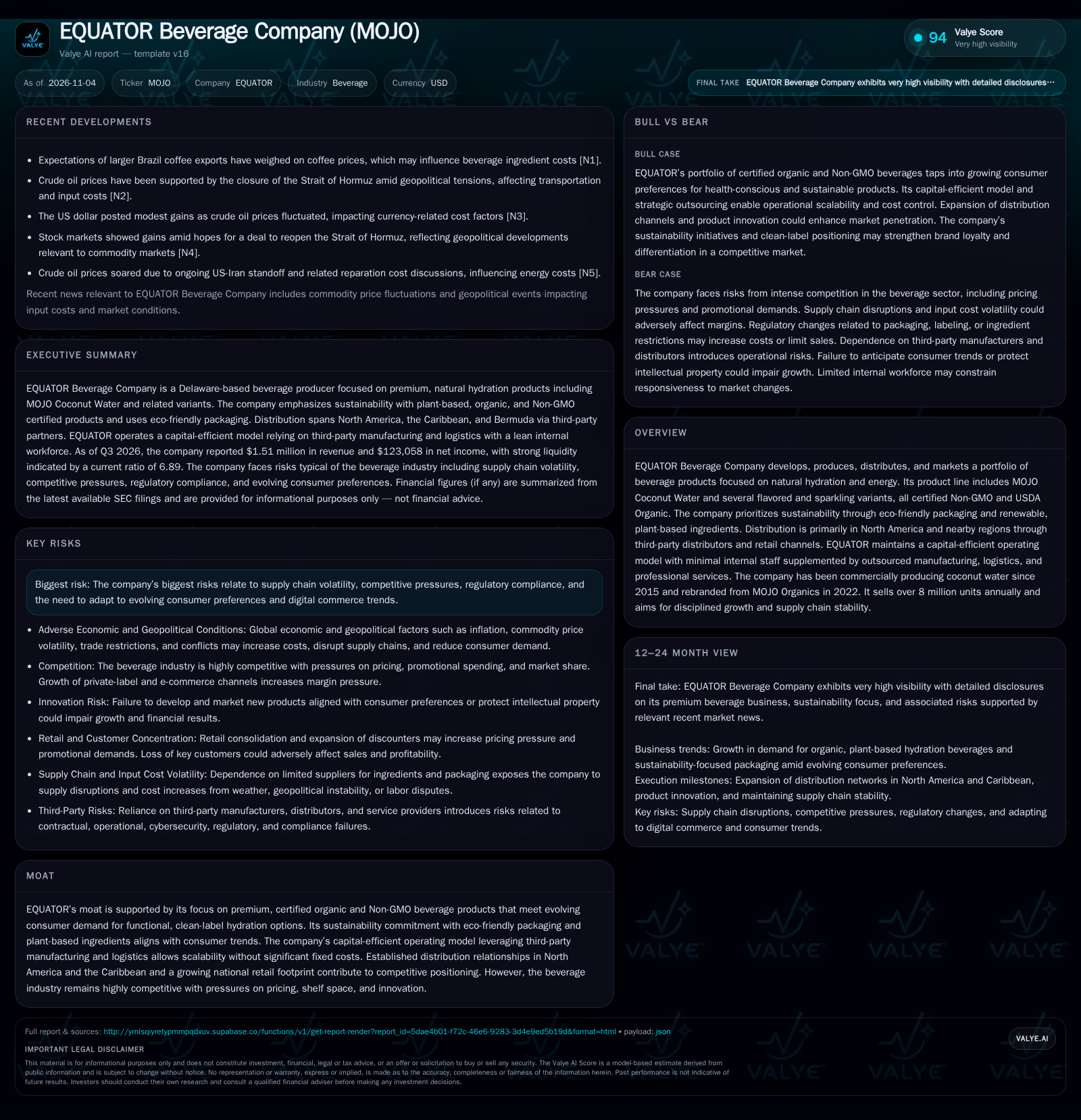
EQUATOR Beverage Company reported $1.51 million in revenue and $123,058 in net income as of September 30, 2026, reflecting its capital-efficient, outsourced operating model and focus on certified organic, plant-based beverages. With over 8 million units sold annually, EQUATOR relies on third-party manufacturing and logistics and targets North America and nearby markets, but faces intense competition, supply chain risks, and the challenge of evolving consumer preferences. [S1] [S2]
EQUATOR Beverage Company stands out in the crowded beverage sector by leveraging a highly outsourced, capital-efficient model to deliver certified organic and plant-based hydration products.With just two employees, the company sells over 8 million units annually, generating modest profitability and maintaining a reported current ratio. As the demand for natural, sustainable beverages grows, EQUATOR’s disciplined approach provides scalability and cost control, but its future hinges on navigating intense competition, input cost volatility, and rapidly evolving consumer preferences. The company’s ability to expand distribution and sustain innovation will be critical determinants of its trajectory in an industry where shelf space and brand loyalty are hard-won.
Recent Performance and Strategic Positioning
As of September 30, 2026, EQUATOR Beverage Company reported revenue of $1.51 million and net income of $123,058, with over 8 million units sold annually [S2]. This modest profitability demonstrates the viability of its capital-light, outsourced operating model—with only two employees and heavy reliance on third-party manufacturing, logistics, and professional services [S1]. The company reported cash and liquidity metrics for the period; these figures do not by themselves establish operating runway, investment capacity, financial flexibility, or financing capacity. [S2] EQUATOR’s products are certified organic, Non-GMO, and marketed as sustainable, using eco-friendly packaging and targeting health-conscious consumers. Distribution is concentrated in North America, the Caribbean, and Bermuda, with ongoing evaluation of further geographic expansion [S1]. These factors collectively frame a business pursuing growth through operational discipline, brand positioning, and strategic channel management, while exposed to sector-specific risks.
How EQUATOR’s Capital-Efficient Model Aims to Capture Value
EQUATOR’s economics are shaped by its decision to outsource both manufacturing and logistics, minimizing fixed costs and capital requirements. This approach allows the company to scale production up or down with demand, limiting the risk of underutilized assets—a frequent pitfall for small beverage brands. However, this model also makes gross margins highly sensitive to third-party pricing and input cost volatility. With a reported revenue base of $1.51 million and over 8 million units sold annually, average realized unit prices are low, suggesting a focus on volume over premium pricing [S2].
The company’s lean workforce—just two employees—means SG&A expenses are likely concentrated in sales, marketing, and outsourced professional services. This should keep operating leverage favorable during periods of revenue growth but could constrain responsiveness to market shifts or supply disruptions. EQUATOR’s eco-friendly, certified product positioning might support some pricing power among niche consumers, but the broader beverage sector is notoriously price-competitive, particularly against private label and legacy multinationals.
Capital needs are modest due to the absence of owned production or logistics infrastructure, but growth initiatives (such as new product launches or distribution expansion) may require incremental investment in working capital, marketing, or inventory buildup. With a current ratio of 6.89, EQUATOR appears to have headroom for such investments in the short term, assuming continued discipline in receivables and payables [S2].
Sustainability Branding in a Fragmented, Competitive Space
EQUATOR’s competitive positioning is anchored in its certified organic and Non-GMO beverage portfolio, eco-friendly packaging, and appeal to health- and sustainability-focused consumers. These differentiators address growing consumer demand for clean-label hydration, but the barriers to entry in this segment are low, and large beverage multinationals have rapidly expanded their own organic and plant-based offerings. Private-label brands and regional upstarts also crowd the shelf space, driving price competition and promotional intensity.
The company’s capital-light model provides agility and cost discipline, potentially allowing faster adaptation to trends and less exposure to fixed-cost operating risk. However, the lack of owned production or proprietary distribution infrastructure may limit control over quality, supply chain continuity, and margin capture. EQUATOR’s reliance on third-party distributors and retailers for market access means shelf space, promotional support, and end-customer relationships are all subject to negotiation and ongoing performance. Maintaining relevance will require continuous product innovation, effective branding, and possibly deeper partnerships with retailers to secure visibility.
Ultimately, while EQUATOR’s sustainability focus and certifications may resonate with a growing consumer base, these advantages are not insurmountable. Competitive intensity, retailer bargaining power, and the risk of commoditization remain persistent threats.
If Distribution Expansion and Brand Innovation Drive Outperformance
The most favorable scenario for EQUATOR is one in which it successfully leverages its capital-light model to expand distribution, launch differentiated products, and deepen brand loyalty among health-conscious consumers. If the company secures additional retail partners or enters new geographic markets—particularly in North America or the Caribbean—unit sales could rise without a commensurate increase in fixed costs, driving operating leverage and margin expansion. Incremental innovation, such as new functional beverage variants or limited-edition flavors, could support higher average selling prices or improved shelf positioning.
Evidence that would confirm this scenario includes sustained growth in unit sales, successful launches of new SKUs with measurable consumer uptake, and new distribution agreements or retail partnerships. Margin improvement—either through higher realized prices or lower outsourced production costs—would further validate the model’s scalability. If disclosed, metrics such as retail door count, same-store sales growth, or customer retention rates would help test the durability of EQUATOR’s competitive advantage.
Steady Volume Growth Amid Persistent Margin Pressures
The most plausible trajectory is that EQUATOR continues to grow modestly by focusing on its core markets and product lines, maintaining profitability but with limited margin expansion. The company may add some new retail partners or geographic territories, but faces ongoing challenges from supply chain volatility, input cost fluctuations, and aggressive competition for shelf space. Operating leverage remains positive due to the capital-light model, but pricing power is constrained by industry dynamics.
Confirmation of this scenario would include stable or gradually increasing unit sales, revenue tracking with market growth rates, and modest but consistent profitability. Gross margins may fluctuate depending on input costs and promotional activity. Absence of major retail wins or transformative distribution deals would reinforce the view that EQUATOR’s model supports sustainability but not outsized growth. Risk factors—such as supply chain hiccups or regulatory changes—would likely be managed but not eliminated.
How Supply Chain Shocks or Shifting Tastes Could Derail Progress
In a less favorable scenario, EQUATOR faces acute supply chain disruptions, input cost spikes, or loses shelf space to larger competitors and private-label brands. The company’s heavy reliance on third-party manufacturing and logistics leaves it exposed to contract failures, commodity volatility, or transportation bottlenecks. If consumer preferences shift away from coconut water or toward alternative hydration formats, EQUATOR’s volume base could erode rapidly.
Indicators confirming this scenario would include declining unit sales, margin compression, or the need to absorb higher costs without the ability to pass them through to customers. Loss of major retail partners, increased promotional spending, or inventory write-downs would also be red flags. If disclosed, rising customer concentration or loss of key distribution agreements would further support the downside case.
Testing EQUATOR’s Growth and Resilience: What Will Distinguish Success
Progress in adding new retail distribution partners or entering new geographic markets—if disclosed—would be a leading indicator of scalable growth.
Unit sales growth across core and new product lines, as well as any disclosed same-store sales or retail door expansion, would help assess demand durability.
Gross margin trends, particularly in response to input cost fluctuations and promotional activity, would clarify EQUATOR’s ability to manage external pressures.
The pace and commercial success of new product launches or line extensions—evidenced by incremental revenue or repeat purchase rates—would test innovation effectiveness.
Changes in customer or retail partner concentration—if disclosed—would highlight exposure to key channel risks.
Any disclosed supply chain disruptions, input shortages, or reliance on single-source suppliers would signal operational vulnerability.
Evidence of increased investment in marketing or brand partnerships—if disclosed—may indicate an effort to build consumer awareness and loyalty.
Tracking regulatory developments in labeling, packaging, or beverage safety that could impact costs or market access remains important for future-proofing the business.
Disclaimer: This is research-only, informational analysis and not investment advice. It may include AI-generated interpretation and general industry context. Always verify important details using primary sources.

Comments