
Independent Bank in 2026: Regional Banking Profitability Amid Digital Transition and Competitive Pressures
Independent Bank Corporation maintains a profitable foothold in Michigan’s commercial banking sector, reporting solid Q3 2026 earnings and stable capital ratios. As customer preferences shift toward digital channels and competitive dynamics intensify, the bank’s ability to adapt its cost structure, sustain loan growth, and leverage its community ties will shape future returns.
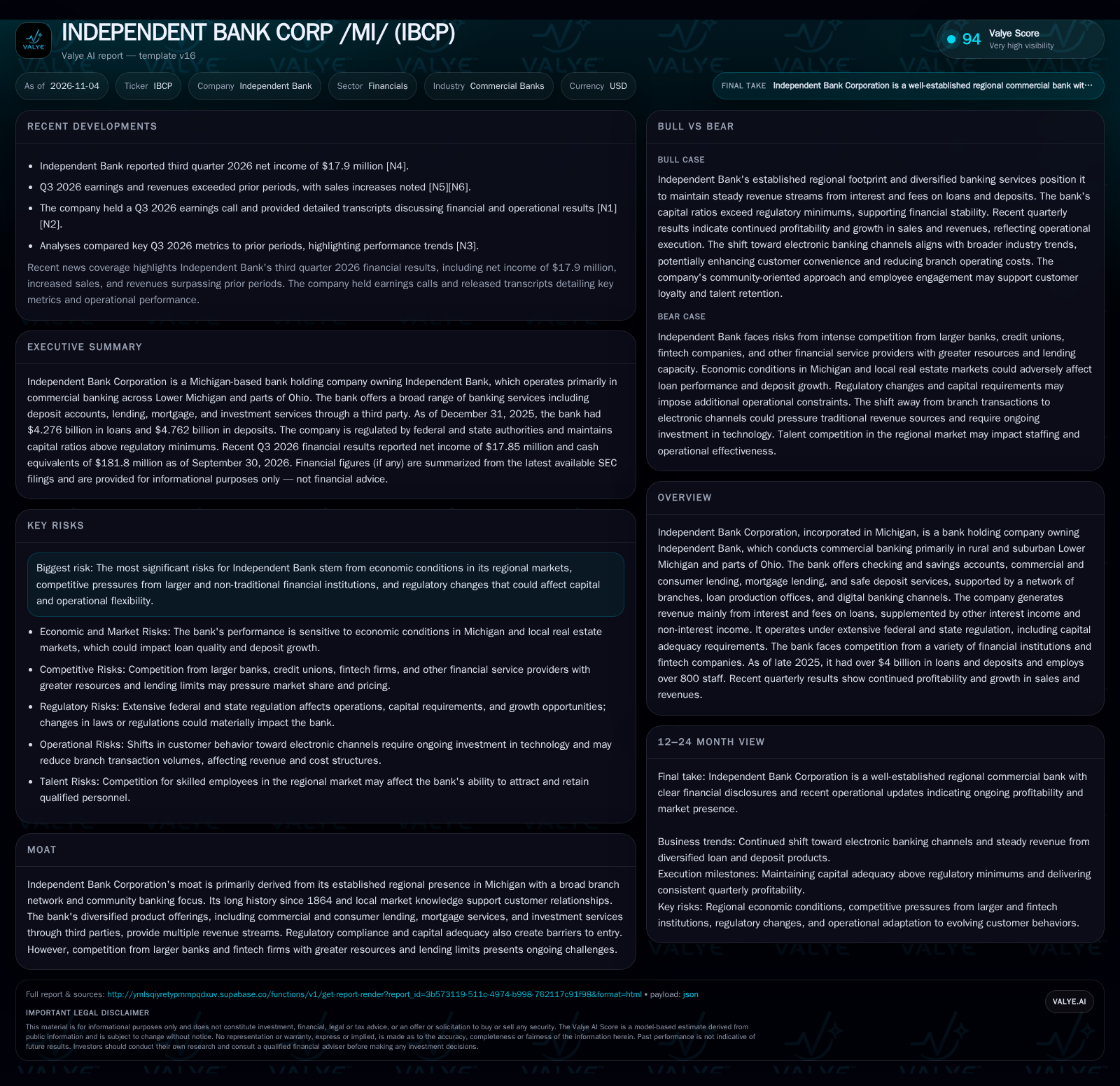
Independent Bank continues to deliver consistent profitability and revenue growth, underpinned by a strong loan and deposit base in Michigan. The bank’s capital position exceeds regulatory minimums, but the ongoing shift to electronic channels and heightened competition from both traditional and fintech peers raise questions about margin resilience and growth. Monitoring digital adoption, loan quality, and cost discipline will be crucial as the regional banking landscape evolves. [S1] [S2] [N4] [N5]
Independent Bank Corporation, a Michigan-based regional lender with deep community ties, reported another profitable quarter in Q3 2026, with net income of $17.9 million and ongoing increases in sales and revenue. The bank’s $4.3 billion loan book and $4.8 billion in deposits anchor its business, but management faces the dual challenge of adapting to rising digital adoption and defending market share against traditional and fintech competitors. As the customer base leans further into electronic channels, the sustainability of Independent Bank’s legacy cost structure and the resilience of its core lending economics are emerging as central questions for investors.
Recent Results Highlight Profitability and Customer Behavior Shifts
Independent Bank reported net income of $17.9 million for Q3 2026, with basic EPS of $0.81 and diluted EPS of $0.80, marking another period of profitability and sales growth compared to prior quarters [S2] [N4] [N5]. As of December 31, 2025, the bank’s total loans were $4.276 billion and total deposits $4.762 billion, underscoring its scale as a leading community bank in Michigan [S1]. The bank’s capital ratios remained above regulatory well-capitalized thresholds at year-end 2025, supporting ongoing lending and operational flexibility [S1]. Notably, management continues to observe a clear migration of customer transaction volume from physical branches to electronic channels, which may alter future cost dynamics and revenue composition [S1].
Revenue Dependence on Lending Spreads and the Cost Structure Challenge
Independent Bank generates the bulk of its revenue (75.7% in 2025) from interest and fees on loans, with additional contribution from other interest income (9.8%) and non-interest income sources such as service fees and investment services (14.5%) [S1]. The core profitability mechanism is the net interest margin—the spread between interest earned on loans and yields paid on deposits and other funding sources. This model is inherently sensitive to interest rate cycles, loan demand, and credit quality. While the bank’s scale allows for some operating leverage, its largely fixed branch infrastructure may become less efficient as more customers shift to digital banking. If digital adoption accelerates, there is potential for cost reductions through branch rationalization, but execution risk remains: upfront technology investments and the challenge of preserving customer relationships in a less personal environment could offset some savings. Capital requirements, set by regulators, act as a constraint on leverage and dividend/funding flexibility, but the bank’s current ratios provide a buffer for moderate balance sheet growth or stress [S1].
Community Focus Versus Scale and Technology: The Competitive Landscape
Independent Bank’s core competitive advantage lies in its entrenched position within Michigan’s rural and suburban markets, supported by a network of 56 branches and local market knowledge [S1]. This enables relationship-based lending and customer retention, particularly among small businesses and households that value in-person service. However, the bank faces competition from regional and national commercial banks, credit unions, mortgage companies, and increasingly, fintech firms and digital-first banks with greater scale, product breadth, and technology budgets. These competitors can often offer superior digital experiences, broader product suites, or more aggressive pricing. As customer preferences evolve, the question is whether Independent Bank’s community orientation and service culture can offset these structural disadvantages or if it will need to accelerate digital transformation and/or pursue partnerships to remain relevant. Barriers to entry exist via regulatory requirements and local trust, but switching costs for commoditized products (like basic checking or savings) are low, and customer loyalty may be tested as digital alternatives proliferate.
Digital Transition as a Catalyst for Margin Expansion
A favorable outcome for Independent Bank would see the successful migration of customers to digital channels, enabling the bank to rationalize its physical footprint and realize significant cost savings. If management can maintain or even grow its deposit base while reducing branch overhead, operating leverage could drive improved margins and returns. Further, if the bank leverages its community brand to cross-sell higher-margin products (such as mortgages, small business loans, or investment services) through digital channels, non-interest income could rise as a percentage of total revenue. Confirmation of this scenario would include evidence of declining branch operating expenses, stable or growing digital customer engagement (if disclosed), and continued loan growth without material deterioration in credit quality. Falsification would come from stagnating digital adoption, rising attrition among core customer segments, or failure to contain technology and compliance costs.
Sustaining Core Banking Profitability in a Competitive Michigan Market
The most plausible outcome is that Independent Bank continues to deliver stable, if modest, profitability by balancing its traditional branch-based service model with incremental digital enhancements. Loan and deposit growth would track regional economic trends, with net interest margins fluctuating in response to market rates and competitive pricing. Non-interest income remains a modest but steady contributor, bolstered by third-party investment services and ancillary products. The bank’s capital position and regulatory compliance remain strengths, allowing for measured growth and resilience against moderate shocks. The scenario is confirmed by ongoing net income in line with recent quarters, stable loan quality metrics, and gradual growth in digital channel usage. It would be challenged by a sharp drop in branch traffic without corresponding digital uptake, or by sudden competitive incursions eroding market share or compressing loan spreads.
Margin Compression and Credit Risk in a Slowing Regional Economy
In a more adverse scenario, Independent Bank could face a combination of margin compression and rising credit costs. Heightened competition—whether from larger banks offering better rates or fintechs with more compelling digital experiences—could force Independent to cut loan pricing or increase deposit rates, narrowing net interest margins. At the same time, if Michigan’s economy slows or local real estate values decline, the bank could experience higher loan delinquencies and losses, pressuring earnings and potentially regulatory capital ratios. Technology investments required to keep pace with digital adoption could further erode profitability if not matched by cost savings elsewhere. Evidence for this scenario would include shrinking net interest margins, rising non-performing loans, negative operating leverage, or any sign of regulatory scrutiny over capital adequacy. A rapid outflow of deposits to digital competitors or money market funds would further stress the business.
Benchmarks for Testing Independent Bank’s Adaptation and Resilience
Quarterly net interest margin trends: Monitoring for compression or expansion as a signal of competitive pricing dynamics and funding cost management.
Non-performing loan and charge-off rates: An increase would indicate rising credit risk, especially if regional economic conditions deteriorate.
Branch operating expense trajectory: Declining costs would suggest successful digital migration and footprint rationalization; rising costs could point to inefficiency.
Digital channel usage and customer migration metrics (if disclosed): Growth here would confirm adaptation to customer preferences and support future cost leverage.
Deposit growth and composition: Outflows or shifts toward higher-cost deposits could signal competitive pressure and funding vulnerability.
Loan growth by segment (commercial, mortgage, consumer): Reveals demand trends and risk appetite, especially in core Michigan markets.
Regulatory capital ratios: Sustained buffers above well-capitalized thresholds indicate resilience and support for measured expansion.
Employee turnover and talent acquisition metrics (if disclosed): High turnover or hiring difficulties could impact service quality and branch operations.
Disclaimer: This is research-only, informational analysis and not investment advice. It may include AI-generated interpretation and general industry context. Always verify important details using primary sources.

Comments