
Parke Bancorp’s 2026 Momentum: Deposit Discipline, Loan Growth, and the Stakes of Geographic Concentration
Riding a wave of net interest income expansion and disciplined expense control, Parke Bancorp posts robust earnings growth for 2026. But with a lending book concentrated in New Jersey and Pennsylvania, and interest rate dynamics in flux, the bank’s next phase will hinge on risk management, funding stability, and its ability to weather regional shocks.
Parke Bancorp’s 2026 results show double-digit growth in net income and net interest income, fueled by higher loan balances and favorable funding costs. Expense reductions, particularly in professional services, further support earnings. However, geographic concentration and credit risk provisioning remain central to the forward thesis, with interest rate and local economic exposures in focus. The bank’s ability to maintain funding discipline and asset quality will determine whether recent growth proves durable or cyclical.
Parke Bancorp’s 2026 financials showcase a classic regional bank playbook: net interest income expansion, cost discipline, and a stable deposit base. The company’s Q3 and year-to-date results reflect an ability to grow earnings through both top-line lending activity and bottom-line expense management. Yet, beneath these headline gains lie enduring exposures—namely, a concentrated geographic footprint and the ever-present challenge of interest rate and credit risk management. Whether Parke’s recent momentum signals sustainable franchise value or cyclical outperformance depends on how it navigates these structural realities in the coming quarters.
Recent Earnings Growth and Risk Provisions Shape Parke Bancorp’s 2026 Outlook
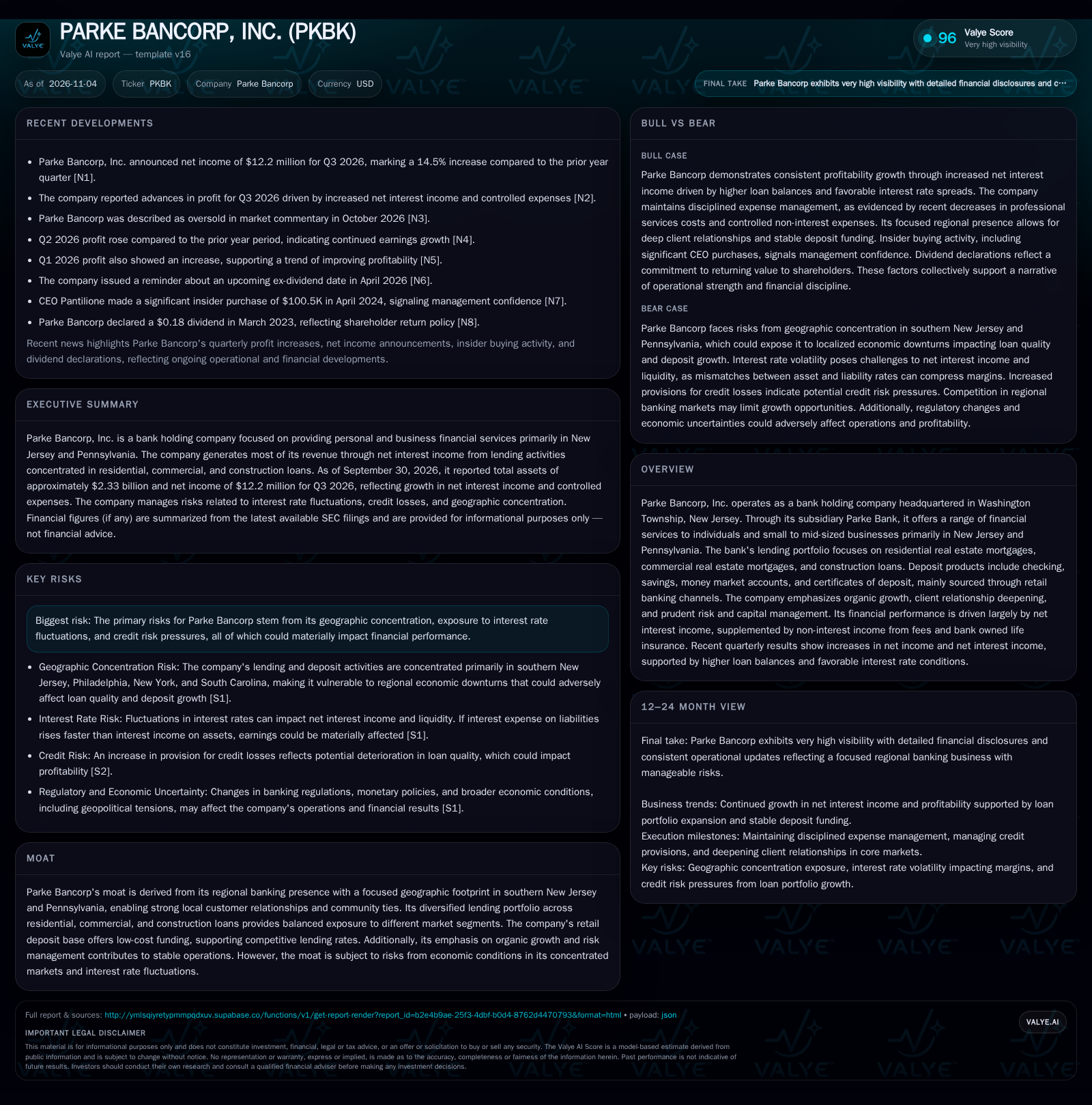
Parke Bancorp reported Q3 2026 net income of $12.2 million, up 14.5% from the prior year, as net interest income increased 14.2% to $23.0 million, supported by higher loan balances and improved funding costs [S2] [N1] [N2]. Non-interest expense declined by 5.4%, primarily due to lower professional services costs, helping drive operating leverage [S2]. However, the provision for credit losses rose to $1.0 million in Q3 2026, up from $0.4 million a year earlier, reflecting the need to buffer against potential loan losses as the lending book grows [S2]. As of September 30, 2026, total assets reached $2.33 billion, with equity of $356.1 million [S1]. The bank’s lending and deposit activities remain heavily concentrated in southern New Jersey and the Philadelphia area, a fact that continues to influence its risk profile [S1].
How Parke Bancorp Makes Money: Interest Margin, Funding Costs, and Scale Leverage
Parke Bancorp’s core profitability relies on the spread between interest earned on loans (primarily residential and commercial real estate, plus construction) and the interest paid on deposits and borrowings. The bank’s retail deposit base provides relatively low-cost funding, especially important in a rising rate environment where liability costs can otherwise outpace asset re-pricing. Net interest income—at $68.2 million for the first nine months of 2026, up 24.8% year-over-year—remains the dominant revenue driver [S2].
Non-interest income, such as loan fees and bank owned life insurance (BOLI), adds modest diversification but is not a primary earnings lever [S2]. Expense discipline, particularly in professional services, has helped offset rising compensation and operating costs. Fixed costs (branches, administration, compliance) create some operating leverage, visible in the recent reduction in non-interest expense as a percentage of assets. Loan growth increases revenue but also necessitates higher provisioning for credit losses, especially as the portfolio expands into riskier segments or if local real estate markets weaken.
Capital requirements are dictated by regulatory standards, the risk profile of the loan book, and the need to absorb potential losses. Dividend payments, such as the $0.18 declared in March 2023, reflect a commitment to shareholder returns but must be balanced against retained earnings for growth and risk coverage [N8].
Regional Focus: Deep Relationships, but Heightened Sensitivity to Local Competition and Economic Cycles
Parke Bancorp’s competitive advantage stems from its entrenched presence in southern New Jersey and the Philadelphia area, enabling strong community ties and relationship-driven lending. This proximity allows for granular knowledge of borrowers and local market dynamics, which can support better credit outcomes and customer retention. However, this same concentration heightens exposure to regional economic downturns—if commercial real estate or construction falters locally, loan quality and deposit growth could quickly deteriorate.
The primary competitor set includes other community and regional banks as well as credit unions and non-bank lenders targeting the same small business and real estate segments. Larger regional and national banks can exert pricing pressure on both loans and deposits, while fintech entrants may gradually erode the bank’s share of transactional and fee-based services. The bank’s low-cost deposit base provides some insulation, but only as long as customers remain loyal—any shift in rate expectations or economic confidence could make funding more expensive or less sticky.
Switching costs are moderate: business customers may value the relationship and local knowledge, but are not locked in by technology or unique product offerings. Digital banking capabilities, if disclosed, would be a useful metric to assess the bank’s ability to defend against tech-enabled competitors.
What Could Sustain Outperformance: Margin Expansion and Asset Quality Resilience
The favorable scenario for Parke Bancorp involves continued growth in net interest income, supported by stable or declining deposit costs and a benign credit environment. If loan demand remains robust—particularly in commercial real estate and construction—and the bank can maintain underwriting discipline, asset quality could hold up even as the portfolio expands. Further reductions in non-interest expense, or the ability to scale without proportionate cost increases, would enhance operating leverage.
Confirmation of this scenario would require evidence of: (1) sustained loan growth without a spike in nonperforming assets, (2) stable or improving net interest margin even as the rate environment evolves, and (3) continued low-cost deposit funding relative to peers.Insider transaction activity was reported in the cited source; this activity does not by itself establish insider confidence. Falsification would come from early signs of credit deterioration—such as rising delinquencies or charge-offs—or a rapid increase in deposit costs that erodes net interest margin.
Earnings Growth Moderates as Risk Management and Funding Costs Become Central
The most plausible path is a moderation of recent double-digit earnings growth as the loan book matures and the cost of risk and funding rises incrementally. Net interest income may continue to grow, but at a slower pace if loan demand softens or if competition for deposits intensifies. Provisioning for credit losses is likely to remain elevated compared to prior cycles, reflecting both regulatory caution and the inherent risks of a concentrated real estate portfolio.
Expense discipline, particularly in controllable categories like professional services, can provide a partial offset to upward pressure on compensation and regulatory costs. Non-interest income will likely remain a small but steady contributor. Evidence supporting this scenario would include gradually rising provisions, stable but not expanding net interest margins, and flat to modestly increasing non-interest expense. If disclosed, stable deposit retention and core customer growth would further validate the base case.
How Concentration and Rate Shifts Could Trigger a Reversal
The adverse scenario centers on simultaneous shocks to asset quality and funding stability. If a regional economic downturn hits southern New Jersey or Philadelphia—leading to falling real estate values or rising business defaults—the bank’s concentrated loan book could experience a spike in nonperforming assets and charge-offs. This would quickly translate into higher provisions, compressing profitability and potentially eroding capital.
A sharp upward move in deposit or wholesale funding costs, not matched by loan repricing, could further squeeze net interest margin. If depositors seek higher yields elsewhere, the bank may be forced to compete on price, raising its cost of funds or risking deposit outflows. Regulatory scrutiny could intensify if asset quality deteriorates, constraining dividend payments or growth initiatives. Evidence confirming this scenario would include a marked increase in nonaccrual loans, a rapid rise in provision expense, or a deterioration in core deposit balances. Early-warning metrics would be any disclosed uptick in delinquencies or adverse trends in local commercial real estate markets.
What Will Determine Whether Parke Bancorp’s Growth Is Sustainable or Cyclical?
Quarterly trends in net interest margin: A useful metric would be the spread between loan yields and funding costs, to test margin durability if interest rates or deposit competition shift.
Provision for credit losses as a percentage of loans: If disclosed, tracking changes would reveal whether credit risk is rising as the portfolio expands.
Nonperforming asset ratio: Monitoring this would provide a leading indicator of asset quality stress, particularly in the commercial real estate and construction segments.
Core deposit growth and retention: If disclosed, this would gauge the stability and cost of funding, especially if competitors increase rates.
Expense ratio (non-interest expense to assets or revenue): Continued discipline here would support operating leverage and profitability.
Geographic loan concentration metrics: Detailed disclosure by region or asset class would clarify exposure to local downturns.
Commercial real estate and construction loan performance: Segment-level trends, if disclosed, would help assess vulnerability to cyclical swings in local property markets.
Disclaimer: This is research-only, informational analysis and not investment advice. It may include AI-generated interpretation and general industry context. Always verify important details using primary sources.

Comments