
AIG in Late 2026: Underwriting Performance, Regulatory Complexity, and the Stakes of Premium Discipline
AIG’s third quarter 2026 results highlight the insurer’s efforts to balance premium growth and underwriting profitability amid a shifting regulatory and tax landscape. With rising revenues and profit, a leadership transition, and ongoing expansion in Latin America, the company faces both opportunities and heightened scrutiny from evolving external forces.
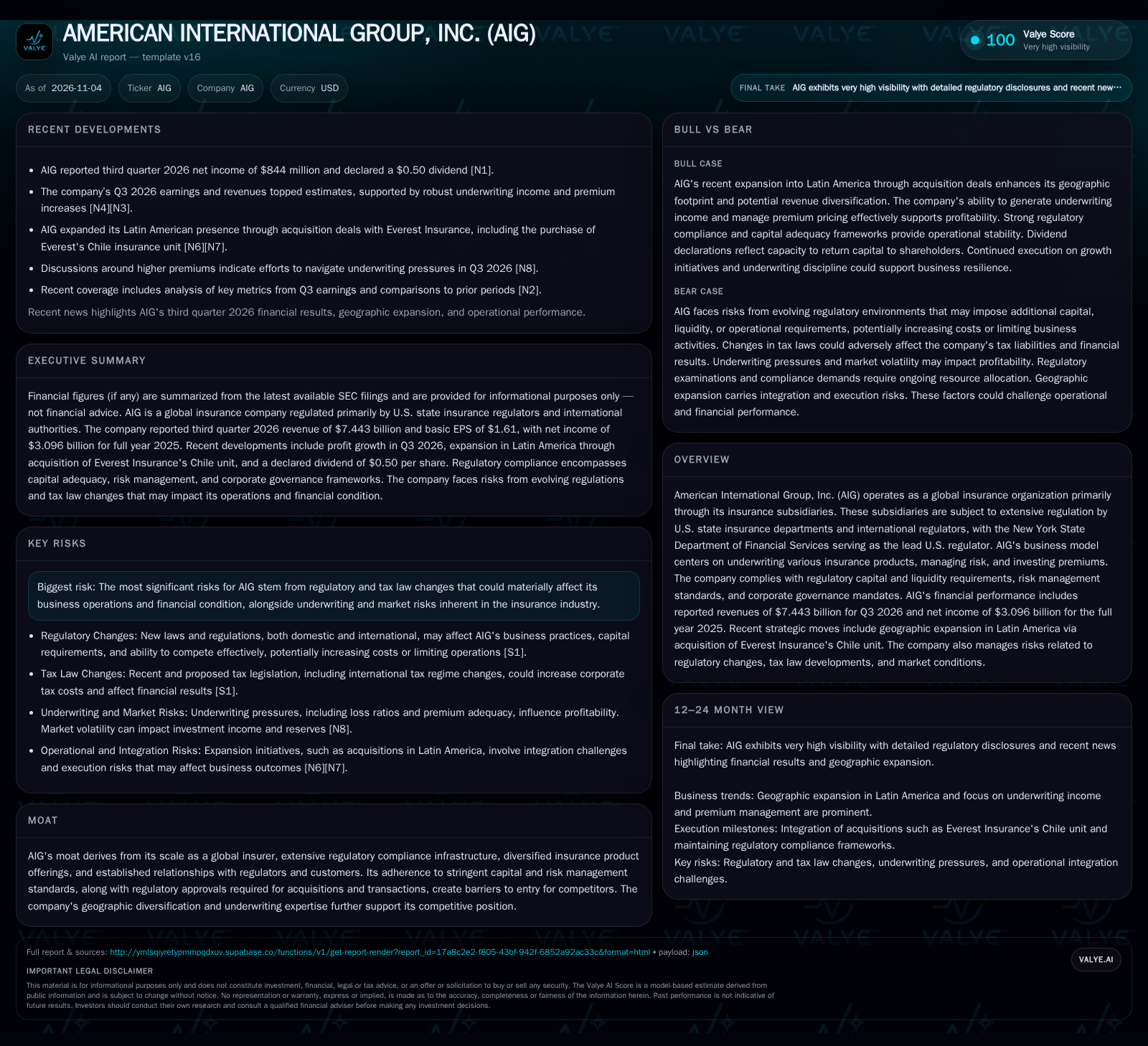
AIG reported Q3 2026 net income of $844 million and revenues of $7.443 billion, exceeding estimates through higher underwriting income and premium increases. The company is navigating a CEO change, continued regulatory complexity, and expansion in Latin America. Its ability to manage underwriting risk and respond to evolving tax and regulatory environments will shape its future profitability and capital allocation decisions. [S2] [N1] [N3] [N4] [N8]
American International Group (AIG) enters late 2026 with rising revenues, strong underwriting performance, and an active expansion agenda, even as it navigates a complex regulatory environment and leadership transition. The company’s Q3 results, which beat estimates on both top and bottom lines, underscore the importance of disciplined premium pricing and risk management to sustaining profitability. Meanwhile, AIG’s acquisition of Everest Insurance’s Chile unit and new CEO appointment highlight a period of strategic change. The central challenge going forward will be AIG’s ability to adapt its operating model and capital management practices in response to evolving regulatory, tax, and market dynamics.
Recent Results Signal Underwriting and Premium Momentum
AIG reported $7.443 billion in revenue and $844 million in net income for Q3 2026, with both figures exceeding analyst expectations. This performance was underpinned by improved underwriting income and premium growth, indicating the company’s ability to raise prices and manage risk in its core insurance lines. The cited source reports dividend-related activity; that disclosure alone does not establish dividend-policy continuity, management confidence, or a material constraint on capital flexibility. These results arrive amid a CEO transition, with Eric Andersen stepping in and Peter Zaffino moving to Executive Chair, and as AIG integrates new operations in Latin America following the Everest Insurance Chile acquisition. This combination of financial outperformance, leadership change, and geographic expansion sets the stage for a period of both opportunity and heightened execution risk. [S2] [N1] [N3] [N4] [N6] [N7] [N8]
How AIG’s Profitability Relies on Underwriting Discipline and Risk Capital
AIG’s core business model is built on collecting insurance premiums, investing float, and managing claims payouts—where profitability hinges on underwriting discipline and investment returns. The ability to price risk correctly (premium adequacy) and control loss ratios directly drive operating margins. Fixed costs include regulatory compliance, technology, and distribution, while variable costs are largely claims and commissions. The company’s large scale offers some fixed-cost leverage, but regulatory capital requirements impose a floor on capital efficiency, especially as product mix shifts or expansion occurs.
The economics of expansion into new markets, such as Latin America, depend on local loss ratios, competitive pricing, and regulatory capital rules, which may differ from the U.S. context. Premium increases, as seen in Q3 2026, can offset loss trends but risk customer churn if not matched by market-wide pricing. AIG’s capacity to generate investment income from its float is sensitive to interest rate environments and portfolio allocation, but underwriting results remain the primary driver of near-term profitability. The cited source reports dividend-related activity; that disclosure alone does not establish dividend-policy continuity, management confidence, or a material constraint on capital flexibility.
Barriers, Substitutes, and the Realities of Global Insurance Competition
AIG’s competitive position benefits from global scale, regulatory expertise, and a broad product portfolio spanning commercial and consumer insurance. Regulatory compliance itself is a barrier to entry, as is the company’s longstanding relationships with regulators and large corporate clients. However, these same factors can slow adaptation and add cost, especially as regulatory regimes evolve or diverge internationally.
Competitive threats come from other global multiline insurers, regional specialists, and increasingly from technology-driven entrants offering digital distribution or analytics-driven underwriting. In specialty and commercial lines, competition often centers on underwriting expertise and claims service, while in personal lines, price and distribution reach matter more. Substitutes such as alternative risk transfer vehicles and captive insurance programs may appeal to large clients if traditional premiums rise or coverage terms tighten. AIG’s ability to innovate in risk selection and customer engagement will determine whether it can defend margins as market conditions shift.
What Could Unlock Durable Margin Expansion for AIG
The most favorable scenario for AIG is one where underwriting discipline holds, premium increases are accepted across key markets, and loss ratios remain contained despite external shocks. Successful integration of the Chile acquisition would demonstrate geographic expansion can be accretive, especially if local operations quickly align with AIG’s risk management standards. If regulatory and tax changes are absorbed without major capital or cost burdens, AIG could see sustained earnings growth and increased capital return to shareholders.
Evidence that would confirm this scenario includes continued premium growth outpacing claims inflation, stable or improving combined ratios, positive regulatory feedback on capital adequacy, and smooth operational integration in Latin America. Rising investment income from a higher interest rate environment would be an incremental benefit, but the core test will be whether AIG can maintain underwriting profitability while expanding its footprint.
Sustained Execution Amid Regulatory and Market Complexity
The most plausible trajectory for AIG is continued modest growth in premiums and earnings, punctuated by periodic volatility from regulatory or market-driven shocks. The company is likely to manage underwriting profitability through selective pricing, reinsurance, and risk selection, but competitive pressure and evolving regulations will constrain margin expansion. The integration of new Latin American operations may deliver incremental growth, but will also bring execution and compliance risks.
This scenario would be confirmed by steady combined ratios near industry norms, incremental premium growth, and periodic regulatory or tax-driven adjustments to capital allocation. Falsifying evidence would include a sharp deterioration in loss ratios, regulatory sanctions, or integration setbacks that materially impact earnings.
How Regulatory Shocks or Underwriting Missteps Could Erode Value
A downside scenario would be triggered if regulatory or tax law changes significantly increase capital requirements, restrict product offerings, or impose new costs that cannot be offset through pricing. Similarly, if competitive dynamics force AIG to price below actuarial risk or if claims inflation outpaces premium growth, underwriting profitability could deteriorate. Operational missteps in integrating new businesses, particularly in unfamiliar regulatory environments, could further strain resources and erode earnings.
Confirming evidence for this scenario would include adverse regulatory findings, abrupt increases in required reserves or capital, a spike in loss ratios, or news of integration failures in Latin America that result in write-downs or loss of market share.
Milestones That Will Shape AIG’s Margin, Growth, and Adaptability Thesis
Quarterly changes in combined ratios and loss ratios—particularly whether underwriting profitability holds or erodes as premium increases are implemented.
Premium growth trends across major geographies, with a focus on Latin America post-acquisition; a useful metric would be disclosed premium and claims trends by region.
Regulatory capital adequacy disclosures, including any changes to required reserves or risk-based capital ratios following new laws or examinations.
Updates on integration progress and financial performance of the acquired Chile operations; management commentary or segment reporting would help test accretive growth.
Evidence of customer retention or churn as premium levels rise; disclosed retention rates or renewal pricing would clarify the impact of pricing actions.
Leadership strategy statements from new CEO Eric Andersen regarding risk appetite, geographic focus, and capital priorities.
Disclaimer: This is research-only, informational analysis and not investment advice. It may include AI-generated interpretation and general industry context. Always verify important details using primary sources.

Comments