
Nabors Industries in Late 2026: Technology-Driven Drilling, Contract Dynamics, and the Realities of Customer Concentration
Despite generating positive free cash flow and expanding internationally, Nabors Industries faces persistent profitability challenges and heavy reliance on major customers. The interplay between advanced drilling technology, contract structures, and commodity price volatility will determine whether its operational leverage translates into sustainable returns.
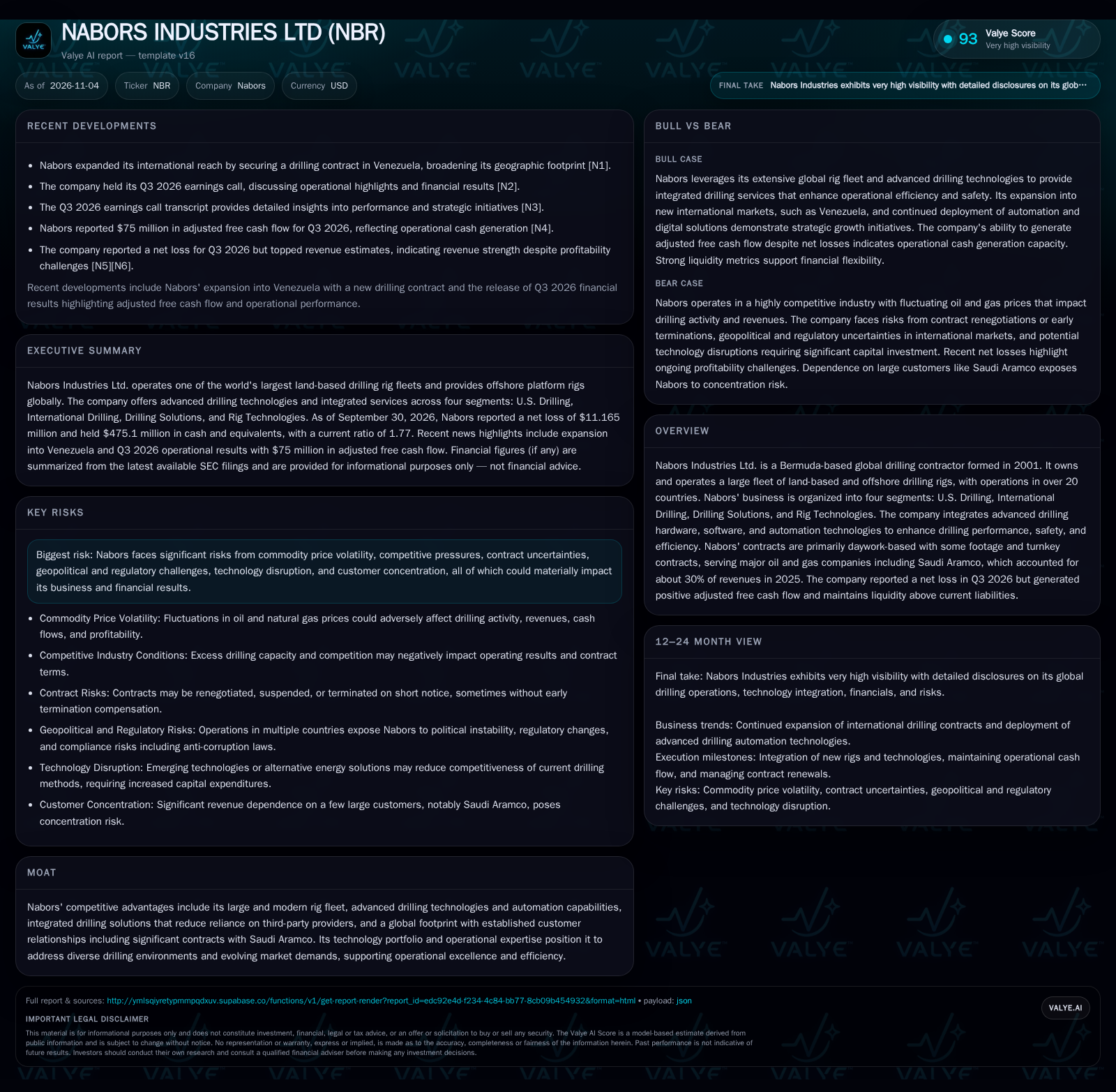
Nabors Industries reported a Q3 2026 net loss but delivered $75 million in adjusted free cash flow and expanded into Venezuela with a new drilling contract. However, with Saudi Aramco representing about 30% of revenue and ongoing exposure to oil price swings, Nabors’ long-term value depends on contract renewal, further technology adoption, and its ability to diversify revenue streams. [S1] [S2] [N1] [N4]
Nabors Industries, one of the world’s largest land-based drilling contractors, enters late 2026 balancing operational momentum with persistent strategic risks. While the company delivered positive free cash flow in Q3 and secured a notable contract in Venezuela, its net loss and heavy exposure to a single customer—Saudi Aramco—raise questions about the durability of its recovery. As Nabors leans on technology-driven efficiency gains and international diversification, the core challenge remains: can it convert operational scale and innovation into consistent profitability amid volatile commodity cycles and evolving energy economics?
Recent Performance and Expansion Shape the Near-Term Outlook
Nabors Industries reported a net loss of $11.165 million for Q3 2026, with basic and diluted EPS of -$1.24. In contrast, the company generated $75 million in adjusted free cash flow during the same period, signaling that operational cash generation remains intact even as GAAP profitability lags. [S2] [N4]
The company reported cash and liquidity metrics for the period; these figures do not by themselves establish operating runway, investment capacity, financial flexibility, or financing capacity. [S2]
Strategically, Nabors expanded its international presence through a new drilling contract in Venezuela, building on its established footprint in the Middle East and Latin America. [N1]
The company’s customer concentration remains high, with Saudi Aramco accounting for about 30% of 2025 revenue—a dynamic that amplifies both opportunity and risk. [S1]
Drilling Economics: Fixed Costs, Contract Structures, and the Leverage of Technology
Nabors’ business model is capital-intensive, with substantial fixed costs tied to its global fleet of 242 land rigs and 27 offshore platform rigs. The economics hinge on high utilization rates and the ability to secure favorable contract terms. Daywork contracts, which predominate, provide predictable daily rates but expose Nabors to downtime risk between contracts; footage and turnkey contracts introduce more variable exposure but can yield higher returns if managed efficiently. [S1]
Operating leverage is significant: incremental rig deployments or contract wins can rapidly improve margins, but idle rigs and contract gaps exert downward pressure. The company’s investment in automation and digital solutions—such as the PACE®-X Ultra rig and Rig Zone Robotics (RZR)—is designed to lower per-well costs, reduce labor intensity, and differentiate Nabors in bidding for new work.
Nabors’ ability to generate adjusted free cash flow despite reported net losses suggests that non-cash charges, interest, or amortization are prominent in its GAAP results. However, persistent net losses indicate that either depreciation, financing costs, or pricing pressure remain headwinds. The capital requirements for maintaining and upgrading the fleet, as well as for developing next-generation drilling technologies, are likely to remain high, reinforcing the need for ongoing operational cash generation and disciplined capital allocation.
Competitive Landscape: Technology, Scale, and the Challenge of Commoditization
Nabors’ global scale and technology integration set it apart from smaller drilling contractors and regional competitors. Its large fleet, automation capabilities, and integrated drilling solutions could increase switching costs for customers who value operational consistency and advanced performance metrics.
However, the industry remains highly competitive and cyclical, with excess capacity often putting pressure on day rates and contract terms. Customers—including major oil companies and national oil companies—are price-sensitive and frequently rebid contracts. Nabors’ emphasis on digital drilling solutions and proprietary rig technologies may provide a modest moat, but these advantages can erode as competitors adopt similar capabilities or as operators internalize more technology.
Customer concentration, particularly the reliance on Saudi Aramco, creates both bargaining power for the customer and heightened revenue volatility should contracts be lost or renegotiated. The entry into Venezuela signals an effort to diversify, but success will depend on sustained contract flow and geopolitical stability.
How Sustained Technology Adoption and International Growth Could Drive Margin Expansion
A favorable scenario would see Nabors leverage its technology platform to win higher-margin contracts, achieve premium day rates, and drive higher rig utilization across both core and new geographies. Continued adoption of automation and digital solutions could reduce operating costs and improve safety metrics, making Nabors a preferred partner for complex drilling projects.
Expansion into Venezuela and other underserved markets could provide incremental revenue streams and reduce dependence on a handful of large customers. If oil prices remain supportive, increased drilling activity could lift utilization, improve pricing, and strengthen cash flow.
Confirmation of this scenario would come from sequential improvement in GAAP profitability, new multi-year contract awards in growth markets, rising utilization rates, and evidence of pricing power attributed to proprietary technology. Falsification would occur if utilization stagnates, contract wins remain limited to legacy markets, or if cost savings from technology adoption fail to materialize.
Operational Stability with Margin Pressures and Concentration Risks Persisting
The most plausible near-term path is one where Nabors sustains cash flow generation and maintains liquidity, but continues to post modest or negative net income due to structural headwinds. Utilization rates may recover gradually, but pricing competition and customer concentration—especially exposure to Saudi Aramco—keep margins under pressure.
Incremental gains from technology adoption and international expansion are likely offset by persistent volatility in oil prices and ongoing capital requirements. This scenario would be confirmed by stable or modestly rising free cash flow, continued contract renewals with major customers, and incremental international wins, but no material shift in overall profitability metrics.
Evidence against the base case would include a sharp rebound in oil prices driving a surge in new contracts and margin improvement, or, conversely, a major contract loss or geopolitical event disrupting revenue streams and utilization.
Commodity Downturn or Contract Losses Could Expose Structural Weakness
A negative scenario unfolds if oil prices decline sharply or if Nabors loses key contracts—particularly with Saudi Aramco or other major customers. Underutilization of rigs would quickly erode operational leverage, while fixed costs remain high, potentially resulting in deeper net losses and cash burn.
Political or regulatory disruptions in international markets such as Venezuela could further limit revenue diversification and expose Nabors to asset write-downs or contract terminations. Technology adoption, while promising, may not offset cyclical pressures if customers delay drilling programs or switch to lower-cost alternatives.
Confirmation of this scenario would include declining free cash flow, a deterioration in the current ratio, increased disclosures of contract suspensions or terminations, and reduced visibility on forward contract coverage. Falsification would require evidence of contract stability, robust utilization, or a rapid recovery in drilling activity even amid commodity weakness.
Factors That Will Define Nabors’ Ability to Convert Scale into Sustainable Returns
Quarterly rig utilization rates—by segment and geography—would help test whether Nabors is capturing incremental activity or losing ground to competitors (if disclosed).
The proportion of revenue from top customers, especially Saudi Aramco, and any changes in contract duration or terms would clarify concentration risk and renewal dynamics.
Sequential trends in adjusted free cash flow versus GAAP net income will reveal if operational cash generation can consistently outpace accounting losses.
Disclosures on technology-driven cost savings, operational incidents, or customer adoption of proprietary automation platforms would indicate the tangible value of Nabors’ innovation push.
Updates on international contract awards, particularly in Venezuela and other new markets, will show whether diversification efforts are gaining traction.
Management commentary on competitive pricing trends, rig reactivations, and capital allocation priorities would provide leading indicators for future margin trajectories.
External developments in oil and gas prices, regulatory frameworks, or geopolitical stability in key regions should be monitored as macro-level drivers of drilling demand.
Disclaimer: This is research-only, informational analysis and not investment advice. It may include AI-generated interpretation and general industry context. Always verify important details using primary sources.

Comments