
UFP Industries in Late 2026: Customer Concentration, Lumber Price Volatility, and the Stakes of Strategic Adaptation
UFP Industries confronts a complex landscape marked by heavy reliance on major retail partners, persistent lumber price swings, and the operational demands of scaling through acquisitions and technology integration. The company’s financial resilience and strategic moves underscore both its strengths and its exposure to cyclical and structural risks.
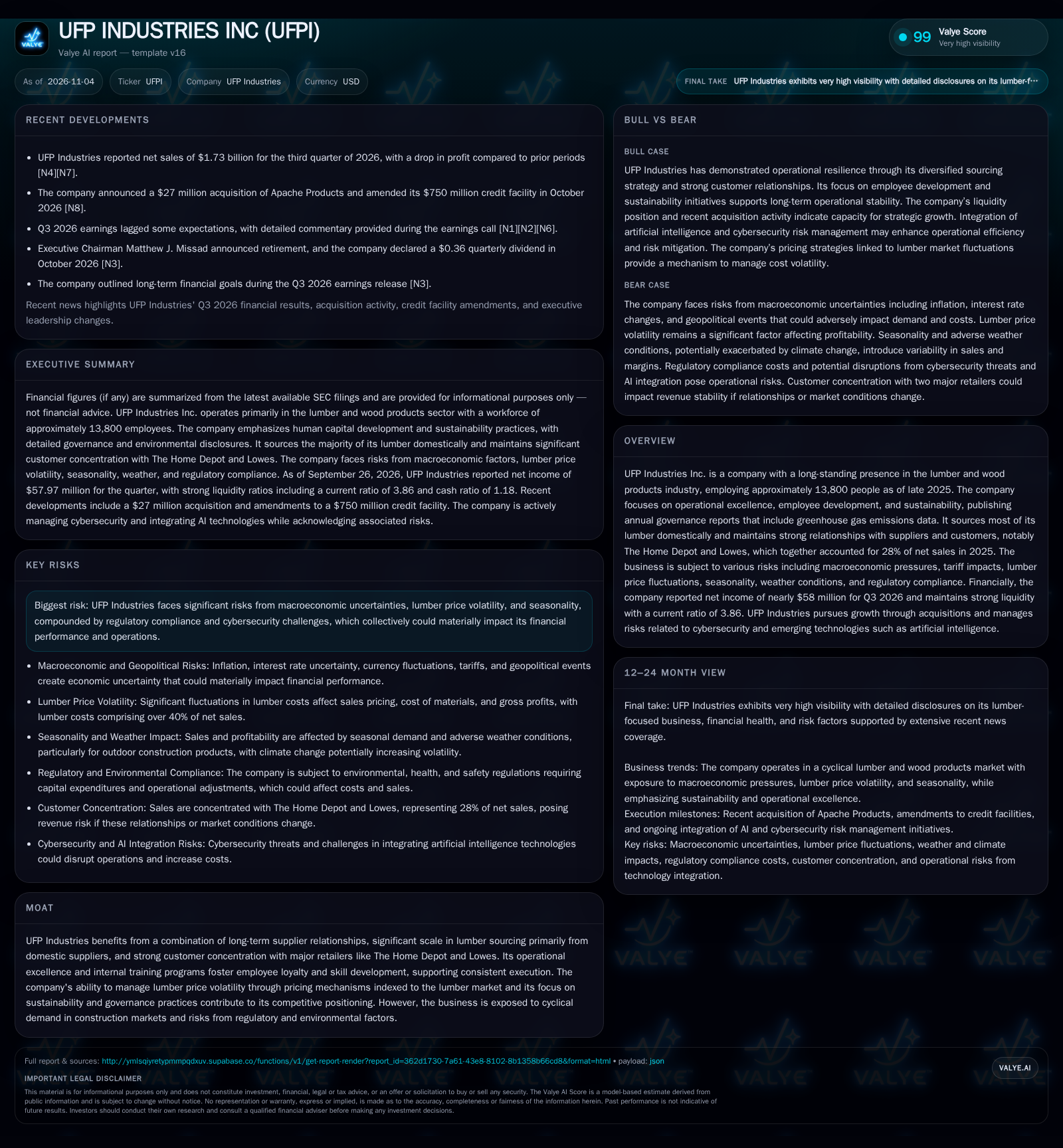
UFP Industries’ Q3 2026 results reveal a business at the intersection of opportunity and risk. With 28% of sales tied to The Home Depot and Lowes, and lumber costs comprising over 40% of net sales, the company’s fortunes are closely linked to both retail channel health and commodity market dynamics. [S2] [N3] [N4] [N8]
UFP Industries enters late 2026 navigating the dual challenges of concentrated retail exposure and persistent lumber price volatility. With a sizable portion of sales anchored to The Home Depot and Lowes, and margins pressured by commodity swings, the company’s performance is shaped by factors largely outside its direct control. [S2] [N4] [N8]
Recent Performance and Strategic Positioning: What Q3 2026 Reveals
UFP Industries reported net sales of $1.73 billion in the third quarter of 2026, accompanied by a net income of $57.97 million and basic and diluted EPS of $1.05. Despite strong top-line results, profit declined year-over-year and earnings trailed some analyst estimates, reflecting the ongoing impact of fluctuating lumber prices and cost pressures. [N4] [N7] [S2]
Customer concentration remains pronounced, with The Home Depot and Lowes collectively accounting for 28% of net sales in 2025. This dependence on a limited number of large retail partners amplifies revenue risk should these relationships weaken or channel dynamics shift. [S2]
Lumber costs comprised 41.6% of net sales in 2025, making the company’s margin structure highly sensitive to commodity price swings. [S2]
Growth initiatives continued with the $27 million acquisition of Apache Products and an amendment to the company’s $750 million credit facility in October 2026, indicating a willingness to deploy capital for expansion. [N8]
How Volatile Inputs and Channel Structures Shape UFP’s Earnings Power
UFP Industries’ business model is fundamentally tied to the economics of lumber and value-added wood products, with revenue recognized primarily at shipment and some construction contracts recognized over time. The company’s cost structure is dominated by lumber, which comprised 41.6% of net sales in 2025, and transportation, representing 9.5%. This leaves gross margins acutely exposed to input cost swings and freight volatility. [S2]
Pricing mechanisms are often indexed to lumber market prices, allowing UFP to adjust output prices in response to commodity changes. However, these adjustments can lag or fail to fully offset rapid cost movements, introducing earnings volatility—especially when lumber prices decline faster than the company can adjust its cost base or inventory positions.
The company’s high customer concentration with large retailers likely drives volume stability but constrains pricing flexibility, as major buyers wield significant negotiating power. This dynamic can compress margins if UFP cannot pass through cost increases or if competitive pressure intensifies.
Capital needs are moderate for a materials distributor and value-added producer, but periodic investments are required for compliance, technology upgrades, and capacity additions. The company reported cash and liquidity metrics for the period; these figures do not by themselves establish operating runway, investment capacity, financial flexibility, or financing capacity. [S2] [N8]
Assessing UFP’s Edge: Scale, Relationships, and the Limits of Differentiation
UFP Industries benefits from scale in procurement and distribution, leveraging long-term relationships with domestic and Canadian lumber suppliers for 95% of its raw material needs. This provides some insulation against global supply shocks and positions the company as a reliable partner for large retail chains. [S2]
Customer relationships with The Home Depot and Lowes underpin volume stability and access to the DIY and pro construction markets, but they also create a revenue concentration risk. If either customer shifts sourcing strategies or private-label penetration increases, UFP could see meaningful revenue disruption.
The company’s operational excellence and internal training programs are intended to foster employee loyalty and execution consistency, contributing to service reliability in a fragmented industry. However, true differentiation in wood products is limited by the commoditized nature of core offerings; UFP’s ability to add value through proprietary products, installation services, or supply chain innovation is crucial to defending margins.
Competition comes from other large lumber distributors, vertically integrated building products firms, and regional suppliers. Substitution risk exists from alternative materials (such as composites or steel) in certain end markets, especially as sustainability preferences evolve and regulatory standards tighten.
Pathways to Margin Expansion: Leveraging Scale, Technology, and Product Mix
The most favorable scenario for UFP Industries involves a combination of stable or rising lumber prices, robust residential and commercial construction activity, and effective execution on technology and acquisition integration. In this environment, indexed pricing contracts would allow the company to pass through higher input costs, while volume growth from key retail partners and new product introductions would drive incremental margin gains.
Successful integration of Apache Products and other bolt-on acquisitions could expand UFP’s value-added product offerings—potentially boosting gross margins and reducing reliance on pure commodity sales. If AI-driven supply chain and manufacturing optimizations deliver measurable cost savings or inventory efficiencies, operating leverage could further improve.
Confirmation of this scenario would include sustained revenue and margin growth above industry averages, a declining share of commodity lumber in the sales mix, rising contributions from proprietary or branded products, and evidence of cost reduction from technology initiatives. Continued reported liquidity position and prudent capital allocation would reinforce the case.
Falsification would occur if gross margins remain stagnant despite favorable market conditions, technology investments fail to yield operational gains, or acquisitions do not enhance profitability or product breadth.
Navigating Cyclicality: Managing Volatility and Incremental Growth
The most plausible outlook is for UFP Industries to experience continued earnings volatility in line with lumber price movements and construction market cycles. Customer concentration will remain a structural reality, with volumes closely tied to the health of The Home Depot, Lowes, and the broader DIY/pro channel.
Margins are likely to fluctuate within a historical band as the company passes through some, but not all, input cost changes. Incremental growth may come from selective acquisitions and gradual adoption of technology-driven efficiencies, but these are unlikely to fully offset the industry’s inherent cyclicality in the near term.
This scenario would be confirmed by continued top-line growth in line with end-market demand, relatively stable gross margins, and manageable swings in net income. Falsification would involve a sustained loss of major customers, significant margin erosion, or failure to integrate acquisitions and technology initiatives.
When Concentration and Cost Volatility Collide: Risks to Revenue and Profitability
A negative scenario would involve a combination of sharp lumber price declines, weakening demand in housing or commercial construction, and a deterioration in relationships with major retail customers. In this case, UFP’s cost structure could become mismatched to revenue, compressing margins and exposing the company to earnings shocks.
If The Home Depot or Lowes were to reduce order volumes, shift to alternative suppliers, or increase private-label penetration, UFP could face abrupt revenue losses that are difficult to replace quickly. Simultaneously, if input costs do not fall in tandem with selling prices, or if inventory is written down, gross profit could be further squeezed.
Additional risks stem from failed acquisition integrations, operational disruptions from technology rollouts (such as AI or cybersecurity failures), and regulatory or compliance cost spikes—any of which could erode profitability or trigger unexpected capital needs.
Evidence of this scenario would include a marked decline in net sales or gross margin, rising bad debt expenses, or negative cash flow from operations. Confirmation would also come from customer or supplier contract losses, material inventory write-downs, or publicized operational disruptions.
What Will Test UFP Industries’ Strategic Resilience in 2027 and Beyond?
Quarterly gross margin trends, especially relative to lumber price movements and the mix of value-added versus commodity product sales.
Proportion of net sales attributable to The Home Depot and Lowes—if disclosed, any shift in customer concentration would signal changing channel dynamics.
Integration progress and financial contribution from Apache Products and any other acquisitions—measured by margin accretion, revenue synergies, or cost savings.
Evidence of operational cost reductions or supply chain efficiencies linked to AI and technology initiatives—if disclosed, quantified savings or productivity gains would be instructive.
Bad debt expense as a percentage of net sales—an uptick could indicate emerging credit risk or customer distress.
Capital expenditure levels and allocation, particularly for compliance, technology upgrades, and capacity expansion.
Incidence and impact of weather-related or climate-driven disruptions on sales volumes and profitability, especially in outdoor construction markets.
Material cybersecurity or regulatory events—public disclosures of breaches, compliance actions, or unplanned costs would be significant.
Disclaimer: This is research-only, informational analysis and not investment advice. It may include AI-generated interpretation and general industry context. Always verify important details using primary sources.

Comments