
SelectQuote’s High-Stakes Pivot: AI Investment, Healthcare Expansion, and the Realities of Insurance Distribution Economics
SelectQuote is doubling down on AI-driven efficiency and healthcare services as it seeks to offset persistent net losses and margin pressure in a competitive insurance distribution market. Its future depends on executing this strategic shift, managing cash flow, and proving that technology and service breadth can deliver durable returns.
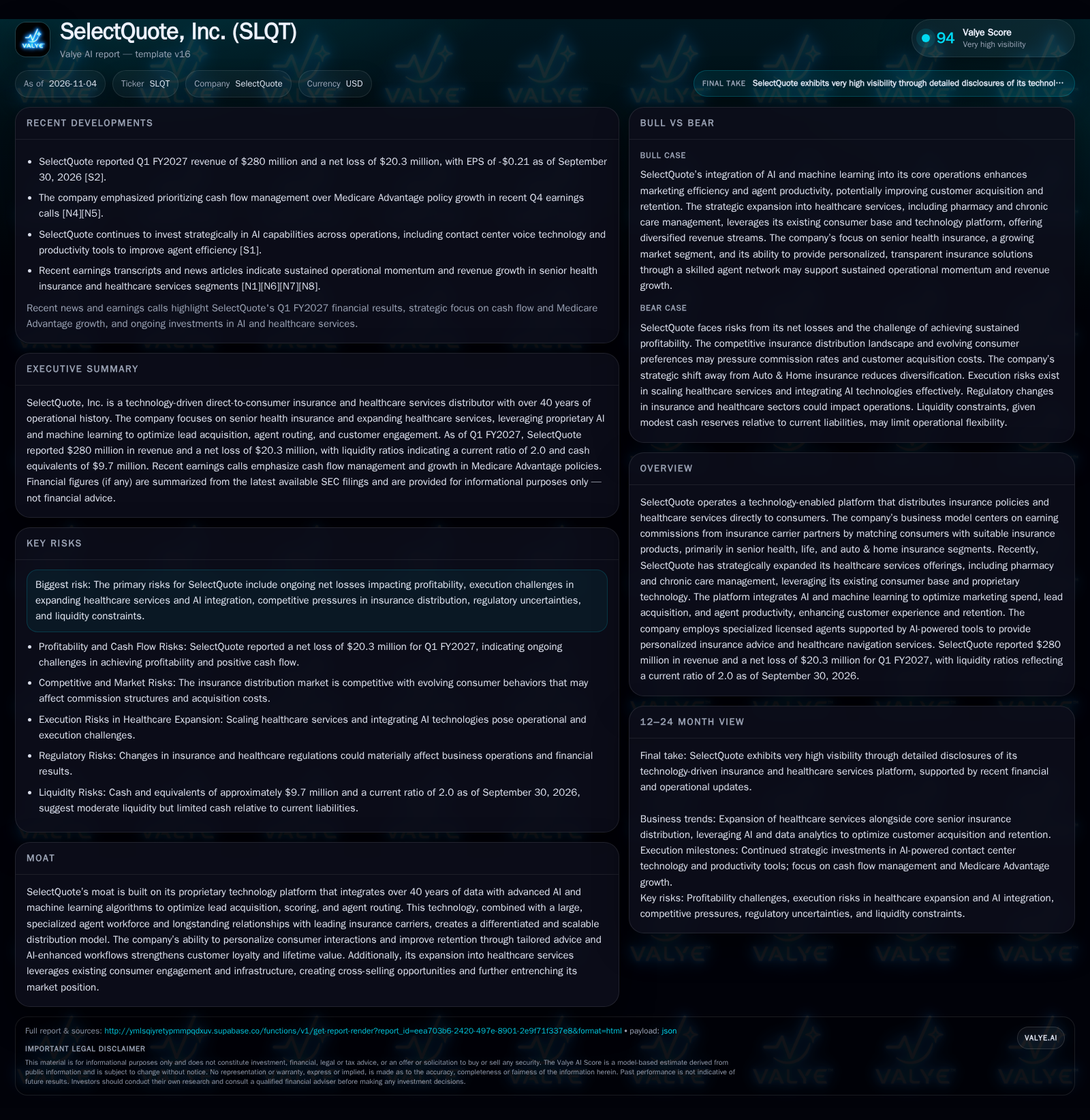
SelectQuote, Inc. reported $280 million in Q1 FY2027 revenue but remains unprofitable, posting a $20.3 million net loss. The company is prioritizing cash flow management and investing heavily in AI and healthcare services, especially for seniors. Its platform-driven approach and experienced agent network support its ambitions, but competition and execution risks remain high. The path to profitability hinges on successfully scaling healthcare offerings and turning technology investments into sustainable margin gains. [S1] [S2] [N4] [N6]
SelectQuote stands at a strategic crossroads, reporting top-line growth but still struggling with persistent net losses. The company’s aggressive push into AI-powered operations and healthcare services aims to generate new revenue streams and improve efficiency, but the transition comes with substantial execution and market risks. As the insurance distribution landscape becomes more competitive and margin-sensitive, SelectQuote’s ability to turn technology and healthcare bets into sustainable profitability will define its next chapter.
Recent Financials and Strategic Priorities Define the Near-Term Outlook
SelectQuote reported $280 million in revenue and a net loss of $20.3 million for Q1 FY2027, with basic and diluted EPS of -$0.21 as of September 30, 2026 [S2]. This underscores that while the company is delivering top-line momentum, profitability remains elusive. Management has signaled a shift in operational priorities, emphasizing cash flow management over pure Medicare Advantage (MA) policy growth in recent earnings calls [N4] [N5]. The company continues to invest in AI and healthcare services expansion, particularly in senior health and pharmacy services, while de-emphasizing Auto & Home insurance [S1]. [S2]
Commission-Driven Revenue Model Faces Margin and Scale Pressure
SelectQuote’s core business model is that of an insurance distributor, earning commissions from carrier partners for policies sold, without taking underwriting risk [S1]. This model is attractive for its asset-light nature, but commission rates are set by insurance carriers and can be pressured by competition or regulatory changes. The company’s revenue is highly sensitive to policy volume and product mix, with Medicare Advantage, Medicare Supplement, and prescription drug plans representing the bulk of senior health commissions.
AI and machine learning are leveraged to optimize marketing spend, lead acquisition, and agent productivity, which could improve customer acquisition cost (CAC) and agent efficiency if execution is strong. However, fixed costs—including technology investment, agent training, and compliance—are significant, and operating leverage is only realized if volume grows faster than these expenses.
The recent expansion into healthcare services (e.g., SelectRx pharmacy, SelectPatient Management) is intended to add recurring, higher-margin service revenue, but these businesses require upfront investment and have different capital and regulatory profiles than pure insurance distribution.
The sensitivity of SelectQuote’s revenue to policy mix underscores the importance of product portfolio management in navigating margin pressures. For instance, Medicare Advantage policies typically offer higher commissions but also come with increased regulatory scrutiny and potential volatility from policy churn or changes in government reimbursement rates. Conversely, Medicare Supplement and prescription drug plans might yield lower commissions but provide more stable, recurring revenue streams. Therefore, the company’s ability to strategically balance these products, aligning sales incentives and marketing focus accordingly, will be critical to sustaining revenue growth without sacrificing margin stability. Additionally, the interplay between volume growth and fixed cost absorption means that SelectQuote must carefully calibrate its investment pace in technology and agent capacity to avoid margin dilution during scale-up phases.
Technology, Data, and Agent Network: Differentiators or Commodities?
SelectQuote claims a defensible position through its proprietary technology platform, which integrates four decades of customer and transaction data with advanced AI to optimize lead scoring, agent routing, and customer relationship management [S1]. This could, in theory, can support customer engagement; company-specific conversion rates are not disclosed and lower CAC than traditional or less tech-enabled rivals.
The company’s large, specialized agent workforce—supported by AI-powered contact center tools—enables personalized advice and potentially higher customer retention. However, barriers to entry in insurance distribution are not insurmountable: competitors range from other DTC digital brokers to captive agency models and even emerging insurtech platforms.
The strategic move away from Auto & Home reduces diversification but could allow deeper focus on senior health and healthcare services, where SelectQuote may leverage its existing consumer base for cross-selling. Still, as digital distribution and AI become table stakes across the sector, the question is whether SelectQuote’s technology leads to durable cost or retention advantages, or if these tools are increasingly commoditized.
From a competitive standpoint, the durability of SelectQuote’s technology advantage depends heavily on continuous innovation and data quality. While the integration of decades of customer data can enhance AI models, competitors with access to alternative data sources or more agile development cycles might erode this edge over time. Moreover, the agent network’s value proposition relies on effective training and retention strategies, as high turnover or skill gaps could diminish the personalized service that differentiates SelectQuote from fully digital or captive agency models. The strategic narrowing of focus toward senior health and healthcare services could improve specialization but also concentrates risk, making the company more vulnerable to shifts in regulatory frameworks or competitive dynamics within these segments. Thus, the sustainability of these differentiators will require ongoing investment and adaptive management to maintain relative advantage.
AI-Enabled Healthcare Expansion Drives Profitability and Share Gains
The most favorable scenario is that SelectQuote’s investments in AI and healthcare services deliver significant improvements in marketing efficiency and agent productivity, lowering CAC and boosting policy conversion rates. If the healthcare services platform—especially pharmacy and chronic care management—scales successfully, the company could capture higher-margin recurring revenue streams and deepen customer engagement.
This would be confirmed by sustained double-digit revenue growth accompanied by narrowing net losses or a transition to profitability, as well as evidence of rising customer lifetime value (LTV) and improved cash flow from operations. Additional confirmation would come from increased policy cross-sell rates, higher agent productivity metrics (if disclosed), and successful expansion of the SelectRx and SPM platforms.
Operational Discipline and Incremental Healthcare Growth Offset Margin Pressure
The most plausible outcome is that SelectQuote continues to grow revenue in its senior health and healthcare service segments, but margin improvement is gradual and dependent on disciplined cost control. AI and technology investments yield modest gains in agent productivity and marketing efficiency but are largely matched by competitors over time.
Net losses persist in the near term, but cash flow management keeps the company solvent and able to invest incrementally in healthcare expansion. Revenue growth remains in the high single digits or low double digits, while policy volume and product mix fluctuate with industry trends and regulatory changes.
Evidence supporting this scenario would include stable or slowly improving loss metrics, continued prioritization of cash flow on earnings calls, and measured expansion in healthcare services without major overextension or capital stress.
Execution Stumbles and Margin Compression Threaten Viability
A more adverse scenario unfolds if SelectQuote’s AI and healthcare initiatives fail to deliver the anticipated efficiency or revenue uplift. If customer acquisition costs rise due to competitive bidding for leads, or if commission rates are pressured by carriers, operating leverage could work against the company, deepening net losses.
Regulatory changes in Medicare or pharmacy services, or execution missteps in scaling healthcare offerings, could further strain resources and limit growth options.
Confirmation of this scenario would include accelerating net losses, declining or stagnant revenue, deteriorating liquidity ratios, and management signaling the need for external capital or retrenchment in strategic initiatives.
Benchmarks for Testing SelectQuote’s Shift Toward Tech-Enabled Healthcare Distribution
Sustained improvement or deterioration in net loss and operating cash flow, especially relative to revenue growth, will reveal whether technology and healthcare bets are paying off.
Disclosure of agent productivity metrics (e.g., policies sold per agent, conversion rates) would clarify the impact of AI and workflow optimization.
Growth rates and margin contribution from healthcare services (SelectRx, SPM) versus insurance distribution would show whether the new segments are scaling and profitable.
Any material changes in customer lifetime value (LTV) or customer retention rates, if disclosed, would help test whether cross-selling and deeper engagement are being achieved.
Updates on cash and liquidity, especially in the context of capital needs for healthcare expansion or technology investment, will be essential for assessing near-term resilience.
Shifts in commission structures or carrier relationships, particularly in Medicare Advantage and prescription drug plans, could materially affect revenue and margin.
Regulatory developments in Medicare, pharmacy services, or DTC insurance distribution may impact compliance costs, addressable market, or business model viability.
Competitive developments—such as new digital entrants, insurtech M&A, or changes in carrier direct-to-consumer strategies—may alter the economics of lead acquisition and distribution.
Disclaimer: This is research-only, informational analysis and not investment advice. It may include AI-generated interpretation and general industry context. Always verify important details using primary sources.

Comments