
UNIFI in Late 2026: Recycled Fiber Expansion, Operational Reset, and the Stakes of Margin Recovery
UNIFI’s operational improvements and real estate-driven deleveraging provide a foundation for renewed focus on its REPREVE recycled fiber brand. The challenge remains: can innovation and sustainability offset persistent demand volatility and margin pressures across global textile markets?
UNIFI has strengthened its balance sheet through real estate sales and debt repayment, while its REPREVE recycled fiber brand now constitutes a significant portion of sales. Despite cost reductions and operational gains, the company continues to face net losses amid weak demand and competitive pressures, particularly in Brazil and Asia. The next phase hinges on whether sustainability-led product strategy and disciplined capital allocation can translate into durable margin recovery and growth.
UNIFI, a veteran producer of recycled and synthetic yarns, is at a critical inflection point. Recent moves—like a substantial real estate sale and debt repayment—have bolstered the balance sheet, while the REPREVE brand’s growing share signals that sustainability is no longer a niche play but a core commercial pillar. Still, the company is not out of the woods: net losses persist, and global textile demand remains uneven. The central question is whether UNIFI’s operational reset and environmental positioning can drive sustained margin improvement, or if competitive and macroeconomic headwinds will continue to constrain its potential.
Recent Actions Reshape Financial Foundations and Strategic Focus
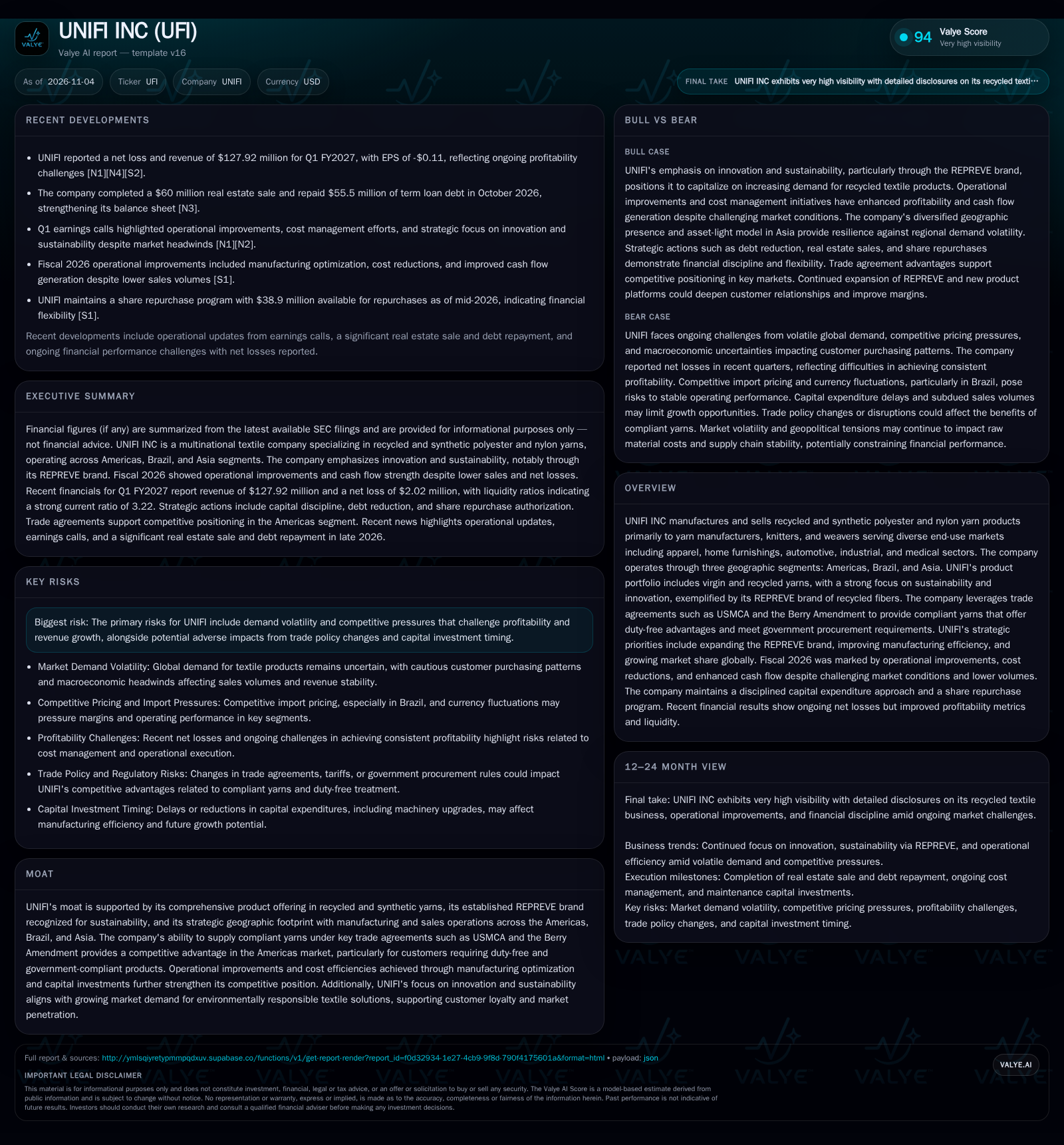
UNIFI’s most material recent developments are: (1) the completion of a $60 million real estate sale and repayment of a $55.5 million term loan in October 2026 [N3], (2) the continued net losses with Q1 FY2027 showing a $2.02 million loss on $127.92 million revenue [S2], and (3) the increasing importance of REPREVE recycled fiber products, now representing roughly 30% of consolidated net sales [S1]. The company reported cash and liquidity metrics for the period; these figures do not by themselves establish operating runway, investment capacity, financial flexibility, or financing capacity. However, persistent net losses underscore that operational improvements have not yet fully overcome pricing and volume headwinds. The REPREVE brand’s prominence demonstrates that sustainability has become central to UNIFI’s value proposition and may be a lever for future growth if demand for recycled products continues to accelerate.
How UNIFI’s Model Converts Sustainability into Cash Flow—And Where Frictions Remain
UNIFI generates revenue by selling virgin and recycled polyester and nylon yarns to intermediate manufacturers in apparel, home furnishings, automotive, and industrial markets [S1]. The economics of recycled yarns, such as those under the REPREVE brand, often entail higher input costs (due to sorting, cleaning, and reprocessing of waste streams) but command premium pricing from sustainability-focused customers. However, premium realization is not guaranteed and can be cyclical, as buyers may trade down to virgin products in weak demand environments or when cost pressures mount.
Fixed costs are significant, particularly in the Americas segment where manufacturing scale and capital intensity drive gross margin sensitivity to volume swings. UNIFI’s recent cost reductions and manufacturing optimization have returned the Americas segment to positive gross profit—even with lower sales—demonstrating operating leverage when volumes stabilize or grow [S1]. The asset-light Asia segment, by contrast, reduces fixed-cost burden but leaves UNIFI more exposed to margin compression from both weak demand and competitive import pricing.
Capital expenditures are currently limited to routine maintenance, with prior investments in efficient texturing machinery delayed due to subdued demand [S1]. This capital-light stance preserves liquidity but may limit future productivity gains if demand recovers. The company’s share repurchase authorization signals willingness to return capital, but actual deployment will likely depend on sustained operating cash flow improvement.
UNIFI’s Moat: Regulatory Tailwinds, Brand Equity, and the Threat of Commodity Substitution
UNIFI’s competitive positioning is anchored on several pillars: (1) the REPREVE brand, which has achieved recognition among brands and retailers seeking to demonstrate progress on sustainability, (2) the ability to supply compliant yarns that benefit from trade agreements like USMCA and the Berry Amendment—providing duty-free or government-preferred status for about half of Americas segment sales [S1], and (3) a diversified geographic footprint with manufacturing and sourcing across the Americas, Brazil, and Asia.
However, these advantages face significant counterforces. In Brazil, competitive import pricing and currency fluctuations pressure margins and may erode local market share [S1]. Globally, recycled yarns compete not just with other recycled suppliers but with lower-cost virgin alternatives, especially when end customers are price-sensitive. While the REPREVE brand may help UNIFI win share with sustainability-driven buyers, the broader textile market remains highly fragmented and competitive, with switching costs for intermediate yarns generally low unless locked in by regulatory or procurement requirements.
If Sustainability Premiums Hold, Margin Expansion Could Follow
A favorable scenario for UNIFI is predicated on (1) accelerating demand for recycled and sustainable yarns, with the REPREVE brand capturing outsized share, (2) continued realization of cost efficiencies in manufacturing, and (3) stable or rising volumes in core end-markets as macroeconomic conditions improve. In this scenario, UNIFI could achieve durable gross margin expansion—particularly in the Americas—by leveraging its regulatory advantages and price premiums for compliant, sustainable products.
Confirmation would come from sustained growth in REPREVE’s share of consolidated sales, stabilization or increase in total volumes, and a return to consistent operating profitability (not just gross profit but net income). Additional evidence would be customer wins or contract extensions with major apparel or automotive brands prioritizing recycled content, as well as resumed capital investment in productivity-enhancing technologies. Falsification would be signaled by stagnation in REPREVE growth, continued net losses, or evidence that customers are unwilling to pay a premium for sustainable yarns in a weak market.
What Stable Demand and Disciplined Execution Likely Mean for UNIFI
The most plausible scenario is one in which global demand for textile products remains subdued but stable, with UNIFI maintaining its market share in core segments. Operational improvements and cost discipline enable the company to generate positive gross profit, particularly in the Americas, but net income remains volatile and sensitive to swings in volumes and input costs. The REPREVE brand continues to represent a substantial portion of sales, but incremental growth is gradual rather than explosive.
Confirming evidence would be quarterly results showing persistent, if modest, profitability at the gross margin level, stable or slowly increasing cash flow generation, and continued prudent capital allocation. Falsification would involve renewed operating losses, shrinking REPREVE contribution, or evidence that cost savings are being offset by ongoing pricing or volume declines.
Margin Compression Risks If Macroeconomic and Competitive Headwinds Persist
The adverse scenario is one in which global textile demand contracts further, competitive pricing (especially from imports in Brazil and Asia) intensifies, and the sustainability premium for recycled yarns erodes. In this environment, UNIFI’s fixed-cost leverage becomes a liability: lower volumes drive gross margins negative, and continued net losses force further cost cuts or asset sales.
This scenario would be confirmed by declining consolidated revenues, shrinking gross margins (especially in the Americas), and an inability to grow REPREVE’s share or pricing premium. Signs of distress would include new asset sales beyond the recent real estate transaction, reductions in workforce or manufacturing footprint, or suspension of the share repurchase program due to liquidity needs.
Milestones That Will Determine Whether UNIFI’s Sustainability Thesis Holds
Quarterly evolution of REPREVE’s share of consolidated net sales—continued growth would support the premiumization thesis; stagnation or decline would raise doubts.
Gross margin trends in the Americas and Brazil segments, as these are most sensitive to volume and import pricing pressures.
Total sales volumes and volume mix between recycled and virgin yarns—if disclosed.
Progress on customer wins or contract extensions with major brands in apparel, automotive, or home furnishings.
Net income and operating cash flow trends, especially evidence of a return to sustainable profitability.
Deployment or suspension of the share repurchase program, which would signal management’s confidence in medium-term cash flow generation.
Capital expenditure levels and the timing of resuming deferred productivity investments—indicating management’s view on demand recovery.
Disclaimer: This is research-only, informational analysis and not investment advice. It may include AI-generated interpretation and general industry context. Always verify important details using primary sources.

Comments