
Enterprise Products Partners in 2026: Distribution Slowdown, Permian Leverage, and the Realities of Midstream Scale
The company’s extensive asset base and long-term contracts provide resilience, but aging infrastructure, competition, and regulatory risk remain persistent counterforces to margin and growth ambitions.
The company’s extensive asset base and long-term contracts provide resilience, but aging infrastructure, competition, and regulatory risk remain persistent counterforces to margin and growth ambitions.
Enterprise Products Partners L.P., a giant in the midstream energy sector, is at a strategic juncture as it balances robust operating profits with a notable slowdown in distribution growth and tightening liquidity. The company’s third quarter 2026 results demonstrate the continued earnings power of its diversified pipeline, processing, and storage network, but also reveal increased pressure on near-term potential financial flexibility and distribution policy. As attention shifts to execution in the Permian Basin—currently the company’s most promising growth engine—investors must weigh the durability of Enterprise’s infrastructure advantages against mounting operational, regulatory, and capital allocation challenges.
Distribution Deceleration and Permian Opportunity Define 2026 Outlook
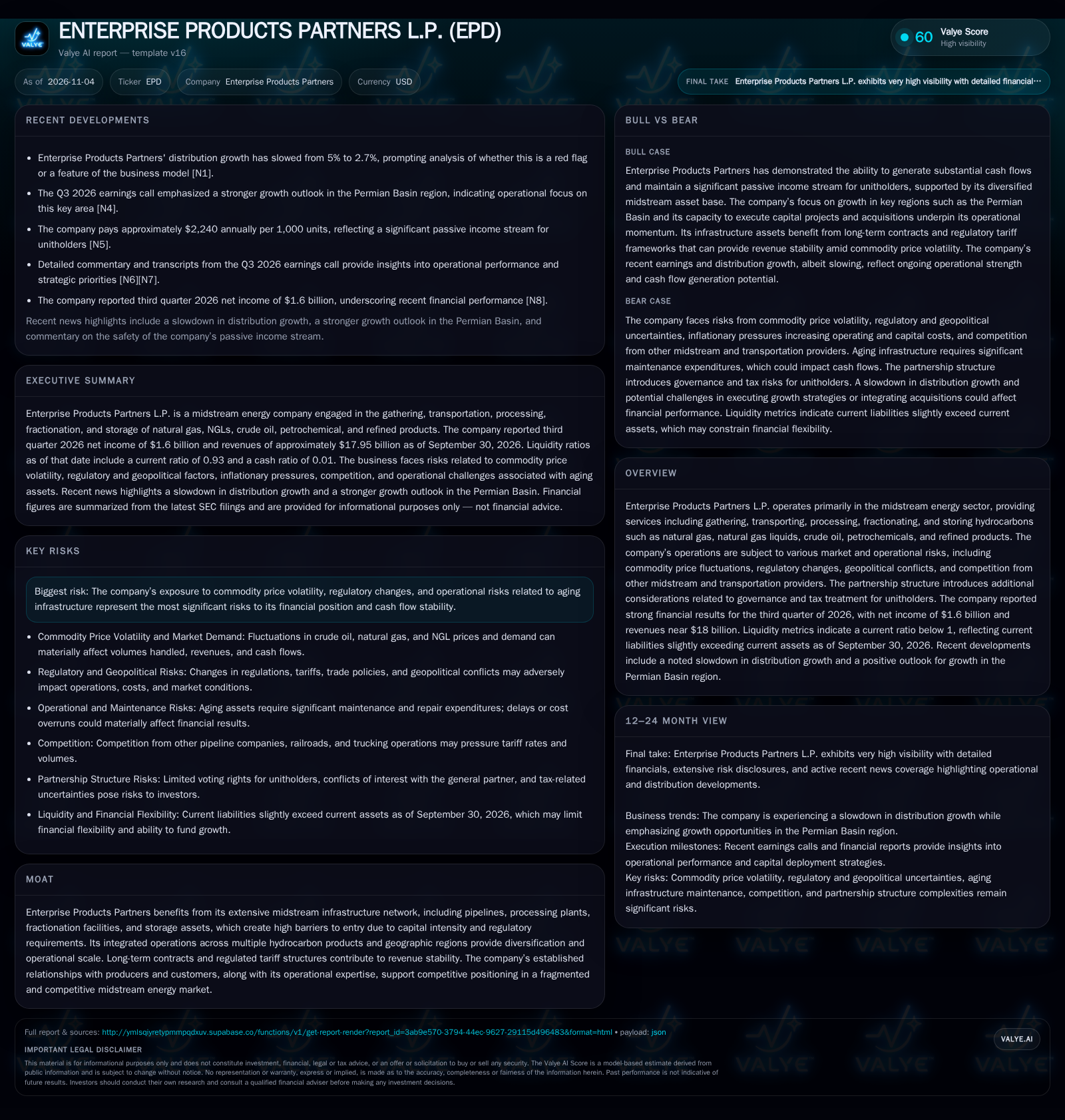
Enterprise Products Partners reported net income of $1.6 billion and revenues approaching $18 billion for the third quarter of 2026, affirming its status as one of the largest and most profitable midstream operators in North America [N8]. However, a reduction in distribution growth—from 5% to 2.7%—has prompted investor scrutiny over the sustainability and strategy behind capital returns [N1]. This slowdown could reflect either a conservative approach to capital allocation amid heightened sector risks or emerging constraints on distributable cash flow. Meanwhile, the company’s Q3 earnings call emphasized a stronger growth outlook in the Permian Basin, suggesting near-term volume and infrastructure expansion opportunities in this prolific region [N4]. [S2]
How Enterprise Makes—and Allocates—Its Money
Enterprise Products Partners generates revenue by charging fees for gathering, transporting, processing, fractionating, and storing hydrocarbons across a vast network of pipelines and terminals. The bulk of its cash flows are typically anchored by long-term, volume-based contracts that can dampen direct commodity price exposure, though volumes and contract renewals remain sensitive to broader market conditions and customer health. Capital intensity is a defining feature: the company must continually invest in asset maintenance, regulatory compliance, and expansions, particularly in growth regions like the Permian Basin.
Operating leverage is significant—incremental throughput on existing assets can drive outsized returns, but fixed costs and depreciation from aging infrastructure are persistent. The slowdown in distribution growth suggests a possible rebalancing between returning cash to unitholders and reinvesting in growth or maintenance. The partnership structure, while tax-advantaged, can also complicate capital allocation decisions due to its governance and incentive dynamics.
Capital allocation decisions at Enterprise must carefully balance the competing priorities of sustaining current asset health and pursuing growth opportunities. Given the capital-intensive nature of midstream infrastructure, deferring maintenance can lead to increased operational risk and higher future costs, while aggressive expansion without secured contracts risks underutilized capacity and margin compression. The partnership’s incentive distribution rights and governance structure may also influence management’s preference for steady distributions versus reinvestment, complicating the alignment of stakeholder interests under varying market conditions. Moreover, the sensitivity of cash flow to volume fluctuations means that even modest declines in throughput can disproportionately impact free cash flow available for distribution or reinvestment.
Infrastructure Scale, Barriers, and Competitive Pressures in Midstream
Enterprise’s competitive moat is built on the scale, integration, and geographic reach of its asset base—pipelines, processing plants, fractionators, and storage facilities serving multiple hydrocarbon streams. These assets create high barriers to entry given their capital requirements, regulatory hurdles, and the logistical complexity of duplicating such a network. Long-term contracts and regulated tariff structures provide some insulation from short-term commodity swings, and the ability to serve multiple end markets (natural gas, NGLs, crude oil, petrochemicals, refined products) diversifies revenue sources.
However, the midstream sector is structurally competitive. Alternative transport options (pipelines, rail, trucking), other major midstream operators, and evolving customer bargaining power all exert pressure on tariffs and volumes. Regulatory changes—such as permitting, environmental standards, or changes to partnership tax treatment—could erode margins or require significant new investment. Furthermore, competition for capital with other high-yielding infrastructure assets may drive up required returns, particularly if distribution growth continues to slow.
The structural competitiveness of the midstream sector implies that Enterprise must continuously innovate operationally and strategically to defend its market position. This includes optimizing asset utilization through technological upgrades, enhancing customer service to secure long-term contracts, and selectively pursuing expansions that align with evolving producer activity and commodity mix shifts. Regulatory compliance costs and environmental considerations increasingly factor into competitive dynamics, potentially raising barriers for new entrants but also increasing operating expenses for incumbents. Additionally, the growing emphasis on sustainability and emissions reduction may necessitate capital expenditures that do not directly generate revenue but are essential to maintain regulatory approvals and customer relationships, thereby affecting margin profiles over time.
Permian Throughput Expansion and Capital Discipline Drive New Value
The most favorable scenario for Enterprise hinges on successful execution and volume growth in the Permian Basin, which could offset slower distribution growth and liquidity constraints. If the company leverages its incumbent infrastructure to secure new long-term contracts with producers ramping up output in the region, it could achieve higher throughput on existing assets and justify further expansion projects. This would enhance operating leverage, allowing incremental revenue to flow through at attractive margins.
Confirmation of this scenario would include sustained volume growth in the Permian, new project announcements with favorable contract terms, and stabilization or re-acceleration in distribution growth without compromising balance sheet health. Additional evidence would be successful renewal or extension of existing contracts at attractive rates, and the ability to fund expansion from internal cash flow rather than reliance on external debt or equity.
Distribution Discipline Amid Steady Operations and Sector Headwinds
The most plausible path forward is one of stable, but slower, growth. Permian Basin operations contribute to volume and EBITDA growth, but may not fully offset headwinds from aging infrastructure, sector competition, and inflationary cost pressures.
Evidence supporting this scenario would be continued strong operating profits, modest but positive distribution increases, and regular capital deployment into both maintenance and selective growth projects. Signs that would falsify this scenario include a material decline in volumes, significant regulatory or cost shocks, or a cut in distributions rather than a continued slowdown in growth.
Liquidity Tightens and Aging Assets Amplify Cash Flow Risk
The main risk to the Enterprise thesis is that liquidity constraints, combined with rising maintenance costs for aging infrastructure, begin to erode distributable cash flow and force more pronounced trade-offs between capital returns and investment.
Warning signs for this scenario would include a spike in capital expenditures for unplanned repairs, negative free cash flow, an inability to fund projects internally, or a move to cut (not just slow) distributions. Regulatory events or major contract losses could further exacerbate downside risk.
In scenarios where liquidity tightens, Enterprise’s ability to access capital markets or alternative financing could become constrained, especially if credit metrics deteriorate or investor appetite for midstream assets wanes amid broader market volatility. This would amplify the challenge of funding necessary maintenance and growth projects internally, potentially leading to deferred investments that undermine operational reliability and future capacity. Furthermore, aging assets may experience increasing frequency and severity of outages or regulatory compliance issues, which could trigger unplanned expenditures and reputational risks. The interplay between these factors may create a feedback loop where financial stress limits operational flexibility, which in turn exacerbates cash flow volatility and heightens distribution risk.
Milestones That Will Clarify Enterprise’s Distribution and Growth Trajectory
Monitoring quarterly throughput and volume growth in the Permian Basin will help assess whether the region can drive incremental cash flow and justify further capital investment.
Updates on distribution policy—specifically whether the company maintains, accelerates, or further slows the rate of distribution growth—will signal management’s confidence in cash flow visibility and capital allocation priorities [N1].
Disclosure of new long-term contracts, renewals, or expansions—especially in the Permian—would support the upside scenario and indicate customer demand for Enterprise’s services [N4].
Capital expenditure trends, both planned and unplanned, will reveal the true cost of maintaining and expanding the aging infrastructure network.
Any regulatory updates or changes to partnership tax treatment could materially impact distributable cash flow and the company’s valuation.
Comparative analysis of tariff rates and contract structures versus peer midstream operators would help test whether Enterprise can sustain a margin advantage in a competitive environment.
If disclosed, churn or renewal rates for key customer contracts would provide a direct read on revenue stability and counterparty risk.
Disclaimer: This is research-only, informational analysis and not investment advice. It may include AI-generated interpretation and general industry context. Always verify important details using primary sources.

Comments