
Circle Internet Group in Late 2026: Stablecoin Economics, Regulatory Exposure, and the Stakes of Digital Finance Scale
Circle Internet Group, a major player in blockchain-based financial services, reported robust Q3 2026 revenue and net income amid tight liquidity metrics. As stablecoin adoption accelerates and regulatory scrutiny intensifies, Circle’s ability to scale its model, defend its market position, and navigate evolving risks will shape its long-term value.
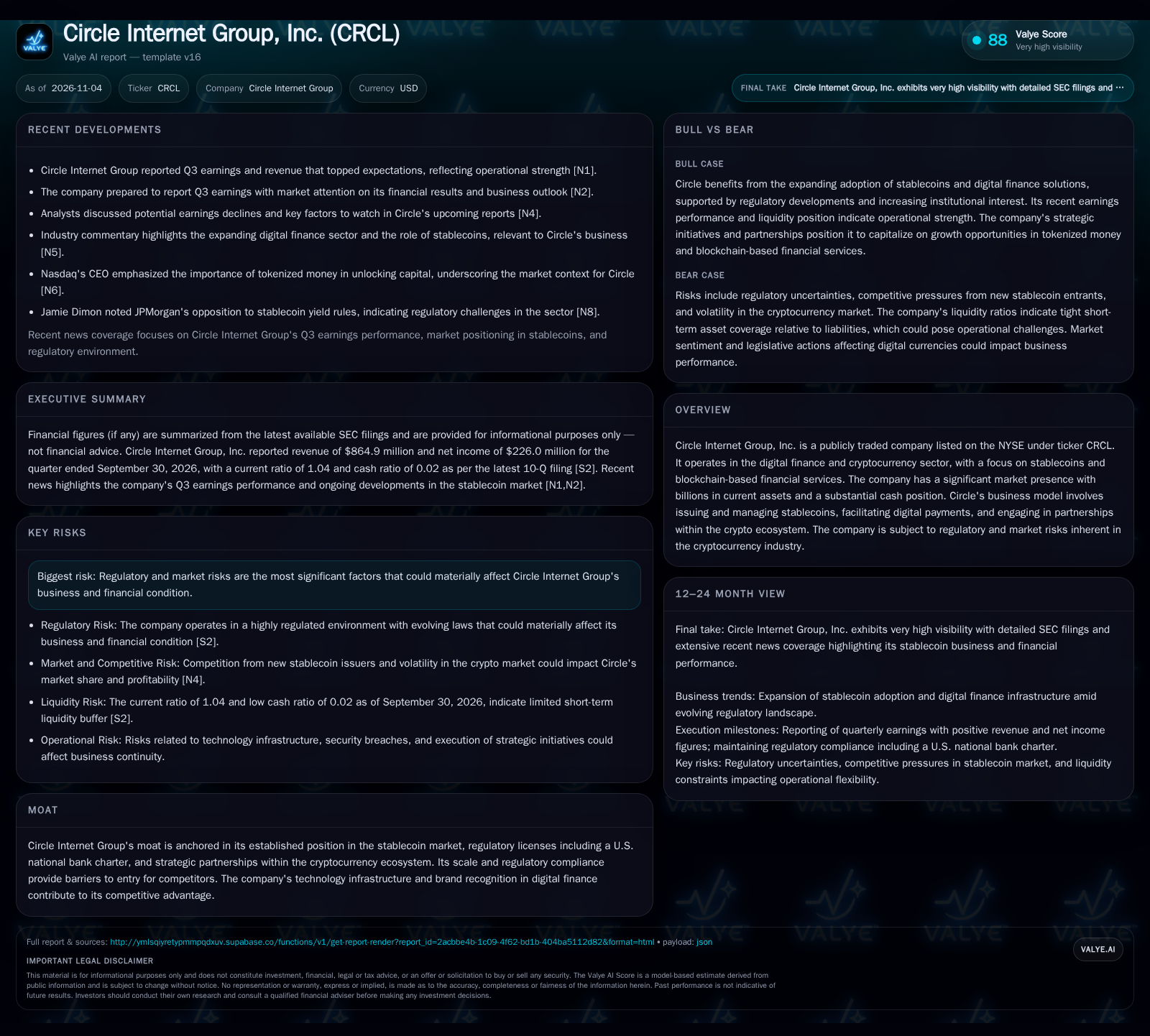
Circle Internet Group posted strong Q3 2026 financials, topping revenue and earnings estimates, yet operates with a reported cash ratio and tight liquidity. The company’s core business—issuing and managing stablecoins—faces both major upside from digital asset adoption and persistent risks tied to regulation and market competition. Execution on compliance, operational resilience, and ecosystem partnerships will be critical as Circle seeks to sustain growth and defend its position in a rapidly evolving sector. [S2] [N1]
Circle Internet Group, Inc. (NYSE: CRCL) has emerged as a leading force in the digital finance ecosystem, leveraging its stablecoin infrastructure and blockchain services to drive substantial revenue and profit in 2026. The company’s Q3 results beat expectations, yet its narrow liquidity ratios highlight the operational balancing act inherent in the high-velocity world of digital asset management. As regulatory frameworks tighten and the competitive landscape intensifies, Circle’s ability to execute on compliance, maintain trust, and expand its network will define its future trajectory.
2026 Financial Pulse: Strong Earnings, Tight Liquidity, and Market Expectations
Circle Internet Group reported Q3 2026 revenue of $864.9 million and net income of $226.0 million, surpassing analyst estimates and demonstrating operational momentum [S2] [N1]. The company’s basic and diluted EPS came in at $0.89 and $0.84, respectively [S2]. Despite this profitability, Circle’s liquidity profile is notably tight: as of September 30, 2026, current assets stand at $76.7 billion versus current liabilities of $73.8 billion, resulting in a current ratio of 1.04 and a cash ratio of just 0.02 [S2]. This indicates that only a small fraction of current liabilities are covered by cash on hand, which could become a point of operational vulnerability if market or regulatory conditions shift rapidly. Recent analyst commentary has also highlighted the potential for future earnings volatility, underscoring the importance of ongoing financial discipline and adaptability [N4].
How Circle’s Stablecoin Model Scales—and Where the Economics Get Tested
Circle’s core business is the issuance and management of stablecoins—blockchain-based digital tokens pegged to fiat currencies—alongside digital payments and broader financial infrastructure services. The company likely generates revenue from a combination of float income (interest earned on reserves backing stablecoins), transaction fees, and service partnerships. In a rising-rate environment, float income can be a significant driver, but as rates normalize or if reserve requirements change, this source could shrink. Transaction volumes and ecosystem integrations create operating leverage: as more users and partners adopt Circle’s stablecoins, incremental revenue can scale faster than fixed costs, potentially supporting attractive margins.
However, the model is capital-intensive. Maintaining sufficient reserves to back stablecoins requires substantial liquid assets, and regulatory changes could force Circle to alter reserve composition or increase capital buffers, directly impacting profitability. The business may also face working capital swings driven by large inflows and outflows as customers mint or redeem stablecoins.
Circle’s ability to manage these flows efficiently, optimize yield on reserves, and control operational expenses will determine whether its platform economics can deliver sustainable, scalable profit in the face of sector volatility and evolving compliance costs.
Where Circle Stands in the Race for Digital Finance Supremacy
Circle competes in a rapidly evolving sector alongside other stablecoin issuers, crypto-native payment providers, and traditional financial institutions exploring blockchain applications. Its technology infrastructure and brand recognition offer durable advantages, potentially lowering customer acquisition costs and enabling deeper integration with ecosystem partners. However, barriers to entry in stablecoin issuance are not insurmountable: well-capitalized fintechs, exchanges, and even banks can launch competing tokens, especially if regulatory clarity improves.
The threat from decentralized stablecoins and programmable money platforms is also rising, as these alternatives could siphon off demand by offering greater transparency or composability. Moreover, traditional financial institutions may leverage their regulatory relationships and balance-sheet strength to compete aggressively if stablecoins gain mainstream adoption. Circle’s competitive moat thus depends on its ability to maintain trust (through transparency and compliance), deliver seamless interoperability, and stay at the forefront of regulatory engagement. Any loss of confidence—due to security incidents, redemption delays, or regulatory action—could rapidly erode market share.
What Would Unleash Circle’s Next Phase of Growth?
The most favorable scenario for Circle is one in which regulatory frameworks provide clear, supportive rules for stablecoin operations, enabling the company to expand its product suite and cement partnerships with major financial institutions. In this world, institutional adoption accelerates, driving higher transaction volumes and reserve balances, which in turn boost both fee and float income. Circle could further benefit from successful integration into mainstream payment rails and cross-border settlement networks.
Confirmation of this scenario would include: sustained double-digit quarterly revenue growth, expanding net income margins, rising reserve balances, and public announcements of large-scale partnerships with banks or enterprise platforms. Regulatory approval for new products—such as a U.S. national bank charter or global stablecoin offerings—would also signal growing institutional confidence. Conversely, evidence that would falsify this scenario includes regulatory setbacks, stalled revenue growth, or the loss of major ecosystem partners.
Sustaining Scale Amid Regulatory and Market Headwinds
The most plausible trajectory for Circle is continued growth in stablecoin adoption and transaction volumes, but at a moderated pace as regulatory uncertainty and market competition persist. Revenue and net income remain positive, but margins are pressured by rising compliance costs and the need for higher capital buffers. The company retains its leading position among regulated stablecoin issuers but faces ongoing competitive encroachment from both fintech challengers and traditional banks.
Evidence confirming this scenario would include stable or modestly growing quarterly financial results, incremental product launches, and periodic regulatory updates without major disruptions. Signs that would falsify this baseline include a sharp drop in operating metrics, material regulatory penalties, or significant loss of market share to new entrants or decentralized alternatives.
How a Regulatory Shock or Confidence Crisis Could Disrupt Circle
A negative scenario unfolds if Circle faces adverse regulatory action—such as restrictive reserve requirements, outright bans on certain stablecoin activities, or sanctions related to compliance failures. Such developments could force Circle to shrink its balance sheet, unwind products, or absorb costly restructuring. Alternatively, a loss of market confidence triggered by a security breach, major redemption event, or operational failure could prompt rapid outflows, stressing Circle’s liquidity and potentially requiring asset sales at unfavorable terms.
This scenario would be confirmed by regulatory announcements imposing new constraints, a sharp reduction in reserve balances, negative net income, or disclosures of customer redemptions exceeding routine levels. Early warnings could include declining liquidity ratios, legal disclosures, or abrupt changes in management or strategic direction.
Milestones and Stress Points to Gauge Circle’s Strategic Trajectory
Quarterly revenue and net income trends: Sustained growth or margin compression would help validate or challenge the scalability of Circle’s business model [S2].
Reserve composition and liquidity disclosures: Greater transparency on asset mix, duration, and liquidity of reserves would clarify the company’s ability to withstand redemption shocks (if disclosed).
Stablecoin circulation and transaction volume: Increases would signal adoption momentum, while declines could indicate competitive or confidence pressures (a useful metric if disclosed).
Regulatory announcements or enforcement actions: Any new guidance or penalties could materially change Circle’s operational and capital requirements [S2].
Partnership or integration deals: Evidence of new or expanded collaborations with banks, payment networks, or enterprise platforms would support the upside case (if disclosed).
Cash flow from operations: Trends here would illuminate whether Circle is generating sufficient internal capital to support growth and compliance (if disclosed).
Management commentary on liquidity management: Statements regarding liquidity strategy, reserve adequacy, or responses to market stress would help test the company’s operational resilience (if disclosed).
Disclaimer: This is research-only, informational analysis and not investment advice. It may include AI-generated interpretation and general industry context. Always verify important details using primary sources.

Comments