
Allison Transmission in 2026: Integration, Electrification, and Global Powertrain Competition Dynamics
Allison Transmission's acquisition-driven expansion and leading position in fully automatic transmissions shape a complex landscape of opportunity and risk, as the company navigates electrification trends, integration challenges, and intensifying competition in global commercial and off-highway vehicle markets.
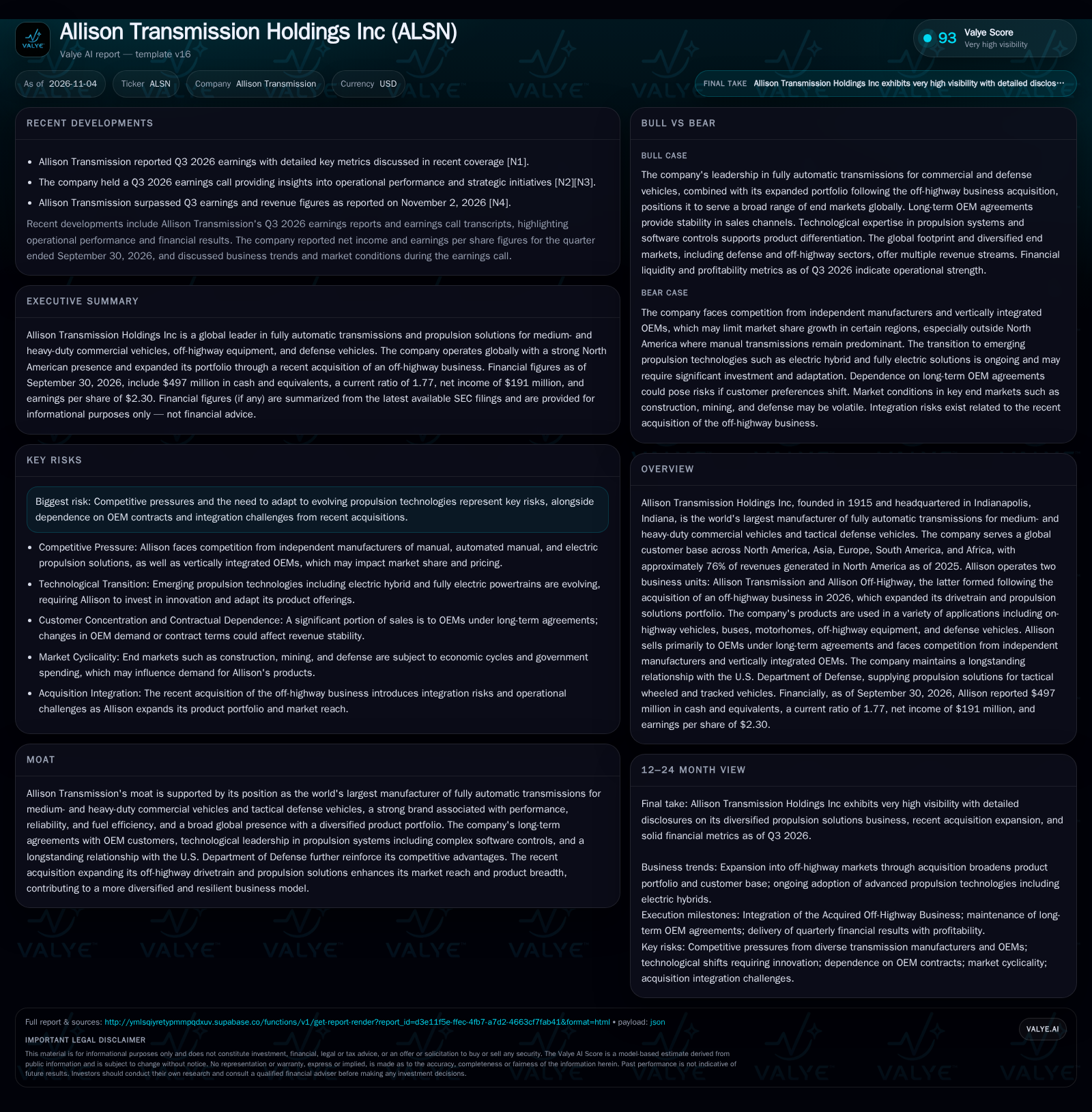
Allison Transmission, following its $2.6 billion off-highway acquisition in early 2026, now combines its North American leadership in fully automatic transmissions with a broadened global portfolio in conventional and electrified drivetrain solutions. The company’s Q3 2026 results show profitability and a reported balance sheet position, but the challenge lies in successfully integrating the new business, adapting to electrification trends, and defending market share against both established and emerging propulsion competitors. The next phase will test Allison’s ability to leverage OEM relationships, manage capital deployment, and convert strategic breadth into durable cash flow.[S1] [S2]
Allison Transmission’s 2026 profile is defined by both continuity and transformation. The company remains the dominant supplier of fully automatic transmissions for North American commercial vehicles and defense platforms, but its $2.6 billion off-highway acquisition marks a strategic push into new end markets and geographies. As Allison integrates this expanded portfolio—now spanning conventional, hybrid, and electric propulsion—its financial results show ongoing profitability and balance-sheet discipline. The core question is whether Allison can translate scale and legacy OEM relationships into sustainable advantage as electrification and global competition reshape vehicle powertrain economics.
Strategic Positioning Following Recent Acquisition and Q3 Performance
The most consequential recent event for Allison Transmission is the $2.6 billion acquisition of Dana’s off-highway business, closed on January 1, 2026. This move added axles, gearboxes, transmissions, and motion systems for both conventional and electrified powertrains, broadening Allison’s reach into construction, agriculture, mining, and material handling beyond its core on-highway and defense segments.[S1] The integration of this business and its global customer base is now central to Allison’s near-term execution risk and long-term growth potential.
Financially, as of September 30, 2026, Allison reported $191 million in net income for the quarter, $497 million in cash and equivalents, and a current ratio of 1.77. These figures reflect post-acquisition balance sheet adjustments, including new debt from the transaction.[S2] North America continues to generate the bulk of revenue (76% in 2025), but the acquisition is intended to accelerate global diversification.[S1]
Operationally, Allison’s long-term agreements with OEMs cover over 90% of North American on-highway unit volume, providing a degree of sales visibility but also tying fortunes closely to OEM propulsion strategies and shifts in end-market demand.[S1]
Transmission Economics Amid Capital and Electrification Challenges
Allison’s legacy business model is built on supplying high-value, engineered automatic transmissions and propulsion modules to OEMs, with revenue primarily generated through direct sales under multi-year agreements. The economics are characterized by high engineering and capital intensity, relatively low variable costs per unit, and significant operating leverage once product platforms are established. Margins have historically benefited from product differentiation, aftermarket parts, and a reputation for reliability in demanding commercial and defense applications.
The off-highway acquisition introduces new fixed costs and integration overhead, but may also offer operating leverage if Allison can achieve cost synergies and cross-sell drivetrain solutions across its expanded customer base. However, the capital structure is now more leveraged post-acquisition, with new senior notes and term loans funding the deal.[S2] This increases interest expense and reduces near-term potential financial flexibility, making cost control and cash conversion especially important.
Electrification trends introduce both risk and opportunity: electrified powertrains may reduce the complexity and value-add of traditional transmissions, potentially compressing margins unless Allison can capture share in electric drive modules or integrated e-axles. The business will need to balance ongoing R&D for conventional products with investments in electric and hybrid solutions, testing its ability to fund innovation while servicing debt.
Maintaining Market Position as Powertrain Technologies Advance
Allison’s historical moat in North American fully automatic transmissions is underpinned by entrenched OEM relationships, high switching costs for fleet operators, and a reputation for durability. In the defense segment, long-standing contracts and technical requirements provide additional barriers to entry.
However, the competitive landscape is intensifying. In North America, Allison faces pressure from automated manual transmissions (AMTs) and vertically integrated OEMs that can bundle their own powertrains. Globally, manual transmissions still dominate, and electric propulsion opens the field to new entrants and established suppliers of electric motors, power electronics, and integrated e-axles.[S1]
The off-highway acquisition provides access to broader end markets, but also exposes Allison to new competitors with deep domain expertise in industrial drivetrains and emerging electrification platforms. The ability to differentiate through software controls, system integration, and post-sale support may become increasingly important as hardware becomes commoditized.
Potential for Margin Growth Through Successful Integration and Electrification
The bullish scenario for Allison rests on three pillars: smooth integration of the off-highway business, successful commercialization of electrified propulsion solutions, and ongoing renewal of OEM contracts. If Allison leverages its scale to realize cost synergies, cross-sells drivetrain modules, and accelerates adoption of its electrified product lines in both on- and off-highway markets, it could achieve higher margins and expand its addressable market.
Evidence for this scenario would include: increasing international revenue mix, expanding gross margins (despite new product investments), and new OEM wins or contract extensions involving Allison’s electric or hybrid systems. Sustained aftermarket parts growth, especially for newer platforms, would signal durable customer loyalty. Clear R&D milestones, such as the launch of competitive e-axle or integrated electric drive products, would further validate Allison’s strategic pivot.
Projected Outcomes from Consistent Execution and Integration Progress
The most plausible outcome is that Allison maintains its leadership in North American automatic transmissions while gradually integrating the off-highway business and investing in electrification at a measured pace. Near-term financials likely reflect stable revenue and profitability, with incremental gains from cross-selling and new product introductions offset by integration costs and rising R&D spend.
Confirmation would come from continued profitability (e.g., net income and EPS at or above current levels), stable or slowly rising international sales, and retention of key OEM contracts. A lack of major integration disruptions and steady debt service would support the base case. Falsifying evidence would include falling margins, significant loss of OEM share, or integration setbacks that erode cash flow.
Risks from Integration Delays and Electrification Shortfalls Affecting Margins
The bear case centers on Allison struggling to integrate the off-highway acquisition, missing electrification milestones, and losing share to AMT, manual, and electric propulsion competitors. If OEMs accelerate the shift to in-house or third-party electric solutions, Allison could face declining demand for its legacy products before new electrified offerings reach scale.
Evidence of this scenario would include rising integration costs, project delays, or restructuring charges; shrinking gross and operating margins; declining North American unit volumes; and loss of major OEM contracts. Additional warning signs would be R&D or capital expenditures that fail to translate into commercial wins, or a credit downgrade due to leverage and cash flow pressures.
Key Developments Influencing Allison Transmission’s Market Competitiveness
Progress on integration of the off-highway business, including cost synergies, restructuring charges, and combined product launches, if disclosed.
Share of revenue from electrified propulsion products and new product pipeline disclosures, especially for electric axles and integrated e-drive solutions.
Renewal or expansion of long-term OEM agreements, particularly with North American commercial vehicle manufacturers and global off-highway equipment makers.
Aftermarket parts and service revenue growth, which would indicate durability of installed base and customer loyalty.
Gross margin trends post-acquisition, as a signal of cost discipline and product mix evolution.
R&D and capital expenditure allocation between legacy and electrified platforms, and evidence of commercialization success.
International revenue growth and share of total sales, particularly in regions historically dominated by manual or AMT solutions.
Debt service coverage and credit metrics in the wake of the acquisition, to assess potential financial flexibility and risk of covenant pressure.
Disclaimer: This is research-only, informational analysis and not investment advice. It may include AI-generated interpretation and general industry context. Always verify important details using primary sources.

Comments