
CS Disco’s AI Legal Platform: Usage Economics, Customer Dynamics, and the Next Phase of LegalTech Competition
CS Disco’s cloud-native, AI-powered legal platform combines a usage-based pricing model with strong customer retention, but faces intensifying competitive and regulatory pressures as the legal tech market matures. The company’s focus on product-led growth and operational discipline will be tested by evolving data privacy requirements and the need to drive deeper adoption within a large, but efficiency-driven, customer base.
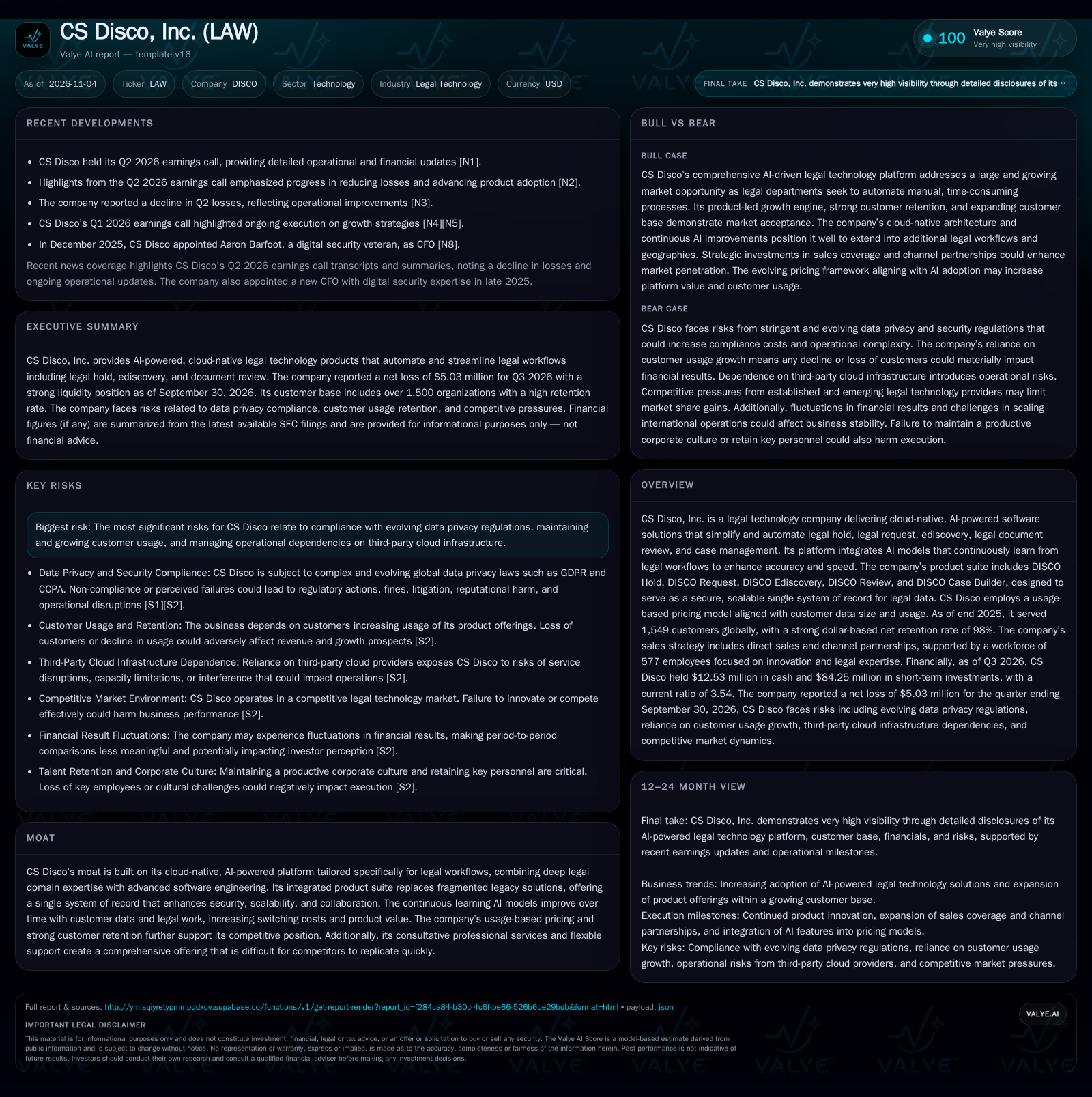
CS Disco, Inc. leverages a cloud-native, AI-driven legal software suite with a usage-based pricing model, serving over 1,500 organizations and maintaining a strong 98% net retention rate. Despite operational improvements and a narrowed Q3 2026 net loss, the company faces material risks from regulatory compliance, customer usage volatility, and competition in a rapidly evolving legal tech market. The business model’s success hinges on expanding within existing accounts, continued product innovation, and managing cost discipline as AI and cloud adoption reshape the economics of legal services. [S1] [S2]
CS Disco, Inc. has emerged as a prominent player in the legal technology sector, offering a suite of AI-powered, cloud-native solutions that automate and streamline key legal workflows for enterprises, law firms, and public sector clients. With a usage-based pricing model and a strong net retention rate, the company has demonstrated traction among large, recurring customers. However, as legal departments become more discerning about technology spend and regulatory scrutiny intensifies, CS Disco’s ability to scale its platform, deepen customer adoption, and maintain operational discipline will be central to its long-term value proposition.
Recent Financial and Customer Metrics Shape the Strategic Backdrop
CS Disco reported a net loss of $5.03 million for Q3 2026, a figure that reflects ongoing efforts to reduce losses and improve operational efficiency [S2]. The company reported cash and liquidity metrics for the period; these figures do not by themselves establish operating runway, investment capacity, financial flexibility, or financing capacity. [S2] The company’s customer base stood at 1,549 as of December 31, 2025, including 330 large customers generating more than $100,000 annually, and a dollar-based net retention rate of 98% [S1]. These facts collectively frame CS Disco’s position as a growth-focused SaaS business with a strong installed base, gradually improving financial profile, and meaningful exposure to both customer expansion and retention dynamics.
How Usage-Based Pricing and AI Automation Drive Revenue and Cost Structure
CS Disco’s revenue model is built on a usage-based pricing structure, where customers pay in proportion to data size, usage volume, and access to AI-enabled features [S1]. This approach aligns platform economics with customer activity, offering significant upside when legal workloads grow or when customers expand their reliance on automation and analytics. However, it also introduces revenue volatility tied to cyclical legal activity and the discretionary nature of technology budgets in law firms and corporate legal departments.
The company’s cloud-native architecture and AI automation underpin a high-fixed-cost, scalable platform, where incremental usage drives operating leverage once core infrastructure and R&D investments are covered. Over time, if customer adoption deepens—such as by integrating more workflows or increasing data processed—the gross margin could improve, assuming cloud infrastructure costs are managed efficiently relative to revenue growth. However, reliance on third-party cloud providers means that gross margin expansion is not guaranteed and could be constrained by external cost structures or unfavorable renegotiations.
CS Disco’s cost base includes substantial ongoing investments in product development and sales, as evidenced by its 577 full-time employees as of December 31, 2025 [S1]. The company’s current net loss suggests that scale and deeper product penetration are needed to achieve sustained profitability. Capital needs appear manageable in the short term, given the current asset position, but long-term self-funding will depend on translating net retention into consistent cash generation.
Differentiation in a Crowded LegalTech Arena: AI, Integration, and Customer Stickiness
CS Disco competes in a fragmented yet rapidly maturing legal technology market, where incumbent legal software vendors, new AI-first entrants, and broader enterprise SaaS providers all seek to automate legal workflows. The company’s competitive edge rests on several fronts: a cloud-native platform purpose-built for legal use cases, deep integration of AI that learns from legal work, and a comprehensive suite that replaces fragmented legacy solutions [S1].
Switching costs could be significant for customers who centralize their legal data and workflows on CS Disco, especially as the AI models improve with customer-specific data over time. This creates potential for embeddedness and higher long-term retention, which is partially evidenced by the 98% net retention rate [S1]. However, competitors may seek to counter with bundled offerings, lower prices, or differentiated AI capabilities, and the ease of migration between cloud platforms remains a latent risk.
CS Disco’s usage-based model may also be a double-edged sword: while it reduces upfront friction for new customers, it can make high-volume clients more price sensitive or incentivize them to seek alternative solutions if platform value does not scale with cost. The company’s ability to maintain its differentiation will likely depend on continuous product innovation, seamless integration with customer workflows, and the demonstrable ROI of its AI-powered automation.
Scaling Within the Enterprise: AI-Driven Expansion and Deeper Workflow Penetration
A favorable outcome for CS Disco would see the company leveraging its installed base and AI differentiation to drive greater adoption of its platform within existing accounts, while simultaneously expanding into new verticals and geographies. In this scenario, corporate legal departments and law firms increasingly automate complex workflows—such as ediscovery, legal hold, and document review—leading to higher usage volumes and greater reliance on CS Disco’s AI models.
Key evidence for this upside would include a sustained increase in average revenue per customer, rising net retention rates, and positive operating leverage as fixed platform costs are absorbed by higher usage. Product innovation that demonstrably improves legal outcomes or reduces client costs would further reinforce CS Disco’s value proposition, supporting pricing power and reducing churn.
Confirmation of this scenario would come from disclosures showing accelerating growth in large customer cohorts, successful cross-sell or upsell of new modules, and expansion into regulated or international markets where automation is especially valuable. Falsification would occur if net retention plateaus or declines, or if customer adoption remains shallow despite product enhancements.
Sustained Growth Amid Intensifying Scrutiny and Operational Maturation
The most plausible trajectory for CS Disco is a gradual deepening of platform adoption among its core customer base, with steady—if not explosive—growth in usage and incremental improvements in operating efficiency. As legal departments become more comfortable with cloud and AI tools, a moderate expansion of usage should support mid-to-high single-digit revenue growth, while ongoing product development and sales investments keep the company in a competitive position.
Evidence supporting this scenario would include continued high net retention rates (in the mid-to-high 90% range), a stable or slowly improving gross margin profile, and periodic new product launches that are met with meaningful customer uptake.
Falsification would come in the form of a marked slowdown in usage growth, declining net retention, or signs that competitors are winning share among large enterprise accounts—possibly evidenced by higher churn, customer downgrades, or price compression.
Regulatory, Usage, or Cost Shocks Derail Operating Leverage and Customer Momentum
On the downside, CS Disco could be materially impacted by adverse shifts in regulatory requirements, such as stricter enforcement of GDPR, CCPA, or other data privacy laws that increase compliance costs or restrict platform functionality [S1] [S2]. Similarly, a cyclical downturn in legal activity, budget tightening among large customers, or dissatisfaction with AI outcomes could reduce usage and expose the business to negative operating leverage.
The company’s dependency on third-party cloud infrastructure providers introduces the risk of cost inflation or service disruptions, either of which could erode gross margins or damage customer trust [S2]. Competitive pressure may also intensify, leading to price wars or loss of key accounts if CS Disco fails to keep pace with innovation or customer support expectations.
This scenario would be confirmed by a decline in net retention rate, significant loss of large customers, margin compression, or regulatory disclosures indicating increased compliance spending or operational restrictions. A liquidity crunch, while not imminent based on current asset levels, could become a concern if losses accelerate and cash burn outpaces growth.
Milestones That Will Validate or Challenge CS Disco’s LegalTech Thesis
Quarterly trends in net retention rate—especially any change in the rate among large accounts—would provide early insight into customer expansion or contraction.
Disclosure of average revenue per customer, if provided, would help clarify whether deeper platform adoption is taking hold within the existing base.
Gross margin trajectory as usage grows: improvement would signal successful scaling, while stagnation or decline could indicate cost or pricing pressure.
The pace and scope of new product/module launches and their adoption rates among current customers would demonstrate the effectiveness of CS Disco’s product-led growth strategy.
Any increase in compliance or regulatory costs, or disclosures about new data privacy regimes, would test the resilience of the company’s operating model.
Customer churn or downgrade events among top 20 accounts, if disclosed, would serve as a leading indicator of competitive or satisfaction risks.
Evidence of international expansion or new channel partnerships, including contributions to revenue mix, would show progress on geographic and distribution diversification.
Cloud infrastructure cost disclosures or commentary about renegotiations with third-party providers would illuminate risks to gross margin and operational resilience.
Disclaimer: This is research-only, informational analysis and not investment advice. It may include AI-generated interpretation and general industry context. Always verify important details using primary sources.

Comments