
Stifel Financial in Late 2026: Fee Mix, Market Sensitivity, and the Stakes of Scale in Mid-Tier Investment Banking
Stifel Financial’s Q3 2026 results highlight robust revenue and earnings momentum, but the company’s future trajectory hinges on its ability to sustain fee income, navigate capital markets volatility, and defend its position amid intensifying competition from both bulge-bracket and digital-first financial services firms.
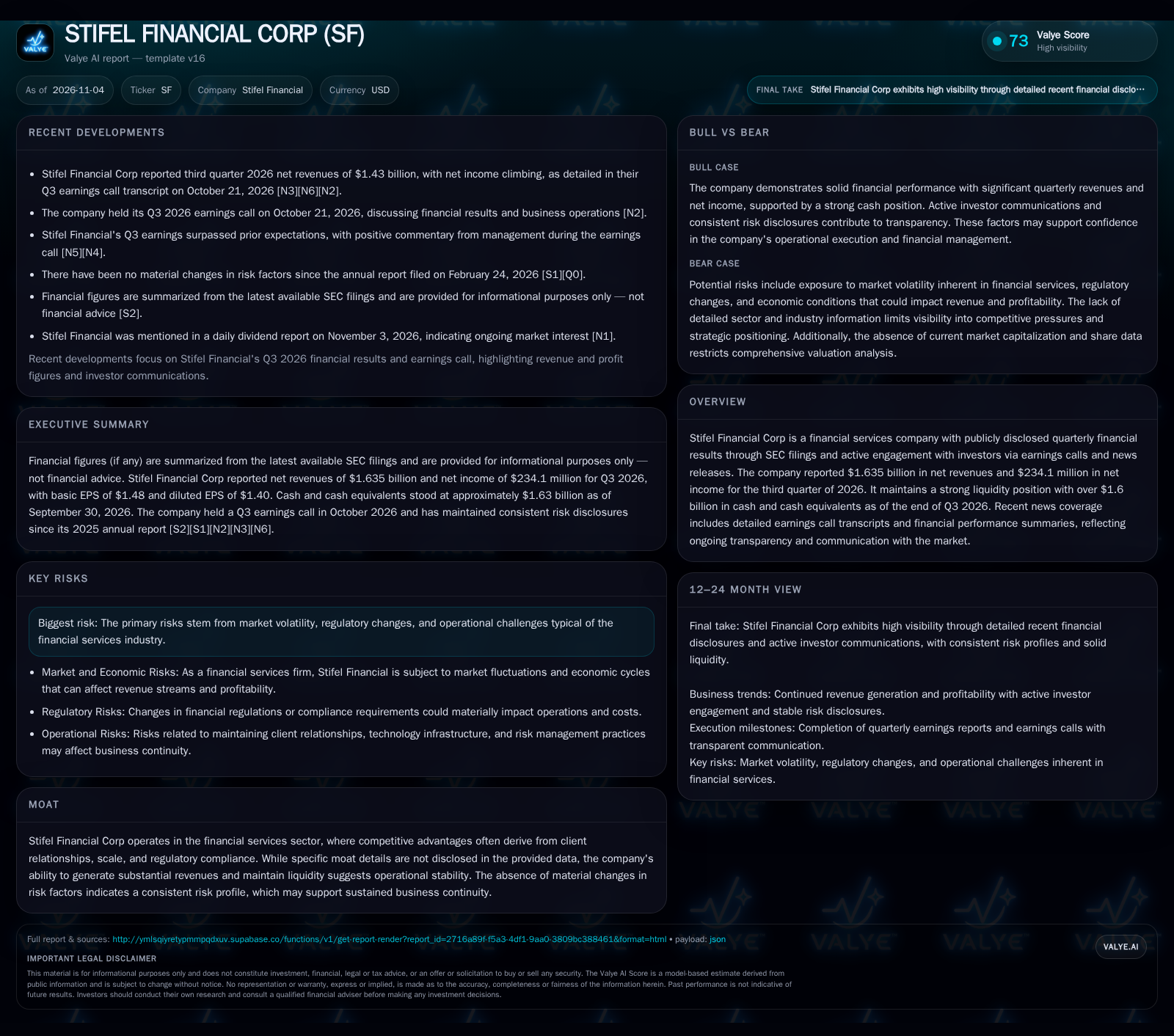
Stifel Financial’s Q3 2026 performance underscores strong revenue and earnings, supported by a sizable cash position and ongoing investor engagement. Yet, the firm’s long-term value creation will depend on its ability to balance market-driven income streams, cost discipline, and competitive differentiation in a consolidating financial services landscape. Key watchpoints include fee mix stability, investment banking pipeline, and evidence of operating leverage as industry conditions evolve. [S2] [N2] [N3] [N6]
Stifel Financial’s latest quarterly results confirm its place as a resilient, mid-sized player in the U.S. financial services sector, with Q3 2026 net revenues of $1.635 billion and net income of $234.1 million. The company’s ample cash reserves and active investor communications reinforce operational stability, but the underlying economics remain sensitive to market swings and competitive dynamics. As the financial sector continues to evolve—with digital disruption, regulatory complexity, and industry consolidation—Stifel’s future performance will depend on its ability to maintain fee income, adapt its cost structure, and differentiate its client offering.
Quarterly Performance and Liquidity: What the Latest Numbers Reveal
Stifel Financial reported net revenues of $1.635 billion and net income of $234.1 million for Q3 2026, translating into diluted EPS of $1.40. The company ended the quarter with $1.63 billion in cash and cash equivalents. Management commentary during the October 2026 earnings call emphasized that results surpassed prior expectations, with positive momentum in core business lines. There have been no material changes in risk factors since the most recent annual report, suggesting a steady risk environment. These facts indicate that Stifel is currently operating from a position of financial strength, but do not by themselves clarify the sustainability of that performance in the face of external shocks or competitive shifts. [S2] [N2] [N3] [N4] [N6]
How Stifel Earns: Fee-Based Resilience Meets Market Sensitivity
As a diversified financial services firm, Stifel generates revenue from a combination of investment banking, wealth management, and institutional brokerage. The mix typically includes advisory fees, underwriting commissions, asset management fees, and trading revenues. This structure offers some diversification, but many revenue streams—particularly investment banking and brokerage—are directly tied to market activity and client transaction volumes. When capital markets are robust, advisory and underwriting revenues can surge; during downturns, fee pools may contract sharply.
Wealth management can provide a more stable base, especially if driven by recurring asset-based fees, but is not immune to market declines affecting assets under management. Cost structure in this sector is marked by high variable compensation (for dealmakers and advisors), with technology, compliance, and regulatory costs forming a growing fixed baseline. Operating leverage can emerge if revenue growth outpaces salary and infrastructure expense, but margin expansion is usually constrained by the need to attract and retain talent in a competitive labor market.
Capital requirements are significant but manageable for a mid-sized firm like Stifel. Regulatory capital ratios, liquidity reserves, and technology investment all demand ongoing allocation. Fee mix and the ability to manage compensation relative to revenue will be central to future margin outcomes.
Defending Share in a Shifting Financial Services Landscape
Stifel operates in a highly competitive environment, facing pressure from bulge-bracket banks, regional broker-dealers, and digital-first financial platforms. Its competitive advantages may include established client relationships, full-service capabilities, and regional market penetration. However, these advantages are under constant threat from larger incumbents with greater scale and technology resources, as well as from fintech entrants targeting advisory and brokerage margins through automation and price competition.
In investment banking, Stifel’s mid-market focus can be both a strength and a vulnerability: the firm can win mandates that are too small for global banks, but is also exposed to cyclical deal flow and potential fee compression as new digital platforms lower transaction costs. In wealth management, client retention and advisor productivity are critical; switching costs are moderate, as high-net-worth clients can move assets with relative ease if service or performance falters. The question is whether Stifel can continue to invest in digital tools, compliance, and talent fast enough to defend its position as industry consolidation accelerates.
What Could Drive Sustained Outperformance Over the Next Cycle?
A favorable scenario for Stifel hinges on robust capital markets activity, disciplined cost management, and successful expansion of its fee-based wealth platform. If equity and debt underwriting remain active and M&A volumes rebound, Stifel could see outsized growth in investment banking revenues. Simultaneously, if the company boosts client acquisition and retention in wealth management—perhaps through digital platform enhancements or targeted recruiting—recurring fee income could become a larger, more stable share of the revenue mix.
The upside case would be confirmed by continued revenue and net income growth outpacing peers, rising operating margins, and evidence of increasing assets under management or advisor headcount. Additional signals might include strategic tuck-in acquisitions that add scale or capabilities without overextending capital, and investor communications highlighting pipeline strength and technology-driven efficiency gains. If Stifel is able to demonstrate sustained operating leverage while maintaining or improving client satisfaction and regulatory compliance, it could reposition itself as a consolidator within the mid-market financial services segment.
What a Typical 2027 Looks Like for Stifel: Balancing Cyclicality and Cost Discipline
The most plausible near-term outcome is that Stifel continues to deliver solid, albeit cyclical, revenue and earnings—reflecting its diversified business mix and sensitivity to capital markets activity. Wealth management provides a degree of stability, while investment banking and brokerage revenues fluctuate with deal flow and trading volumes. Compensation expense remains a large, mostly variable cost, limiting the risk of deep losses but also capping margin expansion.
Confirmation would come from quarterly results showing stable or gradually increasing net revenues, consistent risk disclosures, and management commentary focused on steady execution rather than aggressive expansion. Any deviation—such as a sudden spike in expenses, loss of key advisors, or a sharp decline in deal activity—would challenge this base case.
How Adverse Market Shocks or Fee Compression Could Erode Franchise Value
An adverse scenario would be triggered by a sharp contraction in capital markets activity—such as a prolonged bear market, a collapse in IPO or M&A activity, or a severe drop in trading volumes. Under these conditions, Stifel’s investment banking and institutional brokerage revenues could fall quickly, while wealth management fees would also come under pressure if client assets decline. At the same time, competition for remaining advisory mandates could intensify, driving down fees and increasing client churn risk.
If Stifel fails to flex its cost base—particularly variable compensation—or faces unanticipated regulatory or technology expenses, margins could compress further. The downside case would be confirmed by sequential declines in net revenue, deteriorating operating margins, or management guidance signaling caution. Loss of key advisors, negative client asset flows, or regulatory actions would exacerbate the situation, potentially forcing asset sales, layoffs, or a defensive posture in the market.
Milestones That Will Define Stifel’s Competitive Trajectory
Quarterly trend in fee-based versus transaction-driven revenue mix, if disclosed, to assess resilience to market swings.
Growth or contraction in assets under management and advisor headcount, which would signal success or risk in the wealth platform.
Operating margin movement relative to both revenue changes and compensation costs, to test the presence of operating leverage.
Evidence of organic or inorganic expansion—such as acquisitions or new client mandates—and their impact on scale and capabilities.
Client retention rates, if disclosed, particularly in wealth management, as an indicator of competitive pressure and service quality.
Management commentary on technology investment and digital platform upgrades, to gauge preparedness for fintech competition.
Any change in regulatory capital requirements or compliance costs that could impact capital allocation or return on equity.
Disclosure of pipeline strength in investment banking, including announced mandates or backlog (if provided), to test forward visibility.
Disclaimer: This is research-only, informational analysis and not investment advice. It may include AI-generated interpretation and general industry context. Always verify important details using primary sources.

Comments