
Viridian Therapeutics: Commercialization Inflection, Clinical Breadth, and the Stakes of Execution in Rare Disease Autoimmunity
As Viridian Therapeutics transitions from late-stage clinical development to initial product commercialization in thyroid eye disease, the company’s ability to execute on regulatory, manufacturing, and market access fronts will determine whether its liquidity and clinical momentum can translate into sustainable revenue and pipeline leverage.
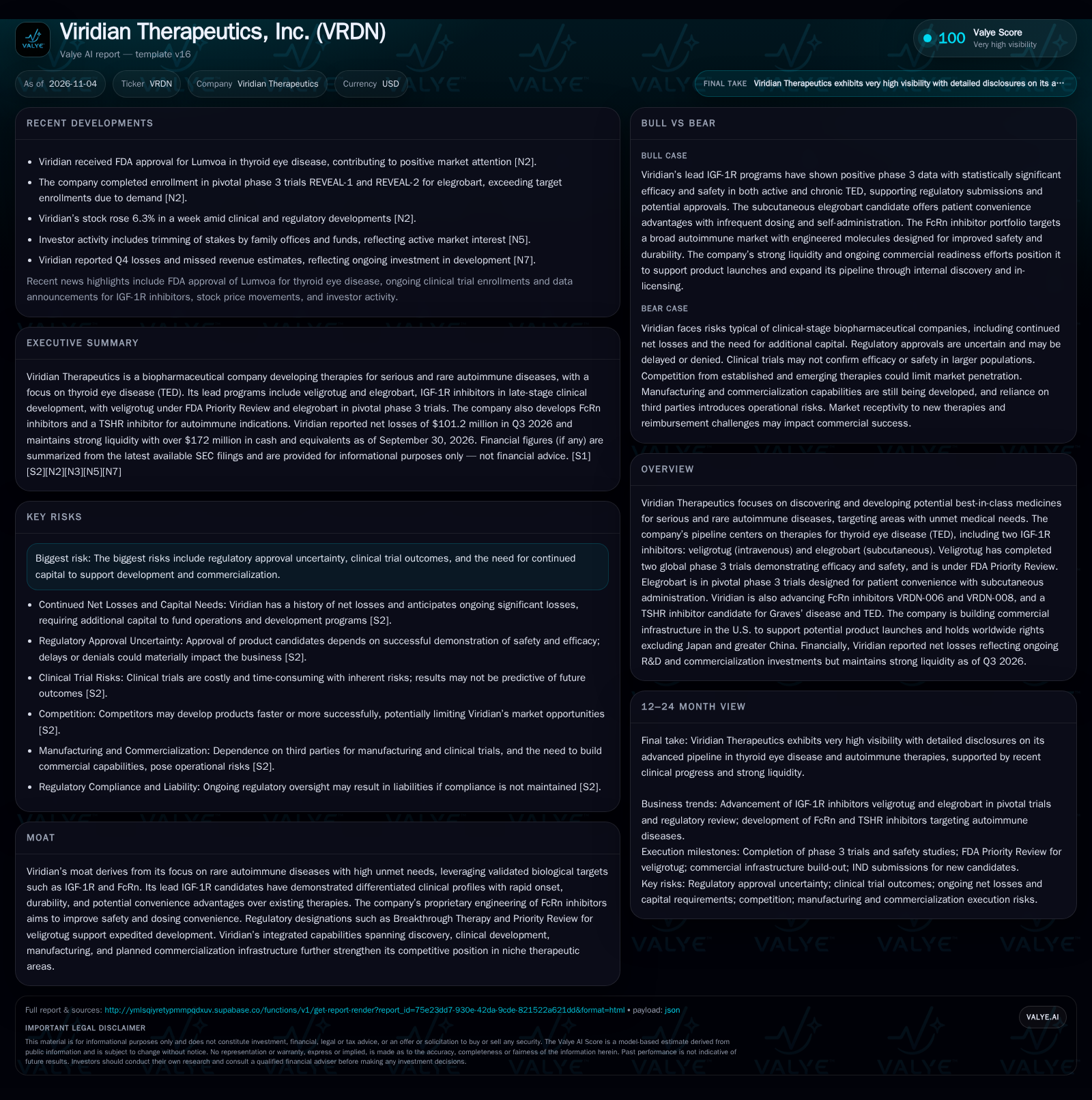
Viridian Therapeutics is at a pivotal moment, reporting its first meaningful product revenue from initial commercial sales while awaiting an FDA decision on its lead therapy, veligrotug, for thyroid eye disease. The company is also advancing multiple late-stage and early-phase assets targeting autoimmune diseases, supported by reported liquidity position. The critical questions are whether Viridian can convert clinical and regulatory wins into substantial market adoption and whether its pipeline can drive long-term growth amid competitive and operational risks. [S1] [S2]
Viridian Therapeutics has reached a commercial turning point, reporting its first product revenue and standing on the cusp of a potential FDA approval for veligrotug, its intravenous therapy for thyroid eye disease. Backed by reported liquidity position and a pipeline spanning multiple autoimmune targets, Viridian is now tasked with turning clinical progress into commercial traction. The central challenge: can the company’s investments in R&D and infrastructure yield sustainable growth and competitive resilience as it faces regulatory, operational, and market adoption hurdles?
From Pipeline to Product: Viridian’s Commercial Debut and Regulatory Milestones
Viridian Therapeutics reported $24.7 million in product revenue for Q3 2026, reflecting the company’s transition from pure clinical-stage R&D to initial commercial sales, likely from its lead thyroid eye disease therapy [S2]. This inflection comes as veligrotug, its intravenous IGF-1R inhibitor, completed two global phase 3 trials and is under FDA Priority Review, with a decision expected by June 30, 2026 [S1]. The company reported cash and liquidity metrics for the period; these figures do not by themselves establish operating runway, investment capacity, financial flexibility, or financing capacity. [S2] Meanwhile, elegrobart (subcutaneous IGF-1R inhibitor) is in pivotal phase 3 trials, and FcRn/TSHR inhibitor programs are advancing, suggesting a multi-pronged late-stage pipeline targeting both immediate and future growth [S1]. These developments set the stage for Viridian’s first real test in converting clinical promise into sustainable business execution.
Revenue Potential, Cost Structure, and the Path to Operating Leverage
Viridian’s business economics are defined by the high-risk, high-reward profile typical of rare disease biopharma. The company’s reported $25.8 million in Q3 2026 revenue, with $24.7 million from product sales, marks the beginning of a potential revenue ramp as more therapies progress through regulatory review and launch phases [S2]. Rare disease therapeutics often command premium pricing due to limited competition and high unmet need, but initial volumes can be modest and heavily dependent on physician adoption, payer coverage, and patient identification.
The underlying cost structure is currently dominated by R&D and pre-commercialization expenses, as reflected in a $101.2 million net loss for Q3 and $333.2 million for the first nine months of 2026 [S2]. Operating leverage could improve significantly if product adoption scales, since manufacturing and commercial infrastructure investments are largely fixed over the near term. However, the transition to profitability is contingent on both regulatory success and the pace at which Viridian can gain market traction and reimbursement for its therapies.
Capital needs remain a central consideration. The ability to manage these dynamics—balancing investment in pipeline breadth with disciplined commercial scaling—will be a key determinant of long-term value creation.
Differentiation in a Crowded Rare Disease Landscape
Viridian’s competitive position hinges on its focus within rare autoimmune diseases, particularly thyroid eye disease, where current therapeutic options are limited and often suboptimal. The company’s IGF-1R inhibitors, veligrotug and elegrobart, aim to differentiate through rapid onset, durability, and—especially in the case of elegrobart—subcutaneous, less frequent dosing. These features could provide meaningful advantages in patient convenience and adherence compared to intravenous competitors and older immunosuppressive regimens.
However, the rare disease space is dynamic, with both incumbent therapies and new entrants pursuing similar targets. Established pharmaceutical companies and emerging biotechs are advancing alternative IGF-1R inhibitors, FcRn modulators, and other biologics for TED and broader autoimmune indications. The degree of clinical differentiation, real-world efficacy, safety profile, and payer acceptance will drive Viridian’s ability to capture and sustain share. Importantly, the company’s proprietary engineering of FcRn inhibitors and early TSHR inhibitor program could open additional markets if these assets succeed in demonstrating superior efficacy or convenience.
Barriers to entry in rare diseases can be high due to the need for specialist sales forces, deep clinical relationships, and patient identification infrastructure. As Viridian builds out its commercial platform, the question is whether it can establish a reputation for clinical excellence and patient support before larger competitors respond or new modalities emerge.
Breakthrough Approval and Rapid Uptake: How Viridian Could Outperform Expectations
A favorable scenario for Viridian involves FDA approval of veligrotug by the June 30, 2026 PDUFA date, followed by rapid commercial uptake, especially among patients with active and chronic thyroid eye disease who have limited effective options [S1]. If elegrobart’s pivotal trials confirm both efficacy and the convenience of subcutaneous self-administration, Viridian could further expand its addressable market, tapping into patients and providers who prefer less invasive, infrequent dosing.
Upside would be amplified if FcRn and TSHR inhibitor programs achieve early clinical wins, opening pipeline options beyond TED and into broader autoimmune disorders. Strong payer coverage and positive real-world outcomes would drive higher-than-expected adoption rates, accelerating operating leverage and reducing the need for dilutive capital raises.
This scenario would be confirmed by: (1) FDA approval of veligrotug on or ahead of schedule; (2) rapid sequential revenue growth post-launch; (3) positive phase 3 data for elegrobart; and (4) meaningful clinical milestones from FcRn/TSHR programs. Evidence of strong physician and patient uptake, broad payer coverage, and expansion into new indications would further validate the upside case.
Execution Hurdles and Gradual Commercial Ramp Define the Most Likely Trajectory
The most plausible scenario for Viridian is a mix of regulatory and commercial progress tempered by the realities of market entry in rare disease. Veligrotug may achieve FDA approval, but initial uptake could be moderate as the company navigates payer negotiations, physician education, and competitive responses. Elegrobart’s pivotal data may support approval and differentiation, but manufacturing, distribution, or reimbursement challenges could slow early adoption.
This scenario would be confirmed by: (1) timely but not accelerated regulatory approvals; (2) sequential but measured growth in product revenue; (3) continued high R&D and SG&A spend relative to sales; and (4) incremental, rather than transformative, clinical progress in pipeline assets. Delays in payer coverage, physician adoption, or manufacturing scale-up would further support a base-case trajectory.
Regulatory, Commercial, or Clinical Setbacks Could Derail the Transition
A downside scenario could materialize if veligrotug faces regulatory delays, negative FDA feedback, or post-approval safety concerns, undermining the commercial launch and delaying revenue inflection. If elegrobart’s phase 3 trials fail to confirm efficacy or safety, the subcutaneous program—critical for differentiation—could be significantly impaired.
Competitive pressures could intensify if alternative therapies demonstrate superior efficacy, safety, or convenience, or if larger players accelerate their market entry. Payer pushback, restrictive reimbursement policies, or slower-than-expected physician uptake could further constrain growth. Operational risks, such as manufacturing setbacks or supply chain disruptions, would compound these challenges.
This scenario would be confirmed by: (1) FDA rejection or significant delay of the veligrotug BLA; (2) disappointing top-line data from elegrobart or pipeline programs; (3) stagnant or declining product revenue; and (4) a rapid drawdown of cash reserves without compensatory revenue growth. Evidence of lost market share, negative safety signals, or difficulty scaling commercial operations would further validate the downside case.
Milestones and Metrics That Will Shape Viridian’s Rare Disease Ambitions
FDA decision for veligrotug—timing, label scope, and any post-marketing requirements will be pivotal for near-term revenue and market positioning.
Pivotal phase 3 trial results and regulatory filing progress for elegrobart, especially data on efficacy, safety, and dosing convenience.
Quarterly product revenue growth and trajectory of new patient starts, if disclosed, to gauge initial commercial traction.
Payer coverage rates, formulary status, and patient access hurdles for TED therapies, as these will directly impact adoption speed.
Progression of FcRn and TSHR inhibitor programs—specifically, clinical trial initiations, top-line data, and regulatory submissions.
Cash burn rate and remaining liquidity, especially in relation to planned commercial and R&D investments.
Expansion and effectiveness of U.S. commercial infrastructure, including sales force deployment and supply chain readiness—any delays or bottlenecks would be material.
Competitive developments in IGF-1R, FcRn, and TSHR inhibition spaces—new data releases, approvals, or launches from peer companies.
Disclaimer: This is research-only, informational analysis and not investment advice. It may include AI-generated interpretation and general industry context. Always verify important details using primary sources.

Comments