
CVS Health’s Breakup Gambit: Integrated Model Undergoes Strategic Disassembly
CVS Health’s decision to split into two public companies—separating healthcare solutions from retail pharmacy—marks a pivotal moment for a diversified healthcare giant.
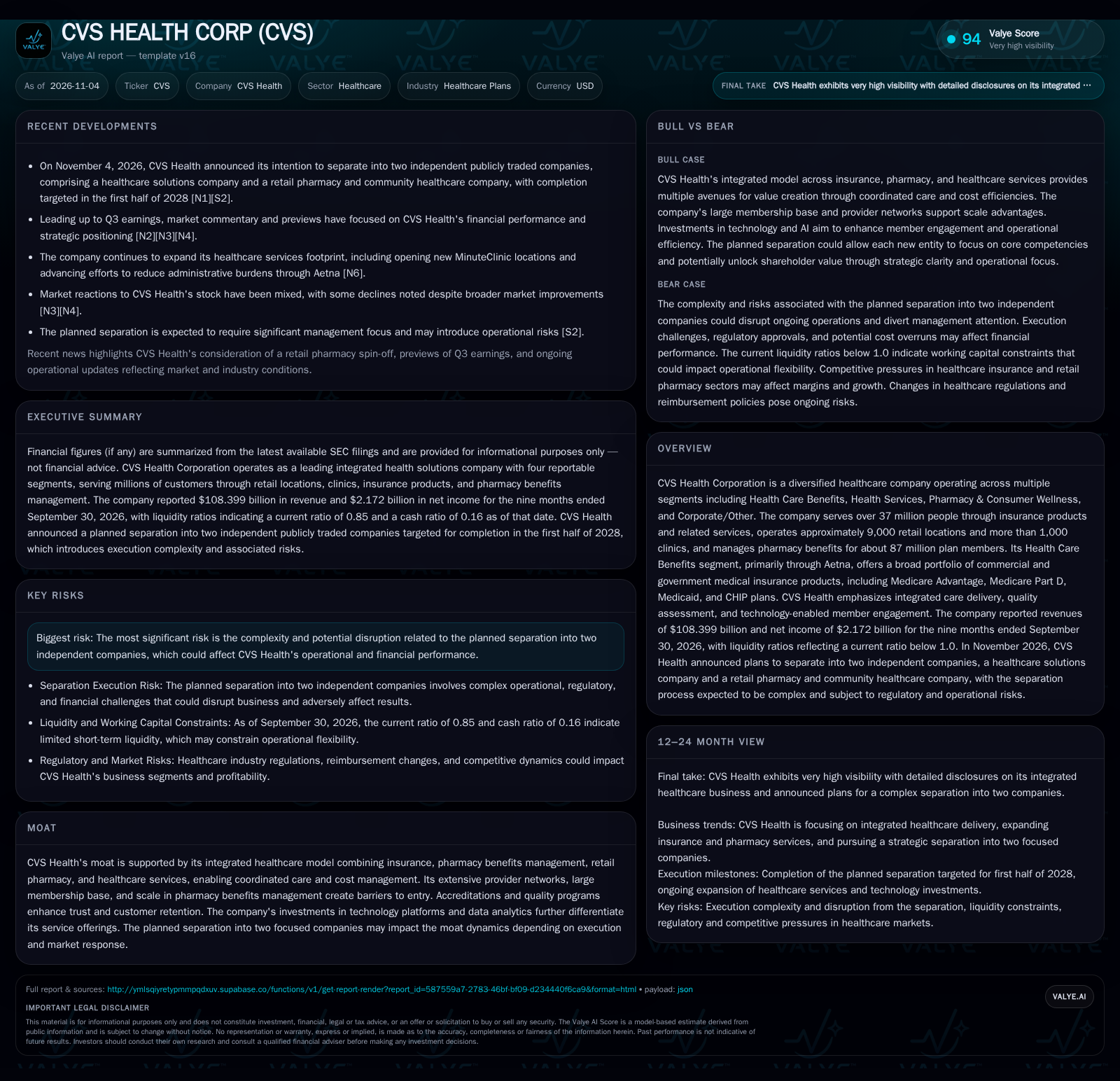
CVS Health will split into two independent companies by 2028, dividing healthcare solutions and retail pharmacy/community care. The company’s current ratio of 0.85 signals tight short-term liquidity. The separation aims to unlock value and sharpen strategic focus but brings significant execution, regulatory, and operational risks. CVS’s scale in insurance, pharmacy benefits management, and retail positions both entities strongly—if transition risks are managed.[S2] [N1]
CVS Health is embarking on one of the most ambitious restructurings in the healthcare industry: a planned split into two independent public companies, separating its healthcare solutions businesses from its retail pharmacy and community healthcare operations. The next 18–24 months will test whether the sum of the parts can outshine the complexity of the whole.
Separation Announcement Reshapes CVS Health’s Strategic Trajectory
On November 4, 2026, CVS Health announced plans to separate into two independent, publicly traded companies: a healthcare solutions company (housing Aetna, Caremark, specialty pharmacy, Oak Street Health, and Signify Health) and a retail pharmacy/community healthcare company (encompassing retail pharmacy, mail pharmacy, MinuteClinic, and Health100 technology).[S2] [N1] This complex transaction is targeted for completion in the first half of 2028 and is intended to be tax-free for U.S. federal income tax purposes.
The company reported a current ratio of 0.85 for the period. [S2]
The company exited the individual public health insurance exchanges in January 2026, which may shift the insurance segment’s growth profile and increase dependence on government and employer group contracts.[S2]
Federal government contracts accounted for approximately 20% of consolidated revenues in 2025, highlighting CVS’s exposure to regulatory and policy dynamics.[S2]
Integrated Economics and the Challenge of Capital Allocation Under Separation
CVS Health’s business model has long been defined by vertical integration—combining insurance (Aetna), pharmacy benefits management (Caremark), specialty pharmacy, retail pharmacy, and clinics under one roof. This structure enables cross-segment synergies, such as steering patients to owned pharmacies and clinics for lower costs and better care coordination. The company’s scale—87 million PBM members, 37 million insurance customers, and 9,000 retail locations—creates negotiating leverage with drug manufacturers and providers.
Revenue is generated through premiums, service fees, prescription dispensing, and healthcare services. Insurance and PBM margins are typically lower but benefit from scale, while retail pharmacy and specialty pharmacy can offer higher per-unit margins but are more exposed to reimbursement pressure and retail competition. Fixed costs are substantial, especially in retail and technology, but the company’s size historically provided operating leverage.
The planned separation will fundamentally alter capital allocation and cost structures. The healthcare solutions business (insurance, PBM, specialty) could focus on technology, care management, and risk-based contracts, while the retail/community unit may prioritize store optimization, front-end retail innovation, and local care delivery. [S2]
The exit from individual exchanges reduces exposure to potentially volatile, lower-margin plans, but could also limit top-line growth if government and employer markets become more competitive or face reimbursement cuts.
Reshaping the Moat: Integration, Scale, and the Risks of Disaggregation
CVS’s competitive advantage has historically come from its integrated model, combining insurance, PBM, and retail assets to control more of the healthcare value chain. This allowed for differentiated member engagement, scale-driven cost advantages, and data-driven care management. The company’s extensive provider network (~2 million providers) and accreditations (NCQA, URAC) further reinforce its position.[S2]
A split may undermine some of these advantages. Standalone healthcare solutions and retail pharmacy companies could lose some of the coordination benefits that reduce costs and improve outcomes. Competitors in each segment—such as standalone insurers, PBMs, specialty pharmacies, and retail chains—may find new opportunities to win share if CVS’s internal referral and data flows are disrupted.
On the other hand, each business could become more agile and focused. The healthcare solutions company could compete more directly with major insurers and PBMs, while the retail/community business could sharpen its local healthcare delivery and consumer engagement strategies. The risk is that disruption during separation provides an opening for rivals, especially if execution falters or customer relationships are affected.
Technology investments, particularly in cloud and AI, remain a differentiator if they enable better member targeting, risk adjustment, and operational efficiency. However, the question is whether these platforms will remain seamlessly interoperable across the new entities, or if value will be lost in the transition.
Strategic Clarity Unlocks Value: How a Clean Separation Could Drive Outperformance
In the most favorable scenario, CVS executes a smooth, tax-free separation, enabling each new company to focus on its core strengths. The healthcare solutions business, unburdened by retail complexity, could accelerate investments in technology, value-based care, and specialty pharmacy, deepening relationships with employers, government, and providers. The retail/community company could revitalize its store base, expand clinics, and integrate technology to capture a larger share of local healthcare and consumer spending.
If both entities achieve operational excellence, the market may reward them with higher multiples reflecting clearer strategic focus and improved capital allocation. The ability to maintain or grow federal and employer contracts, leverage existing technology investments, and avoid major customer or provider attrition would support this case.
Upside confirmation would come from early regulatory approvals, minimal customer churn, retention of major contracts, and signs that both businesses are attracting new partnerships or expanding margins post-separation. Announcements of new technology deployments, cost efficiencies, or growth in core metrics (PBM membership, insurance enrollment, clinic visits) would further validate the upside thesis.
Managing Complexity: A Transitional Period of Uncertainty and Incremental Progress
The most plausible scenario is a drawn-out separation process characterized by incremental progress and periodic setbacks. Management spends significant energy on regulatory approvals, IT disentanglement, and legal structuring, leading to occasional operational distractions or increased costs. Both entities maintain core customer relationships but may struggle to generate outsized growth or margin expansion until the transition is complete.
Retail and insurance businesses face ongoing competitive and reimbursement pressures, with modest improvements in technology-driven engagement and cost management. Liquidity remains tight, so capital investments are prioritized carefully, and any missteps could constrain flexibility.[S2]
Evidence for this base scenario would include steady-to-slightly-improving financials, no major customer or provider losses, and timely updates on separation milestones. However, lack of major contract wins, further margin compression, or regulatory delays would signal the challenges of executing such a complex transaction.
Separation Stumbles: Operational Disruption, Liquidity Strain, and Competitive Encroachment
The adverse scenario involves significant execution failures—regulatory delays, IT integration issues, or management distraction—causing operational disruptions. Customer or provider attrition could accelerate if service levels drop or competitors exploit uncertainty.
If major government contracts are lost or reimbursement rates are cut, both revenue and margin could come under pressure. The retail/community business could be particularly vulnerable to front-end retail weakness or pharmacy reimbursement headwinds, while the healthcare solutions entity might struggle if technology investments are delayed or scale advantages are eroded.
Confirmation of the downside scenario would include negative operating cash flow, covenant breaches (if disclosed), major contract losses, regulatory setbacks, or public evidence of customer churn. Any sign that capital-raising becomes necessary under distressed terms would further validate this risk case.
Milestones and Metrics That Could Define CVS Health’s Breakup Outcome
Progress toward regulatory and board approvals for the planned separation; delays or new conditions would affect the timetable and risk profile.
Trends in PBM membership, insurance enrollment, and retail pharmacy prescription volumes—if disclosed—would indicate whether core business lines are retaining or losing share during transition.
Updates on liquidity and working capital management, including any new financings, credit facility amendments, or evidence of tightening cash flow.
Retention or renewal of large federal government contracts, which account for a significant portion of consolidated revenue.
Evidence of customer or provider attrition, especially if service levels decline or competitors gain share in pharmacy, insurance, or clinics.
Disclosures on IT disentanglement costs, technology platform interoperability, and transition-related operating expenses.
Announcements of new partnerships, technology rollouts, or clinic expansions that demonstrate the ability to execute growth strategies despite separation complexity.
If disclosed, margin trends in each segment post-separation, which would help assess whether operational focus is translating into improved profitability.
Disclaimer: This is research-only, informational analysis and not investment advice. It may include AI-generated interpretation and general industry context. Always verify important details using primary sources.

Comments