
Hut 8’s Power-First Strategy: Scaling Energy Infrastructure for the AI and Compute Era
Hut 8 is rapidly evolving from a Bitcoin-centric operator into a vertically integrated energy infrastructure platform targeting AI, HPC, and next-generation compute workloads. With a substantial development pipeline, active capital deployment, and a power-first approach, the company’s future will hinge on its ability to manage energy procurement, monetize data center assets, and navigate volatile end-markets.
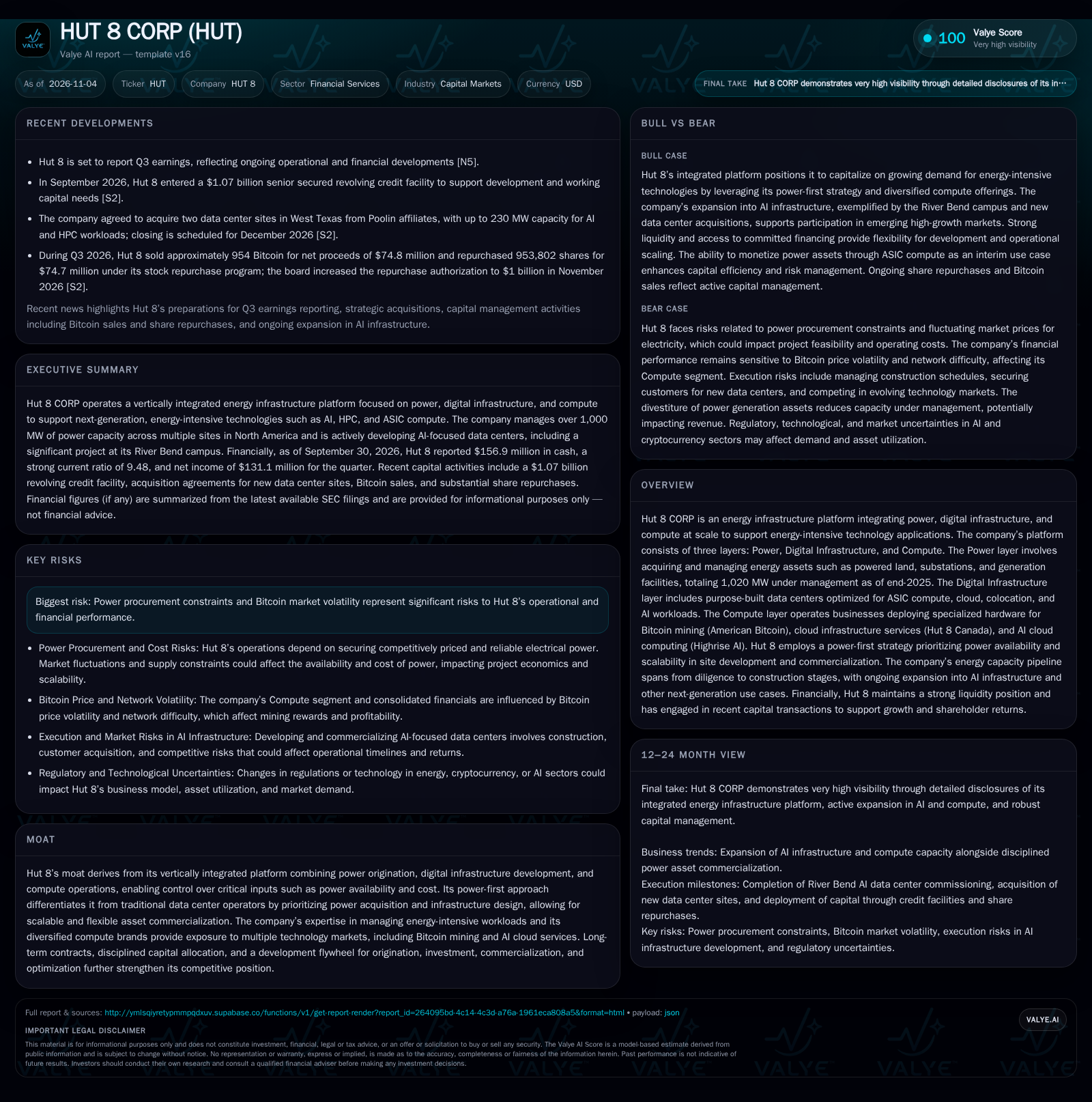
Hut 8 is leveraging its vertically integrated platform—spanning power origination, digital infrastructure, and compute—to capture value in energy-intensive technology markets. Recent acquisitions, a large development pipeline, and a new $1.07 billion credit facility position the company for growth in AI and HPC, but success depends on execution in energy procurement, data center commercialization, and managing Bitcoin exposure. Material risks include power market volatility, execution hurdles in AI infrastructure, and sensitivity to cryptocurrency cycles. [S1] [S2] [N5]
Hut 8 CORP is at an inflection point. Once known primarily for Bitcoin mining, the company is now repositioning as a vertically integrated energy and digital infrastructure platform targeting the surging demand for AI and high-performance compute. With over 8 GW in its development pipeline, a newly secured $1.07 billion credit facility, and a clear power-first strategy, Hut 8 is expanding beyond cryptocurrency into broader, potentially more stable and lucrative markets. Yet, the company’s prospects will be determined by its execution in energy procurement, data center development, and its agility in navigating both the volatile Bitcoin market and the competitive landscape of AI infrastructure.
Substantial Expansion Ambitions, Capital Firepower, and Active Portfolio Rebalancing
Hut 8’s current posture is defined by three material developments. First, the company’s energy capacity pipeline as of September 30, 2026, totals 8,569 MW across stages from diligence to construction, including a flagship 330 MW AI data center at River Bend slated for Q2 2027 commissioning. This signals a major pivot to energy-intensive AI and HPC workloads, moving beyond its legacy focus on Bitcoin mining. Third, the company agreed to acquire two West Texas data center sites (up to 230 MW capacity) to support AI and HPC, with closing scheduled for December 2026. These moves are complemented by active capital management: in Q3 2026, Hut 8 sold 954 Bitcoin for $74.8 million and repurchased nearly 954,000 shares, with its repurchase authorization expanded to $1 billion. [S2]
How Hut 8 Could Monetize Power, Data Centers, and Compute
Hut 8’s vertically integrated platform is designed to capture value at multiple layers of the energy-to-compute stack. The Power segment originates, develops, and manages energy assets, potentially generating revenue from asset management fees (fixed based on MW under management), energy sales, and power arbitrage. The Digital Infrastructure layer builds and operates data centers optimized for ASIC, AI, cloud, and colocation workloads—where revenue may derive from leasing capacity, providing managed services, or direct compute sales.
The Compute segment includes specialized Bitcoin mining, cloud infrastructure services, and AI cloud offerings. Bitcoin mining economics are highly variable, directly tied to Bitcoin price, network difficulty, and energy costs. AI and HPC cloud services, if successfully ramped, could command premium pricing given industry-wide GPU shortages and demand for high-density, low-latency compute. However, capital requirements are significant: building and equipping large-scale data centers, particularly for AI workloads, requires up-front investment in energy infrastructure, land, cooling, and state-of-the-art hardware, which may be partially offset by customer pre-commitments or long-term contracts if secured.
Operating leverage is plausible if Hut 8 achieves high utilization on its data center assets and locks in favorable power procurement. However, the company’s ability to flex between Bitcoin mining and other compute workloads may create a capital efficiency advantage—using ASIC compute as a rapid monetization tool for power assets until higher-value AI/HPC opportunities mature. The key economic swing factors will be power costs, asset utilization rates, and the mix of spot versus contracted revenue streams.
Where Hut 8 Could Stand Out—and Where It Faces Counterforces
Hut 8’s power-first strategy—prioritizing power availability and scalability in site selection and infrastructure design—differentiates it from traditional data center operators who may be constrained by grid access or energy procurement. By integrating power origination with digital infrastructure and compute, Hut 8 seeks to control critical cost inputs and offer flexible, scalable capacity to customers in energy-hungry verticals like AI and crypto.
However, the market is becoming crowded. Large hyperscalers, utility-backed data center developers, and established colocation providers are all racing to secure low-cost, reliable power for AI and HPC. The capital intensity and long lead times for new data center builds are structural barriers, but also mean that execution missteps can be costly. In Bitcoin mining, Hut 8 faces global competition from operators with access to ultra-low-cost power and newer-generation ASIC hardware.
Switching frictions for data center customers may be meaningful if Hut 8 can deliver high uptime, low latency, and tailored services, but price sensitivity remains high in both AI cloud and cryptocurrency markets. The company’s ability to lock in long-term customers, secure power at favorable terms, and flexibly allocate capacity across use cases will determine whether its integrated model translates into durable economic advantage.
If AI and HPC Demand Unlocks Full Asset Utilization
The most favorable pathway for Hut 8 is one in which AI and HPC demand continues to outpace supply, driving strong utilization and premium pricing for new data center capacity—especially at the River Bend campus and the acquired Texas sites. If the company secures anchor tenants or long-term contracts for AI infrastructure, it could achieve attractive, recurring revenue streams with higher margins than legacy Bitcoin mining.
Confirmation would come from disclosed multi-year AI/HPC customer agreements, rapid ramp of the River Bend project, and evidence of high utilization rates across the Digital Infrastructure and Compute segments. Additional upside could be realized if the company demonstrates the flexibility to redeploy power and infrastructure assets between Bitcoin mining and AI workloads in response to market cycles, maximizing capital efficiency.
Falsification would be indicated by persistent underutilization of new capacity, delays in commissioning key projects, or failure to secure institutional AI/HPC customers willing to pay premium rates.
Scaling with Execution Hurdles and Market Volatility
A middle-ground scenario sees Hut 8 successfully expanding its power and data center footprint, but facing typical execution challenges: construction delays, customer ramp-up periods, and competitive pricing pressure. The Bitcoin mining segment remains volatile, with results swinging based on crypto cycles, while AI/HPC infrastructure ramps more gradually as customers test and validate new facilities.
In this scenario, the company’s capital structure—anchored by the $1.07 billion credit facility and active asset management—provides operational flexibility, but returns are mixed and project-dependent. Confirmation would come from steady sequential growth in managed MW, incremental AI/HPC customer wins, and a balance between Bitcoin asset monetization and infrastructure development. Falsification would be signaled by missed project milestones, cost overruns, or an inability to transition sites from ASIC compute to higher-value uses.
When Power Constraints or Crypto Shocks Derail the Platform Play
The adverse scenario is triggered if Hut 8 encounters power procurement constraints—such as grid bottlenecks, regulatory delays, or unfavorable energy pricing—that undermine the economics of its data center projects. Alternatively, a severe downturn in Bitcoin prices or a sharp rise in network difficulty could erode the profitability of the Compute segment, especially if AI/HPC demand fails to materialize at anticipated levels.
Confirmation of this scenario would include project cancellations or significant delays, disclosures of power supply setbacks, or large write-downs on underutilized assets. Prolonged underperformance in the Compute segment, especially if not offset by AI/HPC revenue, would further confirm downside risks.
Milestones and Data Points That Will Determine Hut 8’s Trajectory
Commissioning timeline and customer ramp for the River Bend AI data center—actual delivery and occupancy rates would be decisive.
Progress and terms of the West Texas data center acquisitions, including the speed of integration and initial customer commitments.
Disclosure of long-term AI/HPC customer contracts, pricing, and utilization rates—if disclosed, these would test demand for high-density compute.
Updates on energy procurement costs and availability, particularly for new and developing sites.
Trends in Bitcoin production, realized pricing, and network difficulty—persistent volatility here directly impacts Compute segment economics.
Utilization rates and revenue mix between Bitcoin mining, AI/HPC, and traditional cloud/colocation.
Capital deployment pace from the $1.07 billion credit facility and returns on new projects.
Evidence of successful transitions of sites from ASIC compute to higher-value AI or cloud workloads, including timing and economics—would help test the thesis.
Disclaimer: This is research-only, informational analysis and not investment advice. It may include AI-generated interpretation and general industry context. Always verify important details using primary sources.

Comments