
QuidelOrtho: Diversification Tested as Respiratory and China Risks Reshape Diagnostics Economics
QuidelOrtho’s Q3 2026 outperformance is overshadowed by a lowered full-year outlook, highlighting the company’s vulnerability to shifting demand in respiratory diagnostics and exposure to China.
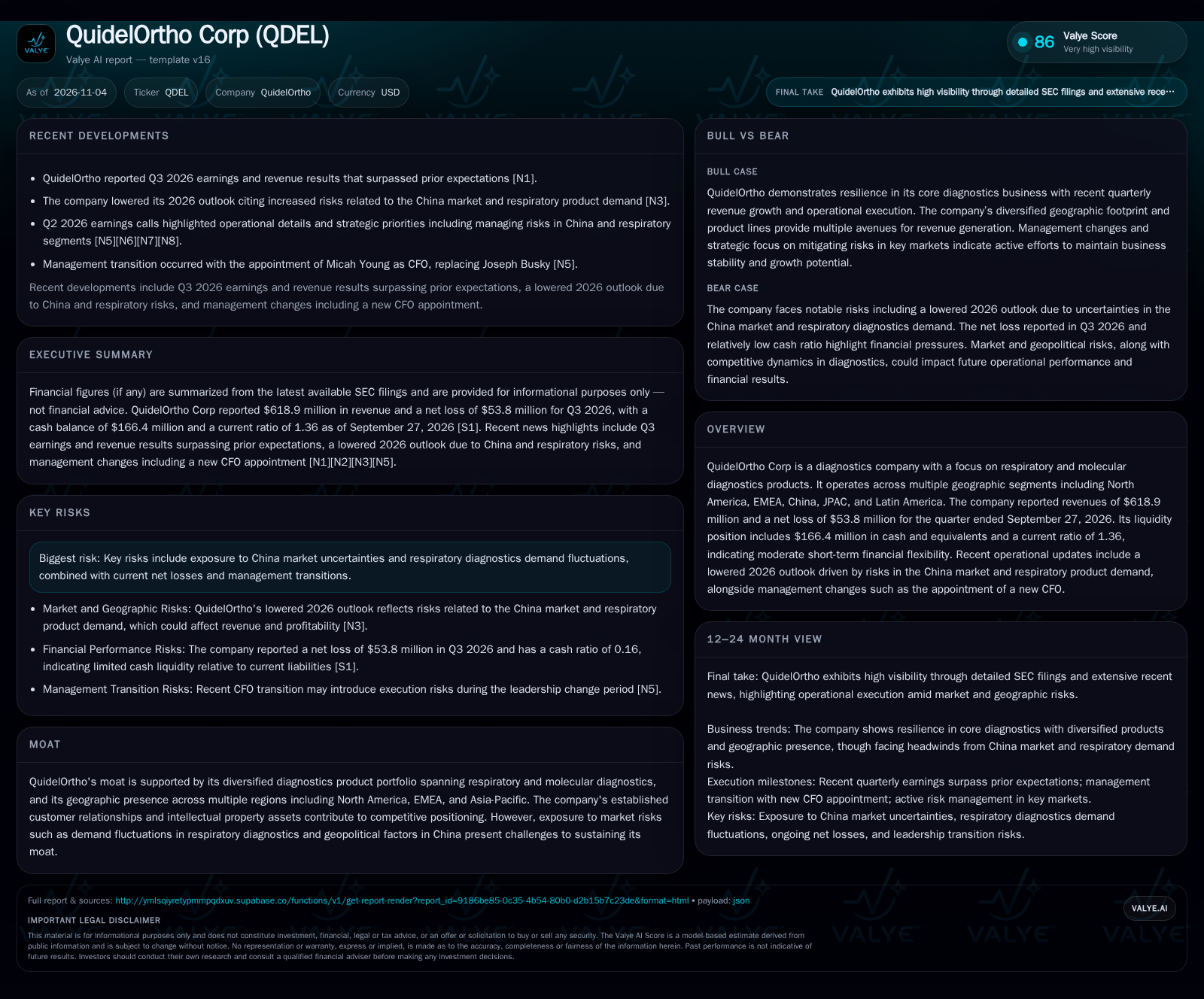
QuidelOrtho exceeded Q3 2026 expectations but faces a lowered outlook due to China and respiratory demand risks. The company reported $618.9 million in revenue and a $53.8 million net loss for the quarter, with a reported cash balance and recent CFO transition. Future performance will hinge on managing geographic risks, product mix, and maintaining operational agility as the diagnostics market evolves. [S1] [N1] [N3] [N5]
QuidelOrtho Corp enters late 2026 at a strategic crossroads. While Q3 results beat expectations, the company’s net loss and a downwardly revised outlook reveal mounting pressures from both macro (China market weakness) and micro (respiratory product demand) fronts. With $166.4 million in cash and a new CFO tasked with navigating these headwinds, QuidelOrtho’s next phase will depend on its ability to rebalance its diagnostics portfolio and adapt to regional volatility. The question is whether a diversified footprint and product base can offset the acute risks now reshaping its economics and capital allocation.
Late 2026 Snapshot: Outperformance Marred by Outlook Revision and Leadership Change
QuidelOrtho reported Q3 2026 revenues of $618.9 million, surpassing prior expectations, yet posted a net loss of $53.8 million and EPS of -$0.78 per share [S1] [N1]. This juxtaposition of top-line strength and bottom-line weakness highlights the company’s profitability hurdles. The company reported cash and liquidity metrics for the period; these figures do not by themselves establish operating runway, investment capacity, financial flexibility, or financing capacity. [S1] The company lowered its 2026 outlook, citing rising risks in China and respiratory diagnostics demand—two pillars of its recent growth strategy [N3]. A management shakeup saw Micah Young replace Joseph Busky as CFO, a move that may signal a need for tighter financial controls and fresh operational discipline [N5].
Diagnostics Revenue Streams: The Mechanics of Diversification and Margin Pressure
QuidelOrtho’s revenue model is anchored in the sale of diagnostic tests and related products across respiratory (including flu and COVID-19), molecular diagnostics, and broader clinical areas. Revenues are generated through a mix of direct sales to hospitals, clinics, and laboratories, as well as distribution through channel partners. Product mix is critical: respiratory diagnostics tend to be high-volume and can swing sharply due to seasonality, pandemic waves, or public health trends. Margins in diagnostics are typically higher on proprietary, rapid, or molecular assays versus commoditized or legacy formats.
Operating leverage in this space can be substantial: fixed costs for R&D, manufacturing facilities, and regulatory compliance are high, but incremental gross margins improve with higher test volumes. However, the recent net loss despite revenue beats suggests that variable costs—perhaps from lower-margin products, adverse geographic mix, or pricing pressure—are eroding profitability. Capital needs revolve around inventory management, working capital for global operations, and ongoing investment in product innovation to stay ahead of technological obsolescence.
Absent explicit disclosure, it is plausible that QuidelOrtho’s China exposure involves both pricing risk (from local competitors and reimbursement changes) and volume volatility (from shifting public health policies), which could compress margins further if not offset by gains in higher-growth or higher-margin segments elsewhere.
How Regional Exposure and Product Breadth Shape Competitive Defensibility
QuidelOrtho’s moat is rooted in its diversified diagnostic portfolio and broad geographic reach. Its ability to serve multiple markets—North America, EMEA, China, JPAC, and Latin America—mitigates dependence on any single region, but rising China risk exposes the limits of this strategy. The diagnostics industry is characterized by rapid technological innovation, regulatory complexity, and entrenched relationships with healthcare providers. Intellectual property, regulatory clearances, and breadth of test menu are traditional barriers.
However, competition is fierce: global diagnostics leaders (including other multinational firms and regional specialists) continually invest in next-generation molecular platforms, point-of-care solutions, and integrated data capabilities. Substitution risk comes from emerging technologies (e.g., digital diagnostics, at-home testing), aggressive pricing by local players in China, and public health shifts reducing demand for specific test categories. The company’s defensibility may depend on its ability to maintain clinical relevance, pricing discipline, and operational agility—especially as respiratory test demand becomes less predictable and as China’s market dynamics become more challenging.
If Product Mix Shifts and Geographic Risks Are Managed, Profitability Could Rebound
A favorable outcome for QuidelOrtho would require stabilizing respiratory diagnostics demand, successfully shifting product mix toward higher-margin molecular and specialty tests, and mitigating China exposure through either cost controls or market diversification. Confirmation of this scenario would come from sustained revenue growth in non-respiratory segments, gross margin improvement, and evidence of pricing power or share gains in North America and EMEA.
Signs of effective risk management in China—such as cost reductions, successful renegotiation of distributor relationships, or expansion in less volatile Asian markets—would further support a rebound. If the new CFO implements tighter cost controls and operational efficiencies, net losses could narrow, restoring investor confidence and freeing up capital for innovation and selective expansion. This scenario would likely be accompanied by positive revisions to guidance and improved cash flow metrics.
Most Likely Trajectory: Margin Recovery Lags as Global Risks Persist
The most plausible near-term path is one of modest sequential improvement in operational execution, but with continued margin pressure and earnings volatility. Respiratory diagnostics volumes may stabilize but not return to pandemic-era highs, while China remains a drag on both pricing and volume. Incremental gains in North America and EMEA could offset some of the weakness, but gross margin recovery may be sluggish if the company cannot fully shift its mix to higher-value segments.
The market may remain in a wait-and-see mode until there is clearer evidence of sustainable profitability and strategic clarity.
Margin Erosion Deepens if China and Respiratory Headwinds Persist
In a more adverse scenario, respiratory diagnostic volumes could disappoint further due to mild flu seasons, lower COVID-19 testing demand, or public health policy shifts. If China market risks intensify—through regulatory changes, reimbursement cuts, or local competition—QuidelOrtho could face outright declines in revenue and sharper margin compression.
Signs of this scenario would include negative trends in gross margin, deteriorating working capital, and management guidance focused on cost-cutting or restructuring. If the new CFO’s initiatives fail to gain traction, execution risk could rise, further undermining confidence and strategic flexibility.
Testing the Resilience Thesis: What Will Determine QuidelOrtho’s Next Phase?
Sequential changes in gross margin, especially as product mix evolves between respiratory, molecular, and specialty diagnostics, would help clarify trajectory.
Revenue growth or contraction in China and the broader Asia-Pacific region—if disclosed—will be a direct signal of risk management success or failure.
Quarterly cash flow from operations is a concrete indicator of whether the business is becoming more self-sustaining or burning through cash.
Updates on the pace and impact of cost control initiatives under the new CFO, particularly in SG&A and R&D spending, would test management execution.
Disclosures on distributor or partnership renegotiations in China and other risk markets would signal progress on geographic diversification.
Growth in non-respiratory diagnostics revenue—such as oncology or other specialty categories—would demonstrate success in product diversification.
Any commentary or data on pricing trends and competitive intensity, especially in core markets, would help assess margin outlook.
Evidence of inventory buildup or write-downs could indicate demand misalignment or operational challenges.
Disclaimer: This is research-only, informational analysis and not investment advice. It may include AI-generated interpretation and general industry context. Always verify important details using primary sources.

Comments