
Celanese in Late 2026: Pricing Resilience, Commodity Exposures, and the Stakes of Capital Allocation Discipline
Celanese’s Q3 2026 results highlight a company leveraging pricing power to offset volume headwinds, while maintaining substantial liquidity and capital return optionality. As industry cyclicality and input costs remain volatile, the focus shifts to whether operational discipline and portfolio integration can sustain earnings quality and shareholder returns.
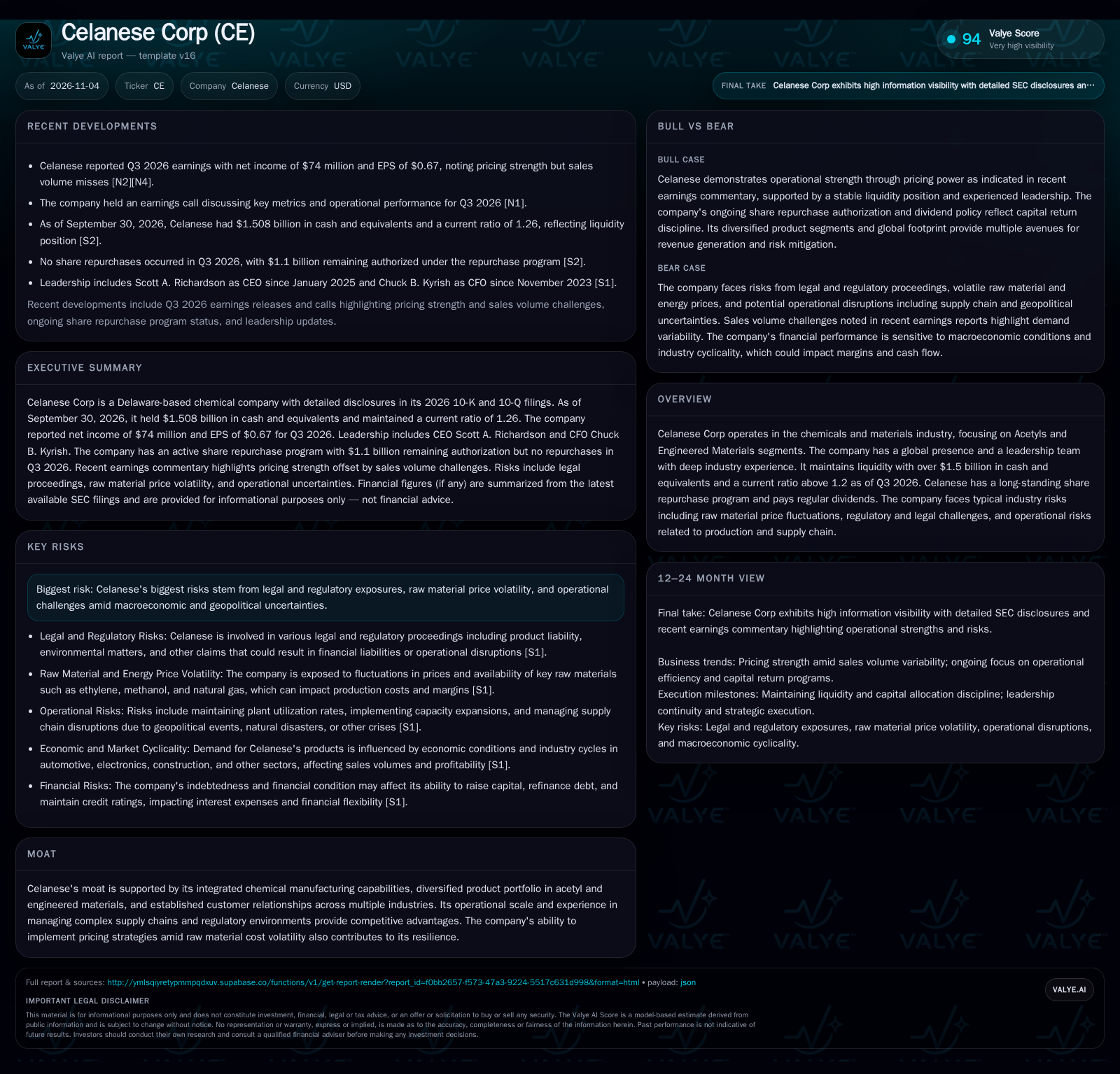
Celanese ended Q3 2026 with $1.5B in cash, a current ratio of 1.26, and $1.1B in remaining share repurchase authorization, but did not repurchase shares during the quarter. Net income for Q3 was $74M, reflecting earnings resilience amid sales volume pressures. The company’s ability to sustain margins and capital returns despite raw material volatility and industry cyclicality is the central thesis test for the next 12-24 months. [S2]
Celanese Corp’s latest financials offer a snapshot of a chemical company navigating sector volatility with disciplined capital allocation and operational resilience. The firm’s Q3 net income of $74 million, achieved amid pressured sales volumes, underscores its reliance on pricing strategies to preserve margins. As raw material volatility and cyclical demand continue to shape the landscape, the core question for investors is whether Celanese’s balance-sheet strength and portfolio breadth can outlast macro headwinds and support continued shareholder returns. [S2]
Q3 2026 Earnings: Navigating Margin Stability and Capital Flexibility
Notably, Celanese did not repurchase any shares in Q3, leaving $1.1 billion authorized for future buybacks, which signals a disciplined or opportunistic approach to capital returns rather than immediate deployment. Net income for the quarter was $74 million, with diluted EPS of $0.67, reflecting profitability despite sales volume pressures. These facts frame a company managing through cyclical and input-cost turbulence by prioritizing margin defense and maintaining capital return levers. [S2]
Revenue Drivers: Pricing Strategy, Product Mix, and Integration Benefits
Celanese generates revenue primarily through its Acetyls and Engineered Materials segments, supplying essential chemicals and advanced polymers to a diversified end-market base including automotive, construction, electronics, and consumer goods. In commodity-facing acetyls, margins are sensitive to raw material input costs—especially methanol, acetic acid, and natural gas—while pricing power is often cyclical and dependent on supply-demand tightness. Engineered Materials, by contrast, may offer higher and more stable margins through specialty applications, product customization, and closer customer integration.
The company’s integrated manufacturing footprint allows for some control over feedstock costs and operational efficiencies, which can support margin stability when input prices are volatile. However, fixed asset intensity and high operating leverage mean that plant utilization rates are critical: underutilization can sharply erode profitability, while high throughput amplifies returns. Celanese’s cash flow generation is thus a function of both top-line pricing/volume dynamics and bottom-line cost discipline, with capital expenditures needed to maintain and expand capacity as well as meet regulatory and safety standards.
Capital allocation remains a central lever: with a history of dividends and a sizable buyback authorization, Celanese can return capital to shareholders, but must balance this against debt management, reinvestment needs, and the risk of cyclical downturns eroding cash flows. The absence of Q3 buybacks suggests either a cautious stance on valuation, a preference for liquidity, or anticipation of future opportunities.
Assessing Celanese’s Market Position: Scale, Integration, and Substitution Risks
Celanese’s competitive position is built on integrated chemical manufacturing, scale in both acetyls and specialty polymers, and established customer relationships across diverse industries. These strengths can enable cost leadership, reliable supply, and the ability to tailor offerings to customer needs, especially in Engineered Materials where switching costs may be higher due to application specificity and technical requirements.
However, the company operates in a sector where commodity cycles, global overcapacity, and raw material price swings can rapidly compress margins. Competitors—ranging from global diversified chemical giants to regional specialty producers—can erode pricing power, especially in more commoditized product lines. Substitution risk is also material: downstream customers may shift to alternative materials (such as bioplastics or metals), particularly if regulatory or sustainability pressures intensify.
The ability to manage complex supply chains and regulatory environments is a differentiator, but also a source of risk if geopolitical or trade disruptions escalate. Ultimately, Celanese’s moat depends on its execution in portfolio management, operational reliability, and the agility to respond to shifting end-market and input cost dynamics.
Potential for Margin Growth Through Sustained Pricing and Volume Improvement
An upside scenario for Celanese centers on sustained pricing strength in key product lines, supported by stable or falling raw material costs and a recovery in end-market demand—particularly in automotive, construction, and electronics. This would enable the company to expand margins, generate robust free cash flow, and deploy its $1.1 billion buyback authorization to enhance shareholder returns. Successful integration of any recent portfolio additions, cost rationalization, and further penetration of higher-margin specialty applications could amplify earnings leverage.
Evidence that would confirm this scenario includes sequential improvement in sales volumes, margin expansion despite raw material volatility, and increased capital returns—either through resumed buybacks or dividend growth. Additionally, positive commentary from management on order pipelines, plant utilization, and customer contract renewals would signal demand stability and pricing discipline. Conversely, failure to resume buybacks or evidence of margin compression despite stable input costs would challenge the upside case.
Forecasting Earnings Under Cyclical Pressures and Capital Discipline
The most plausible path for Celanese is continued earnings stability, with modest growth or flat performance as pricing actions largely offset volume headwinds. The company’s integrated operations and product diversification help buffer against sharp shocks but do not fully insulate it from swings in end-market demand or raw material prices. Management is likely to maintain discipline on capital allocation—balancing dividends, opportunistic buybacks, and reinvestment in core operations—while preserving liquidity against potential downturns.
If volumes remain under pressure but margins hold due to effective pricing, or if the company continues to prioritize liquidity over aggressive capital returns, the base case remains intact. Signs of deteriorating utilization rates, sustained volume declines, or major input cost shocks would challenge this middle-path outlook.
Risks to Earnings from Raw Material Volatility and Demand Challenges
The principal downside risk for Celanese is a combination of sharp increases in raw material or energy costs (e.g., methanol, acetic acid, or natural gas) and protracted weakness in end-market demand. In this scenario, pricing power would be insufficient to offset input inflation, leading to margin compression and reduced cash flows. Operational disruptions—whether from supply chain breakdowns, plant outages, or geopolitical events—could exacerbate these pressures.
Financial strain could then force a reduction in capital returns, with buybacks and potentially even dividends paused to preserve liquidity. Evidence for this scenario would include a sudden spike in input costs, negative revisions to volume guidance, or management commentary signaling caution on cash deployment. Regulatory or legal setbacks, or a downgrade in credit ratings, would further stress the downside thesis.
Factors Influencing Celanese’s Ability to Maintain Margins and Capital Allocation
Quarterly gross margin trends—especially the ability to maintain or expand margins despite raw material volatility—would help test the core thesis.
Sequential volume growth or stabilization in key end-markets (automotive, construction, electronics) would signal demand recovery or resilience.
Plant utilization rates and capacity expansion updates, if disclosed, would show operational leverage and efficiency.
Management commentary on raw material procurement and hedging strategies could clarify risk exposure and pricing flexibility.
Any material legal, regulatory, or environmental proceedings and their potential financial impacts should be monitored closely.
Changes in credit ratings, debt maturities, or refinancing terms would affect potential financial flexibility and capital allocation.
Disclaimer: This is research-only, informational analysis and not investment advice. It may include AI-generated interpretation and general industry context. Always verify important details using primary sources.

Comments