
First United Corporation: Dividend Ambition, Earnings Variability, and the Levers of Banking Diversification
First United Corporation’s multi-segment financial model—spanning community banking, wealth management, and trust services—offers revenue diversity but faces the familiar headwinds of earnings volatility and execution risk tied to leadership change.
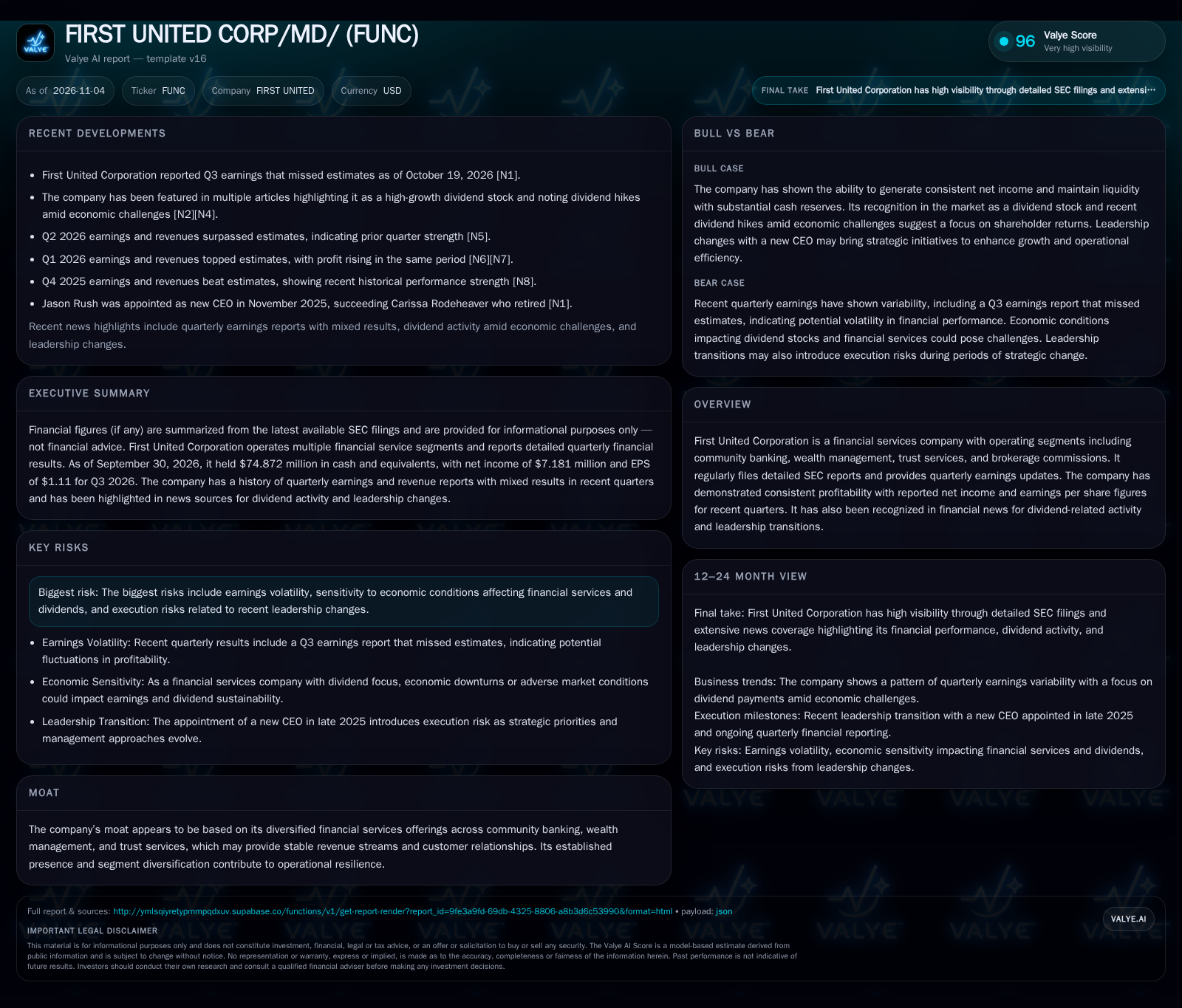
First United Corporation reported $7.181 million in net income and $1.11 EPS for Q3 2026, with $74.872 million in cash and equivalents as of September 30, 2026. Despite a Q3 earnings miss, earlier quarters in 2026 showed profit growth and estimate beats. The company remains recognized for its dividend focus and is undergoing a CEO transition, introducing both opportunity and execution risk. Segment diversification across banking and wealth management may offer resilience, but economic sensitivity and earnings volatility are persistent challenges. [S2] [N1] [N5] [N6] [N7]
First United Corporation stands at a crossroads emblematic of regional financial institutions: balancing the pursuit of shareholder dividends with the realities of volatile earnings and the uncertainties of leadership change. As the new CEO’s tenure unfolds, the real test will be whether First United’s diversified business model can deliver stable growth amid economic unpredictability and sector headwinds.
Recent Earnings Miss and Dividend Activity Shape Investor Outlook
First United Corporation reported net income of $7.181 million and EPS of $1.11 for Q3 2026, with cash and equivalents of $74.872 million as of September 30, 2026 [S2]. However, Q3 results missed analyst estimates, marking a reversal from Q1 and Q2 2026, when the company topped expectations and posted profit growth [N1] [N5] [N6] [N7]. The cited source reports dividend-related activity; that disclosure alone does not establish dividend-policy continuity, management confidence, or a material constraint on capital flexibility. The recent CEO change, completed in late 2025, overlays these results with an additional layer of strategic uncertainty.
Segment Diversification and Its Impact on Revenue Stability
First United generates revenue from community banking, wealth management, trust services, and brokerage commissions, creating multiple streams that could buffer against cyclical downturns in any single segment. Community banking typically anchors the core with net interest income, while fee-based segments like wealth management and trust services may provide more stable, less rate-sensitive contributions. However, the relative scale and margin contribution of each segment are not disclosed, making it unclear how much diversification truly dampens earnings volatility.
The cited source reports dividend-related activity; that disclosure alone does not establish dividend-policy continuity, management confidence, or a material constraint on capital flexibility. Regional banks often face a mix of fixed and variable costs: branch networks and compliance drive fixed expense, while compensation and certain technology costs can be flexed. Operating leverage may be limited if deposit growth stalls or loan losses rise in a downturn. Capital needs are dictated by regulatory requirements, loan growth ambitions, and the desire to support dividends without eroding tangible book value.
The interplay between fee-based and interest-based revenue streams is critical in understanding the stability and growth prospects of First United's financial model. Fee income from wealth management and trust services tends to be less sensitive to interest rate fluctuations, potentially acting as a natural hedge during periods of rate volatility. However, this stability depends heavily on client asset retention and the ability to attract new assets under management, which are influenced by market performance and client trust. Conversely, community banking revenues, primarily driven by net interest income, are more directly impacted by monetary policy shifts and credit cycles, which can introduce earnings volatility. The balance and growth trajectory of these segments will therefore determine the extent to which diversification can mitigate cyclical risks.
The cited source reports dividend-related activity; that disclosure alone does not establish dividend-policy continuity, management confidence, or a material constraint on capital flexibility. The flexibility to reallocate capital across segments or invest in technology and infrastructure improvements can enhance competitive positioning but may be constrained by regulatory requirements or market conditions. Furthermore, the fixed cost structure associated with branch networks and compliance obligations can limit operating leverage, especially if revenue growth slows or loan loss provisions increase. Effective cost management and strategic capital deployment will thus be essential levers in sustaining profitability and dividend capacity amid economic uncertainties.
How Regional Scale and Service Breadth Influence Defensibility
First United’s competitive positioning is shaped by its regional focus and multi-segment offerings. Local banks compete primarily on relationship banking, responsiveness, and tailored services rather than price alone. The addition of wealth management and trust services can deepen customer relationships and increase share of wallet, potentially raising switching costs for high-value clients.
However, the bank operates in a highly competitive environment that includes larger regional and national banks, credit unions, digital-first challengers, and nonbank financial services firms. Technology adoption, digital experience, and service breadth are increasingly critical as customers expect seamless, omnichannel access. Without disclosure of customer retention rates or digital adoption metrics, it is unclear whether First United enjoys above-average customer loyalty or pricing power. The risk of disintermediation by fintechs and larger, tech-enabled banks remains a structural challenge.
If New Leadership Unlocks Operating Leverage and Cross-Sell
A favorable scenario for First United would see the new CEO catalyze improved operational efficiency and deeper cross-sell across banking, wealth management, and trust lines. If efforts to digitize customer experience, streamline branch operations, or enhance fee-generating services succeed, the company could generate higher non-interest income and improved cost-to-income ratios.
Confirmation would come from sequential improvements in non-interest income, a declining efficiency ratio, and evidence of net client growth in wealth and trust segments (if disclosed). Sustained earnings beats and positive commentary on digital engagement or successful cross-segment initiatives would further support the upside thesis.
Earnings Fluctuate Around Modest Growth While Dividends Anchor the Story
The most plausible outcome is that First United continues to deliver modest earnings growth interspersed with quarterly variability, reflecting the realities of regional banking. Net interest income may be pressured by shifting rate environments or credit quality concerns, but fee income from wealth management and trust services helps smooth the overall revenue line.
This scenario would be confirmed by ongoing, if uneven, profitability; steady or slightly rising dividends; and management commentary that emphasizes a balanced approach to growth and risk. Quarterly swings in results would not materially derail the long-term strategy unless they signal structural deterioration in credit quality or customer franchise.
Economic Weakness or Execution Missteps Undermine Stability
In a less favorable scenario, a regional economic downturn, asset quality deterioration, or strategic missteps under new leadership could erode earnings power. Rising loan losses or margin compression might force a cut to the dividend, undermining the company’s market positioning as a reliable income stock. Execution risk is heightened during CEO transitions, especially if cost control or digital initiatives falter or client attrition accelerates in wealth and trust segments.
Downside confirmation would include a spike in nonperforming assets, dividend reductions, negative operating leverage, or commentary indicating difficulties integrating new strategies or retaining key personnel. A sustained pattern of earnings misses, especially if coupled with capital ratio pressure, would further validate this scenario.
What Will Determine Whether First United’s Model Delivers Durable Returns?
Sequential trends in net interest margin and non-interest income would help test whether revenue mix is becoming more resilient or remains highly rate-sensitive.
Updates on efficiency ratio or cost-to-income (if disclosed) would clarify whether operating leverage is improving under new leadership.
Credit quality indicators, such as nonperforming asset ratios or net charge-offs, are critical to evaluating downside risk.
Growth or retention in wealth management and trust client assets (if disclosed) would indicate the success of cross-segment strategy.
Management commentary on digital banking adoption, technology investment, and customer satisfaction would signal competitive positioning against digital-first peers.
Any regulatory capital ratio disclosures will be important for assessing dividend sustainability and shock absorption capacity.
Disclaimer: This is research-only, informational analysis and not investment advice. It may include AI-generated interpretation and general industry context. Always verify important details using primary sources.

Comments