
Corcept Therapeutics: Expanding Beyond Hypercortisolism with Lifyorli’s Oncology Promise
Corcept Therapeutics posts strong Q3 2026 revenue and earnings, fueled by its hypercortisolism franchise, while positive Phase 2 results for Lifyorli in ovarian cancer raise the prospect of a broader portfolio. The company’s robust balance sheet underpins ongoing R&D, but product concentration and regulatory hurdles remain material risks.
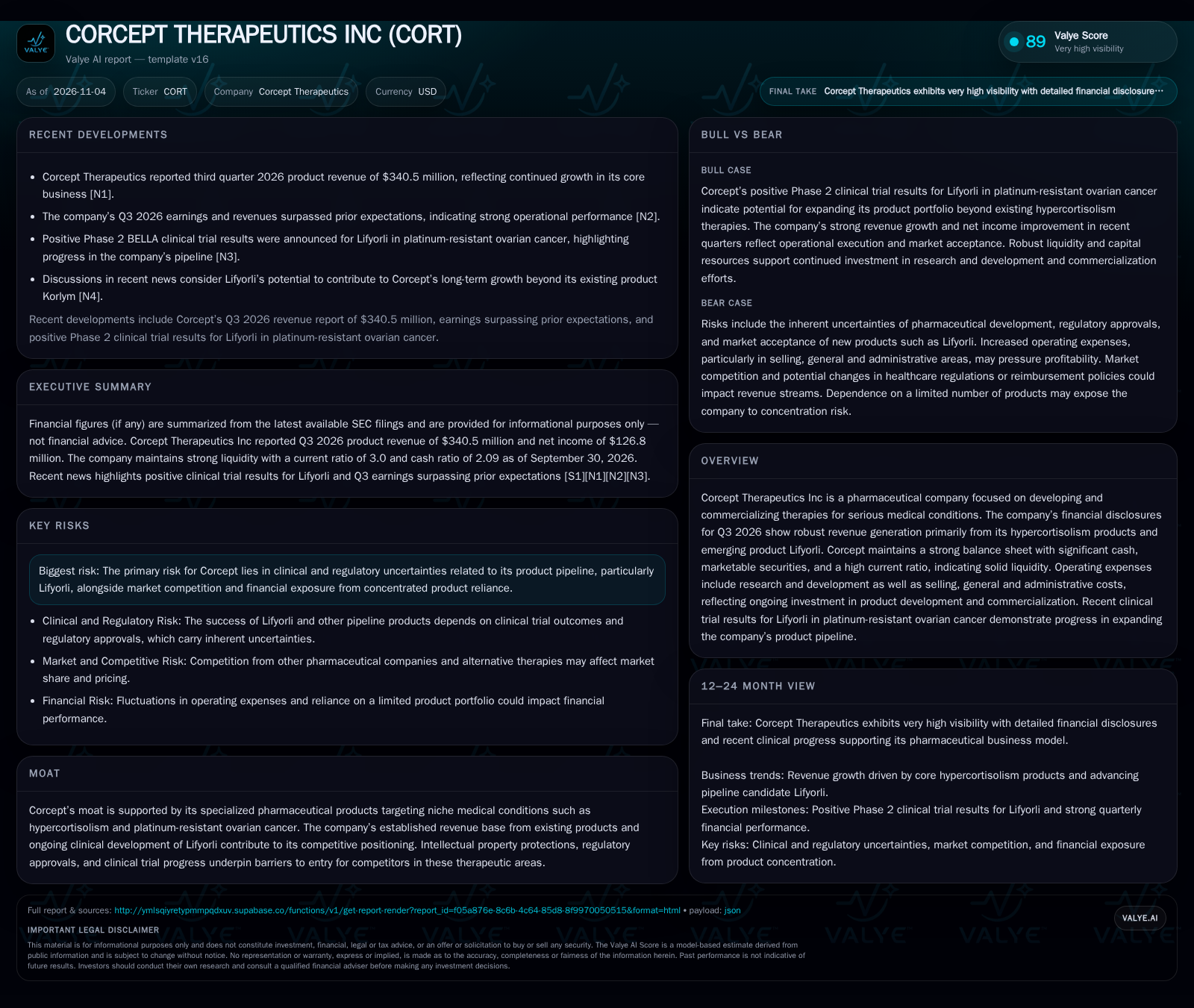
Corcept Therapeutics reported Q3 2026 product revenue of $340.5 million, with net income of $126.8 million and a reported liquidity position. The company’s core hypercortisolism products remain the revenue driver, while positive Phase 2 results for Lifyorli in platinum-resistant ovarian cancer signal potential diversification. Product concentration and clinical/regulatory risks are key watchpoints as Corcept seeks to expand its addressable market. [S1] [N1] [N2] [N3]
Corcept Therapeutics’ Q3 2026 results underscore the company’s effective execution in its core hypercortisolism business, with robust profitability and a fortified balance sheet. Yet the real test for Corcept’s long-term trajectory lies in its ability to broaden its product portfolio. The positive Phase 2 BELLA trial for Lifyorli in platinum-resistant ovarian cancer marks a potential turning point: if Lifyorli advances successfully, Corcept could pivot from a concentrated rare-disease player to a more diversified growth story in oncology. The company faces the classic pharmaceutical tension between near-term financial strength and the long-cycle risks of R&D and regulatory navigation.
Recent Financial and Pipeline Milestones Set the Stage
Corcept Therapeutics reported product revenue of $340.5 million and net income of $126.8 million in Q3 2026, both representing substantial year-over-year growth and surpassing prior expectations. The company’s liquidity position is reflected in $98.7 million in cash, $272.0 million in short-term investments, and a current ratio of 3.0 as of September 30, 2026. On the clinical front, Lifyorli delivered positive Phase 2 BELLA trial results in platinum-resistant ovarian cancer, positioning it as the company’s most advanced pipeline asset beyond its established hypercortisolism products. These developments highlight both operational momentum and the potential for a strategic shift in Corcept’s revenue mix. [S1] [N1] [N2] [N3]
How Corcept’s Revenue Model and Cost Structure Could Evolve
Corcept’s core economics are presently anchored in its hypercortisolism therapies, which likely command premium pricing due to orphan drug status and limited direct competition. This supports high gross margins, as reflected by a cost of sales of only $4.6 million against $340.5 million in revenue for Q3 2026. The company’s operating leverage is visible in its ability to generate $114.7 million in income from operations, even as SG&A expenses rose to $164.4 million. R&D spending fell to $56.7 million, suggesting a shift from early-stage pipeline investment to commercialization and market development.
If Lifyorli is ultimately approved for ovarian cancer, the business could see a structural shift. Oncology drugs, especially for high-need niches like platinum-resistant ovarian cancer, can achieve rapid uptake and premium pricing—but also face intense payer scrutiny and the need for substantial post-approval investment in market education and real-world evidence generation. Commercializing Lifyorli would likely increase both SG&A and R&D expenses in the near term, but could deliver significant operating leverage if the addressable patient pool is meaningfully larger than Corcept’s legacy rare-disease markets.
The transition from a predominantly orphan-disease-focused revenue model to one incorporating oncology therapeutics entails nuanced shifts in cost structure and risk profile. Oncology drug development typically demands larger and more complex clinical trials, which can increase R&D expenditure volatility and extend timelines. Additionally, oncology commercialization often requires more intensive sales force deployment and patient support programs to navigate complex treatment regimens and reimbursement pathways, potentially elevating SG&A costs beyond initial projections. However, if Lifyorli addresses a significant unmet need with a compelling clinical profile, economies of scale and market penetration could enhance operating leverage, offsetting higher upfront investments over time.
Barriers, Differentiation, and Competitive Threats in Corcept’s Targeted Therapy Arena
Corcept’s primary advantage lies in its specialization: developing therapies for under-served endocrine and oncologic indications. Intellectual property protection and regulatory exclusivity for orphan drugs help shield its core hypercortisolism business from immediate generic threats. However, the company’s moat is relatively narrow—therapeutic innovation in rare disease and oncology sees frequent new entrants and rapid shifts in standard of care.
In hypercortisolism, few direct competitors exist, but broader endocrine and metabolic therapy players could enter if market opportunity grows. In ovarian cancer, the competitive field is far more crowded, with large pharma companies, biotech specialists, and novel modalities (e.g., antibody-drug conjugates, PARP inhibitors) all vying for share. Lifyorli’s differentiation will rest on demonstrating clear clinical benefit and/or safety advantages versus entrenched therapies. Should payers or physicians see Lifyorli as incremental rather than transformational, pricing pressure and adoption friction could erode the upside.
The competitive landscape in oncology also introduces dynamic factors such as biomarker-driven patient segmentation and evolving standards of care, which could influence Lifyorli’s market positioning. Corcept’s ability to integrate companion diagnostics or demonstrate synergy with existing therapies could enhance differentiation. Conversely, rapid innovation cycles in oncology may render certain mechanisms of action obsolete or less relevant, imposing ongoing pressure to adapt development strategies. The company’s existing expertise in endocrine disorders may provide a foundation for understanding tumor biology in hormone-responsive cancers, yet success will depend on effectively bridging this knowledge to broader oncologic contexts.
What Success with Lifyorli Could Mean for Corcept’s Growth Trajectory
A favorable scenario sees Lifyorli progressing rapidly through late-stage trials, gaining regulatory approval, and achieving strong uptake in platinum-resistant ovarian cancer—a segment with high unmet need and limited therapeutic options. This would diversify Corcept’s revenue base, reduce its dependence on hypercortisolism, and potentially unlock additional oncology indications for Lifyorli or related compounds. The positive Phase 2 BELLA results provide an initial validation, but the magnitude and durability of benefit in Phase 3, as well as regulatory and payer acceptance, are the critical next hurdles.
Confirmation of this scenario would come from successful Phase 3 data, regulatory filings, and clear guidance on launch timelines and initial market reception. Early commercial metrics—such as formulary inclusion and physician adoption rates—would further support the thesis. If Lifyorli demonstrates a differentiated clinical profile and is embraced by key opinion leaders, Corcept could see a step-change in both revenue growth and investor perception.
Sustaining Profits While Navigating Pipeline Uncertainty
The most plausible path forward is continued strong cash generation from the legacy hypercortisolism franchise, with incremental pipeline progress but not a full transformation in the product mix over the next 12-24 months. Lifyorli may advance to Phase 3, but regulatory approval and commercial launch are unlikely to impact results before late 2027 at the earliest. During this period, Corcept’s financials remain healthy, but top-line growth moderates absent a new launch.
Evidence for this scenario includes stable or gradually increasing revenue from the existing portfolio, R&D spend allocated toward late-stage trials, and limited changes in SG&A as Lifyorli commercialization efforts remain in pre-launch mode. Any delay or ambiguity in Lifyorli’s development timeline, or early signals of competitive pushback in ovarian cancer, would reinforce this base case.
Maintaining profitability while managing pipeline uncertainty will likely require disciplined capital allocation and strategic prioritization. Corcept might need to balance incremental investments in Lifyorli’s late-stage development with sustaining its core business and exploring adjunctive indications or combination therapies that could extend product lifecycle. The timing and magnitude of future revenue inflections will depend on clinical milestones aligning with regulatory expectations and payer acceptance, which can be influenced by evolving health technology assessment frameworks. In this context, maintaining flexibility in R&D spend and commercial readiness could mitigate downside risk while preserving optionality for pipeline advancement.
How Clinical or Regulatory Setbacks Could Expose Concentration Risk
If Lifyorli encounters safety or efficacy concerns in Phase 3, or regulatory agencies raise hurdles, Corcept could face a multi-year period of stagnation or decline. The company’s current revenue is heavily concentrated in hypercortisolism, making it vulnerable to competitive entry, payer pressure, or generic/biosimilar erosion. A negative inflection in the legacy franchise—whether from new therapies, loss of exclusivity, or changes in reimbursement—would be difficult to offset without a successful pipeline launch.
Confirmation of this downside would come from adverse clinical updates, regulatory rejections, or deteriorating revenue/earnings from the core business. Watch for unexpected increases in R&D (as the company scrambles to rejuvenate the pipeline) or sharp drops in SG&A (potential cost-cutting in response to lost growth momentum).
Milestones That Will Shape Corcept’s Next Chapter
Progression of Lifyorli into Phase 3 clinical trials and any updates on enrollment pace, endpoints, or preliminary data.
Regulatory interactions or feedback regarding Lifyorli’s Phase 2 data package and Phase 3 trial design.
Trends in hypercortisolism product revenue—particularly any signs of plateauing, competitive encroachment, or payer pushback.
SG&A and R&D spending trajectories, which could indicate shifting priorities between commercialization and pipeline investment.
Updates on the breadth and depth of Corcept’s pipeline beyond Lifyorli, including new indications or early-stage assets.
If disclosed, formulary wins, reimbursement decisions, or early access programs for Lifyorli that could preview commercial uptake.
Any material changes in the intellectual property landscape, such as patent litigation outcomes or new filings related to the company’s core products.
Disclaimer: This is research-only, informational analysis and not investment advice. It may include AI-generated interpretation and general industry context. Always verify important details using primary sources.

Comments