
Angi Inc.: Leadership Changes and Strategic Moves to Revitalize Home Services Growth
Angi Inc.'s 2026 operational reset—featuring a new CEO, workforce reductions, and ongoing earnings underperformance—reflects the competitive and structural headwinds facing digital home services marketplaces.
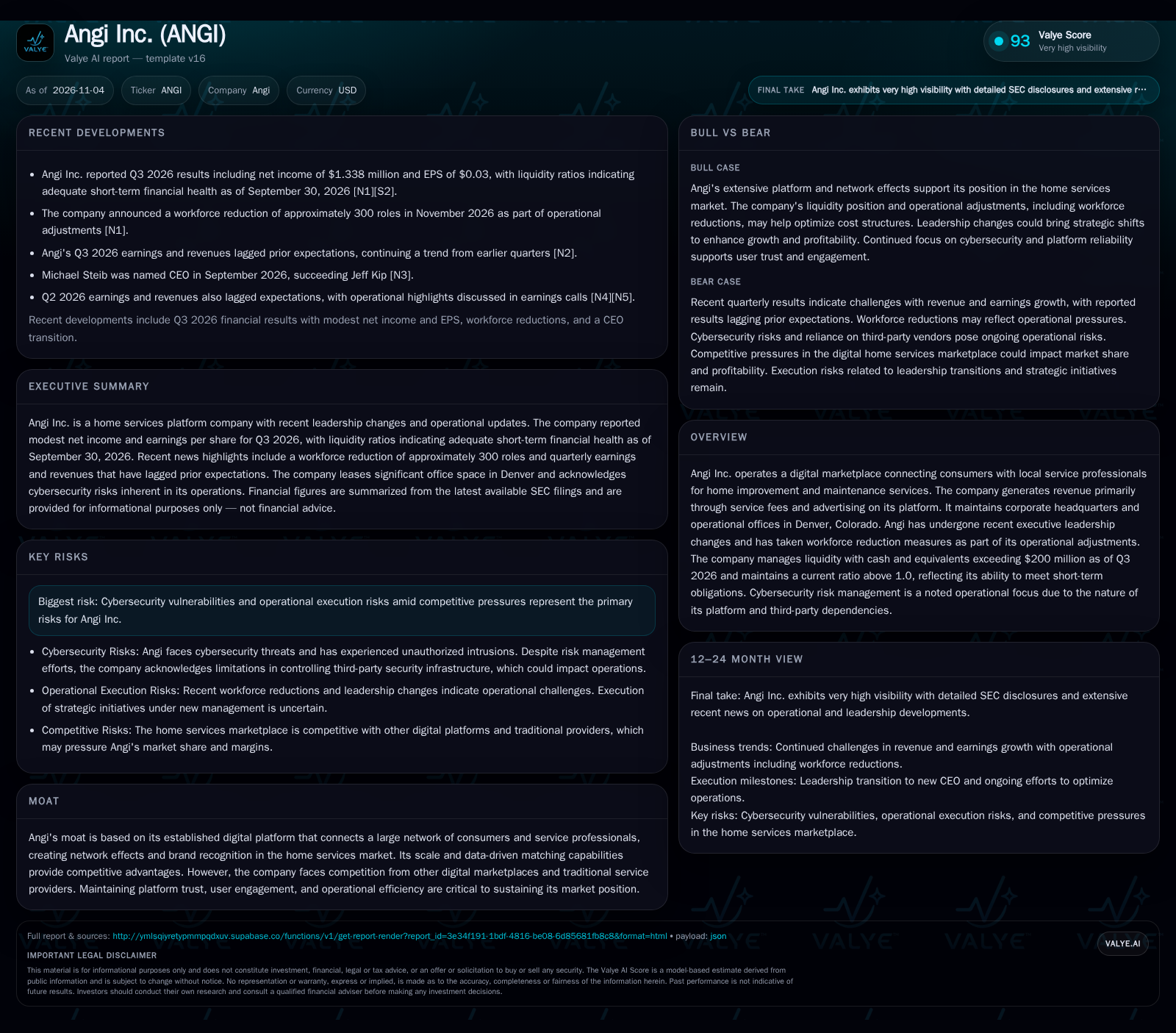
Angi Inc. is navigating leadership change, substantial cost-cutting, and persistent earnings shortfalls as it seeks to reestablish growth in the home services platform market. Future performance will depend on the new CEO’s ability to drive platform engagement and operational efficiency while mitigating cybersecurity and execution pitfalls. [N1] [N2] [S2]
Angi Inc. enters late 2026 at an inflection point: after multiple quarters of underwhelming revenue and earnings, the company has enacted a sizable workforce reduction and installed new leadership with the appointment of CEO Michael Steib. With cybersecurity and execution risks looming, the next phase will test whether Angi can leverage its scale and data-driven matching to revive user engagement and financial momentum. [N1] [N2] [N3] [S2]
The Significance of Angi’s 2026 Restructuring Efforts
Several recent facts shape Angi’s current operating context. In Q3 2026, Angi reported net income of $1.338 million and EPS of $0.03, but both revenue and earnings continued to lag expectations, extending a trend from earlier quarters. In November 2026, the company announced a workforce reduction of approximately 300 roles—one of its most significant operational adjustments in recent years. Meanwhile, Michael Steib assumed the CEO role in September 2026, following a period of underperformance under prior leadership. As of September 30, 2026, Angi’s cash and equivalents stood at $202.5 million, with a current ratio of 1.3 and a cash ratio of 1.07, reflecting moderate short-term liquidity coverage. These developments collectively signal a strategic reset in response to persistent revenue and earnings challenges, and set the stage for possible shifts in execution and strategic priorities. [N1] [N2] [N3] [S2]
Potential Outcomes of Angi’s Platform Monetization Strategy
Angi’s core economic engine is its digital marketplace, which connects homeowners with local service professionals for home repairs, maintenance, and improvement projects. The company primarily generates revenue through service fees, lead generation charges, and advertising placements sold to service professionals seeking customer leads. The platform’s economics are highly sensitive to transaction volume, average booking value, and take rate—the percentage of each transaction Angi captures as revenue.
Operating leverage is a double-edged sword: high fixed costs in platform development, marketing, and administrative functions can magnify gains in periods of revenue growth but exacerbate losses or compress margins when transaction volumes are stagnant or declining. The recent workforce reduction indicates a move to rebalance the cost structure toward current demand levels, which may improve near-term margin but could also constrain growth initiatives if not managed carefully.
Capital requirements for Angi are moderate compared to asset-heavy businesses, with investment focused on technology, marketing, and platform security rather than physical assets. However, persistent underperformance in revenue and earnings suggests that either user acquisition costs, retention spending, or competitive pricing pressures may be eroding profitability. The question is whether Angi can reaccelerate platform engagement and transaction growth fast enough to restore operating leverage and generate sustained free cash flow.
Navigating Network Effects and Competitor Alternatives in Home Services
Angi’s principal competitive advantage is its established two-sided marketplace, which benefits from network effects: more consumers attract more service professionals, and vice versa. This can create a self-reinforcing loop of engagement and data-driven matching, theoretically raising switching costs for both sides. However, the digital home services market remains fragmented, with direct competitors including specialized vertical platforms, newer app-based entrants, and even broader e-commerce players experimenting with services marketplaces.
Traditional offline service providers and local contractors represent a persistent substitute, especially for larger or trust-sensitive projects. For Angi, brand recognition and platform trust are critical—any erosion here, due to either negative user experiences or cybersecurity incidents, could accelerate churn and diminish network effects. Additionally, if competing platforms offer lower fees or more effective lead generation, service professionals may multi-home or switch entirely, reducing Angi’s pricing power.
Recent underperformance suggests that Angi’s historical advantages may be under pressure from both digital and traditional competitors. The critical test is whether the platform can differentiate on user experience, reliability, and value for both consumers and professionals.
Turning Point: The Impact of Platform Enhancements and Strategic Clarity
A favorable scenario for Angi centers on the new CEO successfully executing operational changes that revitalize platform engagement and user growth. If the workforce reduction streamlines decision-making and reallocates resources toward high-impact product features, Angi could improve user experience, increase booking frequency, and raise take rates without materially increasing costs.
Winning back consumer trust—potentially through enhanced cybersecurity, better quality control, and transparent reviews—could also drive higher retention and referral rates. On the supply side, if Angi can offer superior lead generation and lower acquisition costs for service professionals compared to rivals, it could regain or expand share in key local markets.
Evidence for this scenario would include a return to sequential revenue growth, improved margins (even as marketing or tech investments rise), and positive commentary from management or users about platform improvements. Sustained net income and cash flow growth—beyond one-off cost cuts—would further validate the turnaround.
A Realistic Outlook: Angi’s Prospects for Stabilized Performance
The most likely near-term outcome is that Angi achieves operational stability but struggles to reignite strong growth. Cost reductions may support modest profitability and prevent cash burn, but if competitive pressures persist and user engagement remains soft, revenue growth could remain muted.
The company may experiment with incremental product improvements or targeted marketing, but without a step-change in user adoption or platform differentiation, top-line acceleration is likely limited.
Confirmation of this scenario would include flat or slightly positive revenue trends, continued reporting of small net income figures, and management commentary focused on operational discipline rather than breakthrough growth. Evidence to the contrary would be a significant uptick in bookings, service professional sign-ups, or user engagement metrics, if disclosed.
Consequences of Operational Challenges if Adaptation Falls Short
The risk is that Angi’s recent cost cuts and leadership changes fail to address the root causes of its underperformance. If platform engagement continues to deteriorate—perhaps due to poor user experience, ineffective marketing, or competitive attrition—revenue could stagnate or decline further, while fixed costs remain a drag.
Cybersecurity incidents or negative publicity could accelerate user and professional churn, eroding network effects and undermining the value proposition for both sides of the marketplace. In this scenario, Angi might be forced into additional rounds of cost-cutting, potentially impairing its ability to invest in technology or marketing and risking a downward spiral.
Evidence for this outcome would include further revenue declines, widening net losses, negative user or partner feedback, and management warnings about competitive or operational headwinds.
Benchmarks Indicating Progress in Angi’s Platform Transformation
Quarterly trends in core marketplace revenue and total bookings volume—if disclosed—will show whether platform engagement is stabilizing or recovering.
Reported gross margin and operating margin figures, particularly after the workforce reduction, will indicate if cost cuts are translating into sustainable profitability.
User and service professional retention or churn rates—if disclosed—would help test whether network effects are strengthening or eroding.
Management commentary or disclosures regarding platform upgrades, cybersecurity enhancements, or new user-facing features will shed light on strategic priorities under the new CEO.
Competitive benchmarking in terms of pricing, user growth, and platform features versus other digital home services marketplaces would help gauge relative positioning.
External signals, such as negative media coverage or reported cybersecurity incidents, could serve as leading indicators of reputational or operational risk.
Disclaimer: This is research-only, informational analysis and not investment advice. It may include AI-generated interpretation and general industry context. Always verify important details using primary sources.

Comments