
SI-BONE’s Next Stage: Growth Prospects, Recall Fallout, and the Challenge of Scaling Specialized Spinal Implants
SI-BONE, Inc. advances its spinal fusion portfolio with new FDA clearance and double-digit revenue growth, but must navigate the operational aftershocks of a recent recall and persistent supply chain vulnerabilities. The company’s ability to translate innovation into sustainable profitability will hinge on quality control, supplier resilience, and adoption curves in a specialized but competitive orthopedic market.
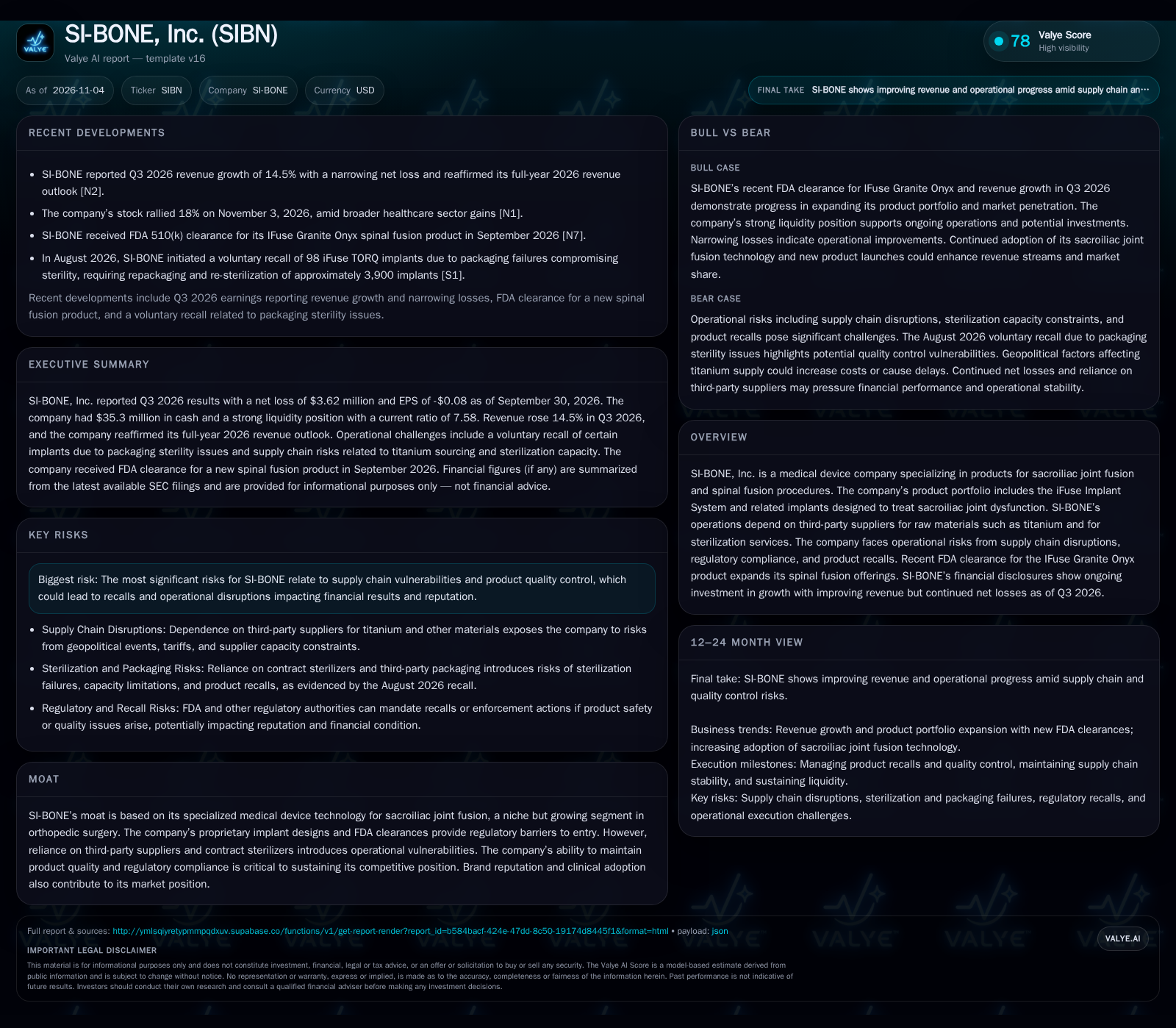
SI-BONE reported Q3 2026 revenue up 14.5% and received FDA clearance for its new IFuse Granite Onyx spinal fusion device, signaling portfolio momentum. However, an August recall of iFuse TORQ implants and ongoing reliance on third-party suppliers for titanium and sterilization services underscore operational risks. Sustained growth will require flawless operational execution and continued clinical acceptance. [S1] [N2] [N7]
SI-BONE, Inc. sits at a crossroads: the company is showing strong revenue growth and expanding its spinal fusion portfolio, as evidenced by a 14.5% Q3 2026 revenue increase and new FDA clearance for its IFuse Granite Onyx device. Yet the August 2026 recall of iFuse TORQ implants due to packaging sterility failures highlights the persistent operational and reputational risks inherent in scaling medical device businesses reliant on complex supply chains. As SI-BONE seeks to deepen penetration of the sacroiliac joint and spinal fusion market, its path to sustainable profitability will depend on mastering quality control, supply resilience, and clinical adoption amid ongoing competition and regulatory scrutiny. [S1] [N2] [N7]
Recent Gains and Setbacks: Revenue Growth, Product Expansion, and Recall Impact
SI-BONE reported a 14.5% year-over-year revenue increase in Q3 2026, with a narrowing net loss of $3.62 million and reaffirmation of its full-year revenue outlook. This momentum was complemented by FDA 510(k) clearance for the IFuse Granite Onyx spinal fusion product in September 2026, signaling continued innovation and potential expansion of the company’s addressable market. However, in August 2026, SI-BONE initiated a voluntary recall of 98 iFuse TORQ implants due to packaging failures that compromised sterility, requiring the repackaging and re-sterilization of roughly 3,900 implants. [S1] [N2] [N7]
How SI-BONE’s Revenue Engine Works—and Where Leverage May Emerge
SI-BONE’s revenue model is anchored in the sale of specialized implant systems—primarily for sacroiliac joint fusion and, increasingly, broader spinal fusion procedures. Pricing is typically at a premium, reflecting the differentiated nature of its FDA-cleared devices and the clinical value proposition for orthopedic surgeons treating chronic back pain. Volume growth depends on driving adoption among surgeons and health systems, with success often tied to clinical evidence, reimbursement coverage, and procedural familiarity.
Gross margin dynamics in this segment are sensitive to manufacturing scale, material input costs (notably titanium), and the efficiency of sterilization and packaging processes. While fixed costs—such as R&D, clinical education, and regulatory compliance—are substantial, incremental unit economics could improve as procedure volume scales and as manufacturing and logistics processes are refined. However, the recent recall demonstrates that quality lapses can introduce both direct costs (rework, lost sales) and indirect costs (reputation, regulatory scrutiny), potentially offsetting operating leverage gains.
SI-BONE’s capital requirements are shaped by inventory needs, ongoing product development, and investments in clinical education and market access. While the company’s liquidity is currently strong, future growth may require further investment in supply chain resilience and quality systems, especially if the business expands internationally or launches additional products.
Specialization as a Double-Edged Sword in the Evolving Orthopedic Device Landscape
SI-BONE competes in a niche but expanding segment of the orthopedic device market, focused on sacroiliac joint fusion and select spinal fusion procedures. Its competitive advantages stem from proprietary implant designs, regulatory clearances, and a clinical track record supporting the efficacy of its devices. These factors create moderate barriers to entry, particularly for new or smaller players lacking FDA credentials or established surgeon relationships.
However, the broader orthopedic market is dominated by well-capitalized firms with extensive sales networks, integrated supply chains, and multi-product portfolios. These diversified competitors may be able to bundle products, leverage purchasing power with hospitals, and absorb supply chain shocks more readily than a focused player like SI-BONE. Additionally, technological substitutes—including non-fusion therapies, biologics, or minimally invasive alternatives—could limit long-term adoption of implant-based solutions if clinical outcomes or payer preferences shift.
SI-BONE’s reliance on third-party suppliers for titanium and sterilization services introduces a vulnerability not just to cost inflation but to potential delays or disruptions, especially in a geopolitical environment where raw material supply chains can be volatile. The company’s brand reputation and ability to maintain regulatory compliance will be central to sustaining its market position.
From Clinical Traction to Scalable Profitability: What a Bullish Outcome Would Require
A favorable scenario for SI-BONE would see the company successfully leveraging its new FDA-cleared IFuse Granite Onyx device to expand its footprint in the spinal fusion market, driving double-digit revenue growth and improving gross margins through operational scale. This pathway would require effective commercialization, growing clinical adoption among surgeons, and expanded reimbursement coverage—factors supported by robust clinical evidence and positive physician experiences.
Operationally, the company would need to demonstrate that the August 2026 recall was an isolated event, with improved quality control and supply chain processes preventing further disruptions. Sustaining strong relationships with suppliers and diversifying sourcing channels could help mitigate input cost volatility and supply interruptions.
Confirmation of this scenario would come from sustained revenue acceleration, margin expansion, new account wins, and a lack of further recalls or regulatory setbacks. Additional FDA clearances or successful entry into adjacent orthopedic segments could further validate the upside case.
Executing on Growth Amid Recurring Frictions: The Most Plausible Trajectory
The most likely outcome for SI-BONE is continued revenue growth in the mid-to-high single digits or low double digits, as the company benefits from new product introductions and ongoing sacroiliac joint fusion adoption. However, growth is likely to be tempered by periodic operational hiccups—such as supply chain bottlenecks, input cost pressures, or isolated quality incidents—that offset some margin gains.
The company’s ability to manage recalls, regulatory compliance, and supply disruptions will be key to maintaining credibility with both clinicians and investors.
Evidence for this scenario would include steady revenue growth, modest improvements in operating margin, and no further escalation in recall frequency or severity. However, occasional quarter-to-quarter volatility in results may persist as the company navigates its operational and market expansion challenges.
How Quality Failures or Supply Chain Shocks Could Derail the Expansion Story
A negative scenario would materialize if SI-BONE experiences additional product recalls, persistent supply chain disruptions—particularly in titanium sourcing or sterilization capacity—or regulatory actions that undermine customer confidence and strain financial resources. Multiple adverse events could erode the company’s reputation among surgeons and hospitals, slow adoption, and trigger increased scrutiny from the FDA or other regulators.
Financially, repeated disruptions could lead to declining gross margins, lost sales, inventory write-downs, or even liquidity pressures if recalls or supplier renegotiations become costly. If the company cannot restore operational reliability or faces challenges in securing high-quality third-party partners, its competitive position could be compromised, and the pathway to profitability pushed further out.
Evidence of this downside scenario would include an uptick in recall announcements, negative physician sentiment, regulatory warning letters, or sequential declines in revenue and margin performance. In such a case, SI-BONE’s ability to raise capital or attract strategic partners could also be impaired.
Milestones That Will Determine SI-BONE’s Transition from Innovation to Reliable Growth
Surgeon adoption rates for IFuse Granite Onyx and other new products—if disclosed—would provide insight into the pace of market expansion and procedural acceptance.
Gross margin trend, particularly in the wake of the recent recall, would help assess the company’s ability to manage costs and scale manufacturing efficiently.
Frequency and severity of product recalls or field safety notices, as recurring events could signal systemic quality or supply chain issues.
Supplier diversification progress and any new partnerships for titanium or sterilization capacity would indicate improved operational resilience.
Quarterly inventory turnover and days in inventory—if disclosed—would highlight supply chain efficiency and potential mismatch between production and demand.
Updates on reimbursement coverage or clinical guideline endorsements for sacroiliac joint and spinal fusion procedures could drive broader adoption.
Regulatory developments, such as new FDA clearances or warning letters, would signal the company’s compliance trajectory and market access potential.
Disclaimer: This is research-only, informational analysis and not investment advice. It may include AI-generated interpretation and general industry context. Always verify important details using primary sources.

Comments