
TEVA in 2026: Expanding Biosimilars, Financial Constraints, and Pipeline Renewal Hurdles
TEVA Pharmaceutical Industries is doubling down on biosimilars and immunology partnerships amid a period of constrained liquidity and clinical trial setbacks. The company’s ability to leverage its scale and distribution in a changing market will determine whether recent product wins offset competitive and financial pressures.
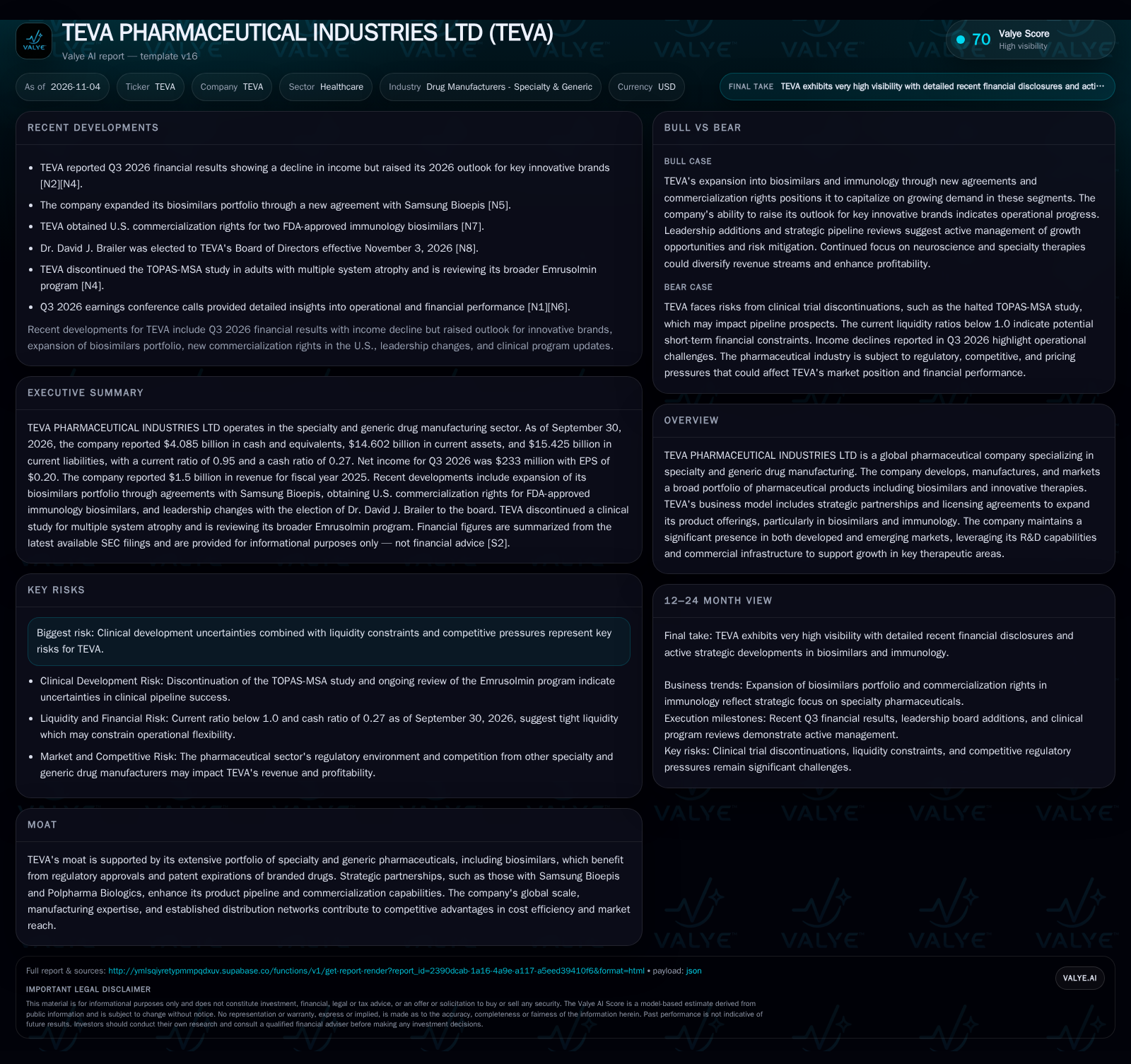
TEVA’s 2026 strategy centers on expanding its biosimilars and immunology footprint, highlighted by new commercialization agreements and raised guidance for innovative brands. The company’s future rests on its ability to translate recent portfolio moves into sustainable revenue growth while managing liquidity and navigating a crowded competitive landscape. [S2] [N2] [N4] [N5] [N7]
The company’s latest expansion through Samsung Bioepis and U.S. commercialization rights for immunology biosimilars signals an urgent push to refresh its product mix and offset pipeline disappointments, notably the halted TOPAS-MSA study. [S2] [N2] [N4] [N5] [N7]
2026 Overview: Balancing Financial Pressure with Portfolio Growth
As of September 30, 2026, TEVA reported $4.085 billion in cash and cash equivalents, with current assets of $14.602 billion and current liabilities of $15.425 billion, yielding a current ratio of 0.95 and a cash ratio of 0.27. This positions the company with liquidity below the conventional 1.0 benchmark, highlighting potential short-term financial constraints. Net income for Q3 2026 was $233 million, translating to basic and diluted EPS of $0.20. Full-year 2025 revenue was reported at $1.5 billion. Despite a decline in quarterly income, TEVA raised its 2026 outlook for key innovative brands, signaling management’s confidence in certain higher-margin segments. The company is also actively growing its biosimilars platform, entering new agreements with Samsung Bioepis and securing U.S. commercialization rights for two FDA-approved immunology biosimilars. However, clinical risk is elevated by the discontinuation of the TOPAS-MSA study and ongoing review of the Emrusolmin program. [S2] [N2] [N4] [N5] [N7]
Transformations in TEVA’s Revenue Through Biosimilars and Specialty Medicines
TEVA’s economics are shaped by its dual focus on high-volume generics and higher-margin specialty pharmaceuticals. Generics are typically volume-driven but face ongoing price erosion due to competition and payer pressure, leading to thin margins and a need for operational scale. In contrast, specialty drugs and biosimilars offer higher pricing power and longer life cycles, especially when supported by regulatory exclusivity or complex manufacturing barriers.
Recent biosimilar agreements—such as with Samsung Bioepis—suggest a strategic pivot to segments where TEVA can leverage its global distribution and regulatory expertise to capture share in high-growth therapeutic areas like immunology. Commercialization rights for FDA-approved biosimilars could accelerate revenue contribution without the full R&D risk of in-house development, but may involve milestone or royalty payments that temper gross margins. The decision to discontinue the TOPAS-MSA trial and review the Emrusolmin program reflects the high fixed cost and risk profile of specialty drug development: failed clinical programs can quickly erode return on invested capital.
The company reported cash and liquidity metrics for the period; these figures do not by themselves establish operating runway, investment capacity, financial flexibility, or financing capacity. Fixed manufacturing and R&D overheads mean that achieving operating leverage depends on successfully scaling recently acquired or partnered assets, especially in biosimilars where market entry can be lumpy and reimbursement dynamics complex.
Navigating the Biosimilar Market Amid Rising Competition
TEVA operates in a hyper-competitive landscape that includes global generic manufacturers, specialty pharma players, and increasingly, large-cap biopharma companies entering the biosimilar space. Its established manufacturing scale, global distribution, and regulatory know-how provide cost and reach advantages, particularly in mature generics. However, persistent pricing pressure, patent cliffs, and payer consolidation continue to erode generic margins.
The biosimilars market offers a potential escape from commodity competition, especially as biologics lose patent protection and payers seek lower-cost alternatives. TEVA’s ability to source, co-develop, or in-license biosimilars—such as through the Samsung Bioepis partnership—could provide access to differentiated molecules with meaningful market potential. However, the biosimilar field is also attracting investment from originators and well-capitalized peers, leading to crowded launches, aggressive contracting, and uncertain pricing durability.
The company’s competitive position in immunology and other specialty areas hinges on its ability to bring new biosimilars to market quickly and secure formulary access. Partnerships can accelerate market entry but may limit margin capture compared to in-house innovation. Clinical setbacks, like the stopped TOPAS-MSA study, also underscore the risk of pipeline attrition relative to competitors with broader or deeper R&D engines.
Potential for Recovery Driven by Biosimilars and New Brand Innovations
The most favorable scenario for TEVA sees its recent biosimilar agreements and U.S. immunology launches gaining strong commercial traction, allowing the company to offset generic price erosion and pipeline attrition. If adoption of new biosimilars is robust—supported by payer acceptance and minimal legal or regulatory setbacks—TEVA could realize higher-margin revenue streams, driving operating leverage and improved free cash flow.
Raised guidance for innovative brands in 2026 suggests that at least some specialty assets are performing ahead of plan. If these brands sustain growth, TEVA may establish a reputation as a credible player in select specialty niches, attracting further partnerships or licensing deals. Confirmation of this scenario would be visible in sequential revenue growth in biosimilars and specialty lines, improved gross margins, and a rebound in operating cash flow. Announcements of additional product approvals or expanded payer coverage would further validate the thesis. Conversely, failure to gain market share or unexpected commercialization hurdles would challenge the upside.
Outlook for Stability Despite Margin Challenges and Targeted Expansion
The most plausible path forward is one of modest stabilization: TEVA’s biosimilar and immunology launches contribute incrementally, but competitive intensity and generic price deflation continue to weigh on overall profitability.
In this scenario, clinical pipeline attrition—such as the discontinued TOPAS-MSA trial—remains a drag on valuation and investor sentiment, but is partially offset by steady execution in the company’s core business and select specialty areas. Operating leverage is limited by the need to invest in new launches and defend market share, resulting in only gradual margin improvement. Evidence supporting this scenario would include flat to modestly rising revenues in biosimilars and specialty, continued but unremarkable profitability, and no material worsening of liquidity ratios. A sharp improvement or deterioration in cash flow, or a dramatic pipeline breakthrough or setback, would falsify this outlook.
Risks from Clinical Failures Coupled with Funding Limitations
The adverse scenario sees TEVA’s liquidity position deteriorate further, with the current ratio slipping below 1.0 and cash burn accelerating due to weak generic pricing, slow biosimilar uptake, or further clinical trial failures. If new launches fail to gain traction or pricing in biosimilars is undercut by aggressive competitors, revenue stagnates or declines, and fixed costs become more difficult to absorb.
Discontinued or delayed clinical programs—such as the Emrusolmin review—compound negative sentiment, making it harder to attract partners, raise capital, or invest in next-generation assets. In this scenario, TEVA could face a need to restructure operations, divest non-core assets, or seek new financing under less favorable terms. Evidence for this scenario would include declining operating cash flow, a worsening current ratio, additional clinical discontinuations, or loss of key commercial contracts. A stabilization or improvement in these metrics would challenge the downside thesis.
Key Developments That Will Determine TEVA’s Strategic Progress
Sequential revenue growth from biosimilars and innovative brands, particularly those recently launched or acquired through new agreements, would help validate the turnaround thesis.
Gross margin trends: Expansion would support the notion that specialty and biosimilar products are offsetting generic price erosion; contraction would signal competitive or reimbursement headwinds.
Operating cash flow generation, which if sustained or improved, would demonstrate that TEVA can self-fund new investments despite tight liquidity.
Updates on the Emrusolmin program review and outcomes on other pipeline assets—either positive or negative—would materially affect future growth potential.
Additional biosimilar or specialty product approvals, especially in the U.S. or other major markets, would help test the company’s ability to commercialize and scale new assets.
If disclosed, payer and formulary access wins for new biosimilars and specialty products would provide an early read on commercial traction.
Board or senior management changes, particularly those bringing new commercial, scientific, or financial expertise, could signal shifts in strategic direction or risk appetite.
Disclaimer: This is research-only, informational analysis and not investment advice. It may include AI-generated interpretation and general industry context. Always verify important details using primary sources.

Comments