
PennyMac Financial Services: Navigating the Mortgage Cycle’s Crosscurrents in a Challenging Rate Environment
With Q3 2026 earnings and revenues lagging expectations and leadership changes underway, PennyMac Financial Services faces a market defined by volatile interest rates, housing affordability pressures, and the operational demands of large-scale mortgage servicing. The company’s integrated production-servicing model and ties to government-sponsored entities support stability, but exposure to delinquencies and secured financing constraints remain central challenges.
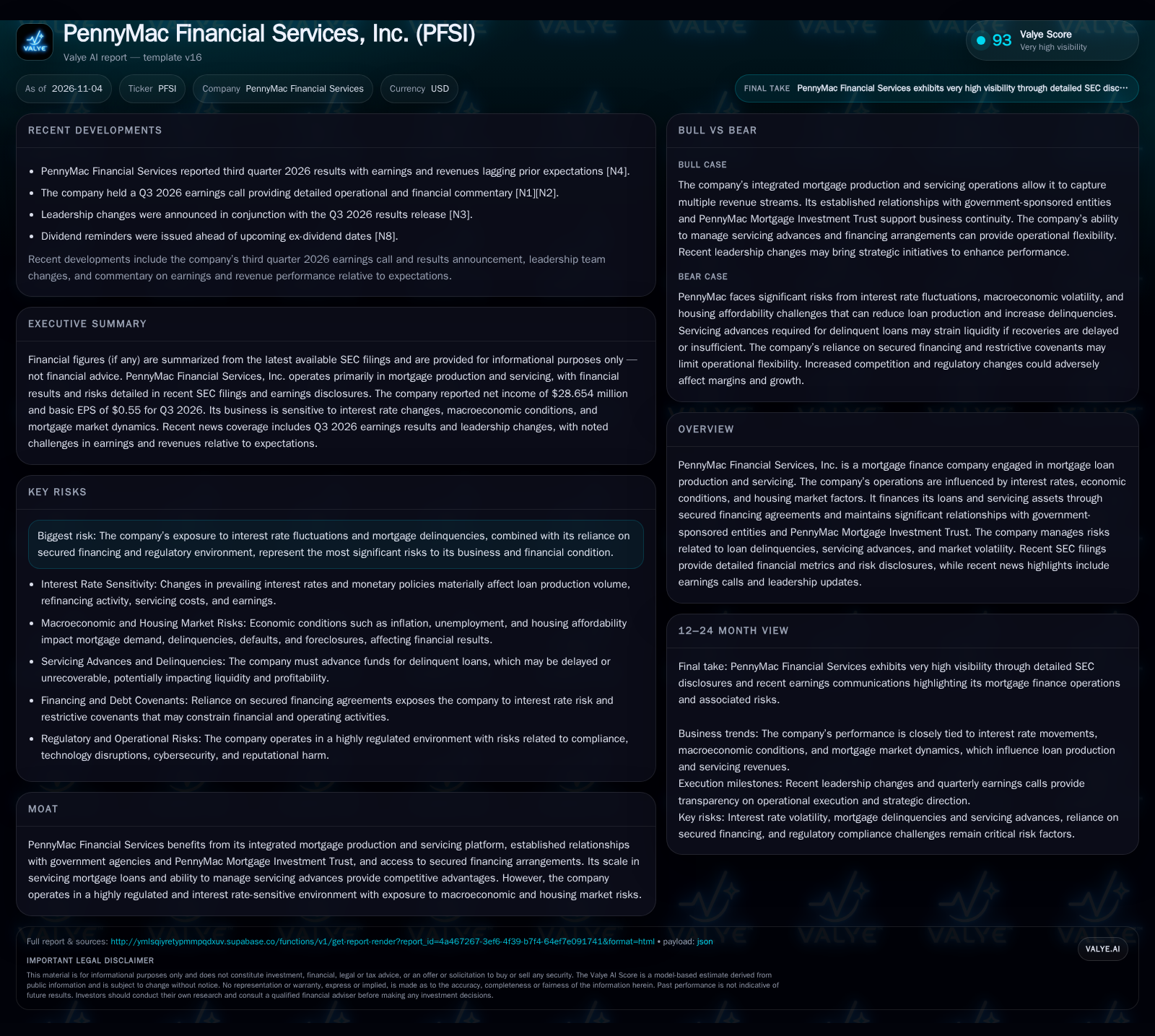
PennyMac Financial Services reported Q3 2026 net income of $28.654 million and EPS of $0.55, missing expectations as revenues and earnings trailed forecasts. Short-term investments stood at $412.5 million. The company’s results highlight its sensitivity to interest rates, macroeconomic volatility, and the cost of managing delinquent loans. [S2] [N1] [N2] [N3] [N4] [N8]
PennyMac Financial Services enters late 2026 at a pivotal moment for the U.S. mortgage finance sector. The company’s third quarter results undershot expectations, with net income of $28.654 million and revenues below forecast, reflecting both the headwinds of higher-for-longer interest rates and the operational complexity of large-scale mortgage servicing. As leadership changes are implemented, PennyMac must manage the dual pressures of volatile loan production and rising servicing demands, all while maintaining compliance with restrictive financing covenants and navigating the risks of increased delinquency advances. The company’s financial position and long-term relationships with government-sponsored entities offer some ballast, but the next phase will test the resilience of its integrated model and its ability to adapt to macroeconomic and regulatory shifts. [S2] [N1] [N3] [N4]
Earnings Shortfall and Executive Changes Reshape the Immediate Outlook
PennyMac Financial Services reported net income of $28.654 million and basic EPS of $0.55 for the third quarter of 2026, with results trailing both internal and external expectations. Short-term investments stood at $412.5 million as of September 30, 2026, providing a snapshot of liquidity but not establishing long-term financial runway or flexibility. Leadership changes were announced alongside the Q3 results, suggesting a potential shift in strategic direction at a time when the company is underperforming relative to market forecasts. The context is one of heightened sensitivity to interest rates, with both production and servicing businesses exposed to the macroeconomic environment. [S2] [N3] [N4]
Production-Servicing Integration Drives Revenue Streams—With Embedded Volatility
PennyMac’s business model is built on the dual engines of mortgage loan origination and servicing, capturing fee income and float from the former and recurring servicing revenues from the latter. In periods of low or stable interest rates, origination volumes and refinancing activity can drive earnings, while servicing revenues provide a ballast during origination slowdowns. However, the model introduces inherent volatility: originations are highly rate-sensitive and can swing dramatically with monetary policy changes, while servicing operations are exposed to delinquency risk, requiring advances on behalf of mortgage investors that may be delayed or unrecoverable. The company finances its loans and servicing rights primarily through secured arrangements, which introduces fixed financing costs and restrictive covenants. This means that operating leverage can be positive during volume surges but may turn negative if rising delinquencies increase servicing costs or if origination volumes drop sharply. Capital needs spike during stress periods, especially when servicing advances mount, and the ability to recycle or refinance assets becomes critical.
The interplay between origination and servicing also creates complex capital allocation decisions. When origination volumes surge, the company must deploy capital both to fund new loans and to acquire servicing rights, which are amortized over time but require upfront investment. Conversely, during downturns, capital tied up in servicing advances can constrain liquidity, necessitating a careful balancing act to optimize return on equity. The sensitivity of the model to interest rate shifts means that forecasting cash flow timing and magnitude becomes challenging, requiring robust risk management frameworks and stress testing. Additionally, the reliance on secured financing introduces refinancing risk, especially if market conditions deteriorate or credit spreads widen, potentially increasing funding costs or limiting access to capital.
Scale and GSE Ties Offer Advantages, but Regulatory and Market Pressures Intensify
PennyMac’s integration of production and servicing, along with long-standing relationships with government-sponsored entities (GSEs) and PennyMac Mortgage Investment Trust, provides a platform advantage versus pure-play originators or servicers. Scale enables some cost efficiencies and the ability to absorb regulatory compliance demands. However, the competitive landscape remains fierce, with banks, non-bank mortgage lenders, fintech entrants, and specialty servicers all vying for market share. Regulatory requirements and evolving GSE standards create ongoing operational burdens. Moreover, in a rising rate environment, refinancing volumes contract while servicing portfolios become more exposed to delinquencies, eroding the value of scale and increasing the importance of risk management. Substitution risk is also present: if technology or regulatory changes favor direct-to-consumer models or automated servicing, PennyMac’s traditional cost structure could come under pressure.
From a competitive standpoint, PennyMac’s scale offers both advantages and vulnerabilities. While larger size can enable investments in technology and compliance infrastructure, it may also reduce agility compared to smaller, more specialized players who can pivot quickly in response to market or regulatory changes. The evolving regulatory landscape, particularly around servicing standards and investor protections, demands ongoing investment and operational adjustments, which can disproportionately impact firms with legacy systems or complex organizational structures. Moreover, the entrance of fintech competitors leveraging automation and data analytics to streamline origination and servicing processes may pressure traditional cost structures, necessitating strategic innovation to maintain competitiveness. The company’s ability to integrate technology effectively while managing regulatory compliance will be critical in sustaining its market position.
A Favorable Macro Turn Could Unlock Margin Expansion and Volume Recovery
If interest rates stabilize or begin to decline—and housing affordability improves—PennyMac could benefit from a surge in refinancing and purchase activity, driving higher origination volumes and fee income. At the same time, improved employment and consumer credit could reduce mortgage delinquencies, lowering the burden of servicing advances and improving operating margins. The company’s scale and integrated platform could allow it to flex capacity quickly, capturing market share from less agile competitors. Evidence confirming this scenario would include a sustained uptick in origination volumes (if disclosed), declining delinquency and advance rates, and margin expansion in both production and servicing. Early signs could also be visible in positive guidance revisions, improved earnings momentum, and stabilization or growth in the servicing portfolio’s profitability.
Furthermore, a favorable macroeconomic environment could enhance PennyMac’s competitive positioning by enabling it to leverage its integrated platform to cross-sell products and deepen customer relationships. Improved housing affordability and credit conditions might also reduce credit losses and servicing costs, freeing capital for growth initiatives or shareholder returns. In such a scenario, the company’s scale could facilitate more efficient capital deployment and risk diversification across origination channels and servicing portfolios. Additionally, a stable or declining interest rate environment could improve the economics of secured financing arrangements, reducing funding costs and enhancing net interest margins. Monitoring shifts in borrower behavior, such as increased refinancing activity or improved payment performance, would provide early signals of this positive trajectory.
Adapting to Choppy Markets: Moderate Growth and Margin Compression Likely
The most plausible near-term outcome is a continuation of challenging conditions: interest rates remain elevated or volatile, keeping refinancing activity muted and origination volumes below historical norms. Servicing revenues provide a partial offset, but increased delinquencies and associated advance requirements put pressure on margins. PennyMac adapts through cost controls, operational efficiencies, and selective capacity adjustments, but net income growth remains slow and margins are compressed relative to peak cycles. Confirmation of this scenario would come from stable but subdued origination trends, persistently high servicing costs or advances, and management commentary focused on expense discipline and risk mitigation. Falsification would require a clear inflection in macro conditions or a step-change in operational performance.
Rising Delinquencies and Liquidity Strain Could Trigger Financial Stress
In a more adverse scenario, a combination of persistent high interest rates, worsening housing affordability, and macroeconomic deterioration (such as rising unemployment) leads to further contraction in origination volumes and a spike in mortgage delinquencies. PennyMac is forced to advance substantial funds to cover delinquent loans, potentially straining liquidity if recoveries are delayed or insufficient. Restrictive covenants on secured financing could limit flexibility, and the company may need to curtail growth initiatives or raise additional capital under less favorable terms. Confirmation of this scenario would include a sharp rise in delinquency and advance rates, negative cash flow trends, disclosure of covenant pressures, or management guidance signaling capital-raising needs. Falsification would require stable or improving credit performance and no material increase in servicing advance outflows.
Testing PennyMac’s Resilience: Operational and Credit Metrics to Scrutinize
Origination volume trends by channel and product type (if disclosed) to gauge sensitivity to rate and macro shifts.
Net servicing advance balances and delinquency rates, as sustained increases would pressure liquidity and margins.
Progress on cost containment and operating leverage, especially in the context of lower origination volumes.
Servicing portfolio mix and concentration, including exposure to high-risk geographies or borrower segments.
Covenant compliance disclosures or commentary on secured financing flexibility and refinancing capacity.
Impact of leadership changes on strategic priorities, risk management, and operational execution.
Any changes in regulatory or GSE requirements that could affect operational economics or compliance costs.
Disclaimer: This is research-only, informational analysis and not investment advice. It may include AI-generated interpretation and general industry context. Always verify important details using primary sources.

Comments