
Denali Therapeutics: Platform Validation, Commercial Inflection, and the Next Phase of Neurodegenerative Drug Economics
With Avlayah's commercial launch and a validated blood-brain barrier technology, Denali Therapeutics enters a new phase—balancing substantial liquidity, rising product revenue, and partnership leverage against the uncertainty of clinical and market adoption cycles.
Denali Therapeutics has transitioned from a development-stage biotech to a company with commercial product revenue, anchored by its proprietary blood-brain barrier platform as demonstrated by Avlayah’s launch.
Denali Therapeutics’ evolution from a clinical-stage biotech to a revenue-generating company marks a pivotal moment in its trajectory. The validation of its blood-brain barrier technology through the commercial launch of Avlayah, combined with reported liquidity position and high-profile partnerships, positions Denali as a contender in the competitive field of neurodegenerative disease therapeutics. However, the durability of its commercial momentum and its ability to scale depend on execution across clinical, regulatory, and market dimensions, as well as continued innovation in a sector defined by high attrition rates and rapidly evolving standards of care.
Commercial Launch and Financial Inflection: Recent Developments That Shape the Thesis
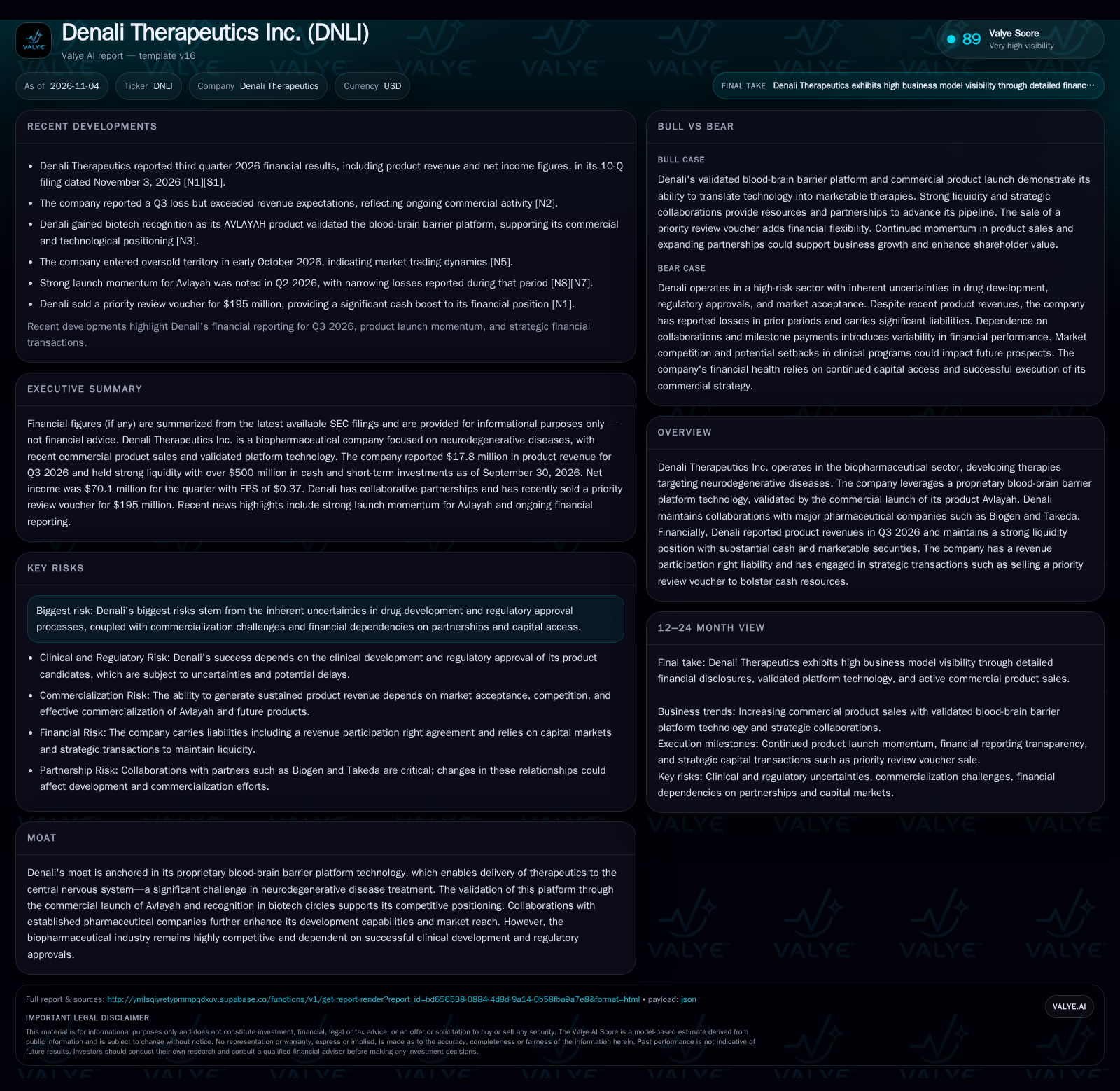
Denali Therapeutics reported $17.8 million in product revenue for Q3 2026 and $21.4 million for the first nine months of the year, marking a clear shift into commercial-stage operations [S1] [N1]. The company also posted net income of $70.1 million for the quarter, an unusual milestone for a biotech transitioning from R&D to commercialization. Its liquidity remains substantial, with $102.9 million in cash and cash equivalents and $413.3 million in short-term investments as of September 30, 2026, for a total of $516.2 million in liquid assets [S1]. The commercial launch of Avlayah, which leverages Denali’s proprietary blood-brain barrier (BBB) platform, has not only generated revenue but also received biotech industry recognition for platform validation [N3]. These facts collectively signal that Denali is at a commercial and financial inflection point, with significant implications for its risk profile and future strategic options.
How Denali’s Platform Approach Could Reshape CNS Drug Economics
Denali’s business model is predicated on unlocking new therapeutic opportunities in neurodegenerative diseases by overcoming the blood-brain barrier—a major obstacle in central nervous system (CNS) drug development. The successful launch of Avlayah demonstrates the platform’s ability to enable CNS delivery, potentially allowing differentiated efficacy profiles for biologics or small molecules that would otherwise be excluded from the brain. If this approach proves scalable, Denali could generate a portfolio of products with premium pricing justified by clinical impact in high-unmet-need indications.
The economics of CNS therapeutics are typically characterized by high R&D costs, long development timelines, and uncertain regulatory outcomes. However, once a product is approved and demonstrates efficacy, pricing power can be significant, especially for indications with limited existing therapies. The company’s $17.8 million in Q3 product revenue suggests initial market traction, but the sustainability and growth of this revenue will hinge on adoption rates, payer coverage, and competitive differentiation. Collaborations with large pharma partners like Biogen and Takeda may provide upfront payments, milestones, and shared commercialization economics, but also entail revenue sharing that could impact long-term margins.
Operating leverage could increase meaningfully if Denali’s platform enables efficient development of multiple assets, allowing fixed R&D and infrastructure costs to be spread across a broader product base. The company reported cash and liquidity metrics for the period; these figures do not by themselves establish operating runway, investment capacity, financial flexibility, or financing capacity. [N1] However, the revenue participation right liability ($209.7 million as of September 30, 2026) introduces a future claim on cash flows, which could limit net profitability as commercial revenues ramp.
Platform Differentiation Meets Sector Headwinds: Denali’s Place in the Neurodegenerative Landscape
Denali’s proprietary BBB technology is a core competitive asset, addressing a bottleneck that has historically limited the success of CNS drugs. This platform, now validated by Avlayah’s commercial launch and industry recognition [N3], may confer a first-mover advantage in certain neurodegenerative indications. Collaborations with established players like Biogen and Takeda not only provide capital and external validation but may also facilitate broader market access and accelerate clinical development.
However, the competitive environment in neurodegenerative diseases remains intense, with numerous biotechs and pharmaceutical companies pursuing both traditional and novel modalities (e.g., gene therapies, small molecules, antibody-drug conjugates). Larger incumbents have scale, commercial infrastructure, and deep pipelines, making sustained differentiation challenging. Moreover, the risk of technological leapfrogging—such as alternative BBB bypass strategies or next-generation CNS delivery platforms—could erode Denali’s current advantage if competitors achieve superior clinical outcomes or safety profiles.
Switching frictions in neurology can be high if a therapy demonstrates clear efficacy and safety, but initial adoption is often slow due to physician caution, payer hurdles, and the need for long-term outcome data. Denali’s ability to build a multiproduct CNS franchise will depend on maintaining technological leadership, securing favorable reimbursement, and translating platform validation into durable physician and patient adoption.
What Accelerated Adoption and Pipeline Success Would Look Like
In a favorable scenario, Avlayah’s market uptake accelerates as real-world evidence confirms its therapeutic benefit, leading to broader clinician adoption, improved payer coverage, and potentially label expansions into adjacent indications. Additional pipeline candidates leveraging the BBB platform progress through clinical trials, with positive data enabling new launches or lucrative out-licensing deals. Collaborations with Biogen, Takeda, or other partners yield milestone payments and co-commercialization opportunities, further de-risking the R&D spend.
This scenario would be confirmed by sequential quarterly growth in product revenue, new regulatory approvals or label expansions, and announcements of additional clinical-stage assets entering pivotal trials. Evidence of new or expanded partnerships, particularly those involving co-development or revenue-sharing structures, would reinforce the thesis. Conversely, if Avlayah sales plateau, clinical setbacks occur, or partnership momentum fades, the upside case would be challenged.
Sustained Revenue Growth With Gradual Pipeline Progression
The most plausible trajectory is one in which Avlayah continues to generate steady, though potentially modest, revenue growth as market adoption builds incrementally. The BBB platform supports further pipeline advancement, but new product launches are spaced over several years due to the intrinsic timelines of CNS drug development. Collaborations remain a source of non-dilutive funding and external validation, but milestone and royalty flows are lumpy and unpredictable.
Confirmation would come from stable or gradually increasing product revenue, continued reporting of positive clinical progress, and maintenance of a reported liquidity position. The base case would be falsified if Denali experiences significant clinical or regulatory setbacks, faces rapid competitive encroachment, or sees a material deterioration in partner relationships.
When Platform Risk and Commercial Friction Converge
The downside scenario is defined by slower-than-expected Avlayah adoption, possibly due to limited efficacy signals, safety concerns, or payer pushback. If the BBB platform fails to deliver robust results in additional pipeline programs, Denali could lose its perceived technological edge. Clinical trial failures, regulatory delays, or adverse safety findings would not only stall pipeline momentum but could also undermine confidence in the entire platform.
Financially, lumpy or declining product and milestone revenue—combined with the ongoing revenue participation right liability—could erode the reported cash balance, especially if additional capital must be raised on unfavorable terms. The scenario would be confirmed by declining or stagnant quarterly revenues, negative clinical updates, or the loss of key collaborations. A useful early warning would be management guidance downgrades or the disclosure of new pipeline discontinuations.
Milestones and Data Points That Will Shape Denali’s Platform Trajectory
Quarterly product revenue trends for Avlayah, to assess adoption rates and market penetration [S1].
Progression of pipeline candidates leveraging the BBB platform, including advancement into pivotal or registrational trials if disclosed.
Updates on the status and terms of collaborations with Biogen, Takeda, or new partners, especially those involving co-development or commercialization.
Net cash flow and changes in liquidity, particularly in relation to the revenue participation right liability and future funding needs [S1].
Regulatory filings, approvals, or label expansions for Avlayah and pipeline assets.
Real-world evidence and post-marketing safety data for Avlayah, as these influence payer and clinician adoption.
Announcement of new platform applications or indications that would broaden Denali’s addressable market.
If disclosed, gross-to-net adjustments or payer mix for Avlayah, to clarify realized pricing and reimbursement dynamics.
Disclaimer: This is research-only, informational analysis and not investment advice. It may include AI-generated interpretation and general industry context. Always verify important details using primary sources.

Comments