
IIPR’s Strategic Evolution: Cannabis Real Estate, Life Science Bets, and the Test of Specialized REIT Economics
Innovative Industrial Properties (IIPR) maintains strong occupancy and long-term lease structures in its cannabis-focused portfolio, but faces tenant payment headwinds and regulatory risk. Its significant move into life science assets via IQHQ marks a pivotal diversification—raising both opportunity and concentration risk as the cannabis sector’s volatility persists.
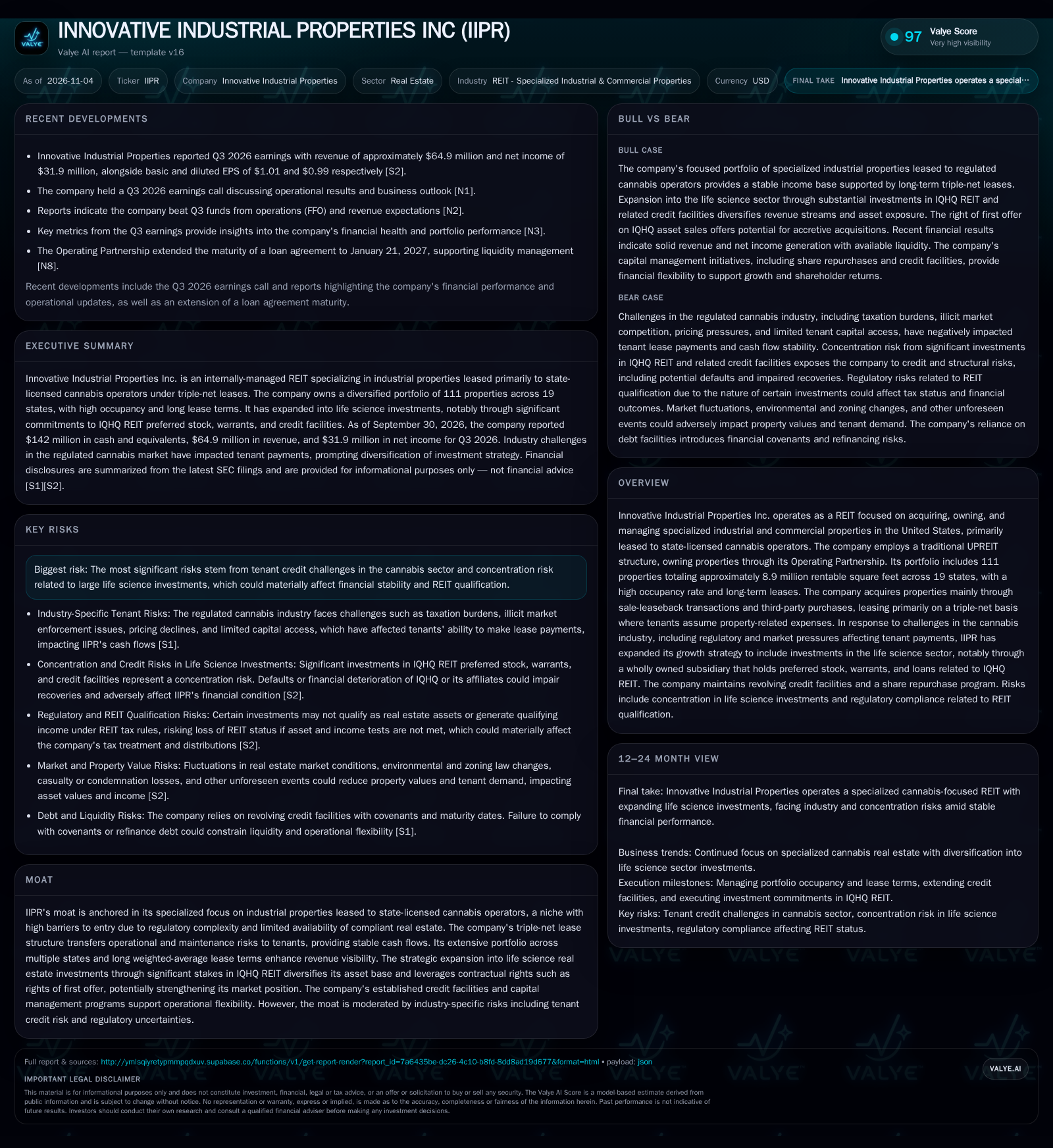
IIPR’s Q3 2026 results highlight stable cash flow from a specialized cannabis real estate portfolio with high occupancy, but persistent cannabis industry stress is pressuring tenant payments. The company’s $411 million investment in life science properties via IQHQ signals a material strategic shift, introducing new diversification and risk dynamics. Ongoing regulatory, credit, and REIT qualification risks will shape IIPR’s value proposition as it tests the durability of its dual-sector model. [S1] [S2]
Innovative Industrial Properties (IIPR) stands at a strategic crossroads. Its core cannabis real estate business continues to deliver high occupancy and long-term, triple-net lease stability, but structural headwinds in the regulated cannabis sector are eroding tenant payment reliability. The company's decisive pivot toward life science assets—anchored by a $411 million investment in IQHQ—has diversified exposure but also concentrated risk in a single external platform. This evolving asset mix, paired with regulatory and REIT qualification sensitivities, makes IIPR’s next phase less about routine property management and more about navigating sectoral volatility, tenant credit, and the economics of high-conviction diversification. [S1] [S2]
Recent Results Reveal a Business at an Inflection Point
IIPR reported Q3 2026 revenue of $64.9 million and net income of $31.9 million, with basic and diluted EPS of $1.01 and $0.99, respectively. The company’s portfolio comprises 111 properties across 19 states, with a high occupancy rate of 96.7% and a weighted-average lease term of 12.8 years as of December 31, 2025. Importantly, IIPR’s $411 million investment in IQHQ REIT, now about 16% of total assets, marks a substantial allocation to life science real estate. The company also extended a key loan maturity to January 21, 2027, and reported $142 million in cash and equivalents at quarter-end. These facts underscore a business with stable near-term financials but heightened exposure to tenant risk in cannabis and concentration risk in its new life science bet. [S1] [S2] [N8]
How IIPR’s Revenue Model and Capital Structure Shape Its Resilience
IIPR’s core economics are defined by long-term, triple-net leases with state-licensed cannabis operators, which shift property-related expenses to tenants and, in theory, stabilize the company’s cash flows. This structure typically produces high margins and low direct operating costs, but the durability of those cash flows depends on tenant solvency—a growing concern as cannabis operators face tax burdens, illicit market competition, and capital scarcity. The company’s use of sale-leaseback transactions monetizes operator real estate while locking in contractual rent streams, but exposes IIPR to sector-specific credit cycles.
The move into life science real estate—primarily via preferred stock, warrants, and a credit facility with IQHQ—introduces a different risk-reward profile. These investments offer potential for higher yields and embedded optionality (e.g., rights of first offer on asset sales), but lack the granular diversification of directly owned, multi-tenant properties. However, the company’s potential financial flexibility is now partly tied to the performance and liquidity of its major life science investment, raising the stakes for its diversification strategy.
Specialization, Regulatory Barriers, and the Challenge from New Entrants
IIPR’s moat is rooted in its early, specialized focus on cannabis-related industrial properties, a segment where regulatory complexity and limited availability of compliant assets deter new entrants. The triple-net lease model, combined with long average lease terms, could increase switching costs for tenants and revenue visibility for IIPR. However, competition may intensify if cannabis legalization expands at the federal level, attracting traditional REITs and institutional capital.
The pivot to life science properties places IIPR in a more crowded and mature segment, where established players like Alexandria Real Estate Equities and Healthpeak Properties dominate. Here, IIPR’s edge would depend on execution, deal flow (potentially aided by rights of first offer from IQHQ), and the ability to source accretive acquisitions. The key counterforce is that life science real estate, while less volatile than cannabis, also faces cyclical tenant demand and capital market fluctuations. IIPR’s hybrid approach may reduce single-sector risk but also dilutes its original competitive differentiation.
If Cannabis Stabilizes and Life Science Bets Pay Off, Durable Growth Could Resume
In a favorable scenario, regulatory reforms or improved enforcement reduce illicit competition and tax burdens for cannabis operators, stabilizing tenant cash flows and lease payments. This would restore confidence in IIPR’s core portfolio, supporting rent escalations and low vacancy. Meanwhile, IQHQ’s life science assets could appreciate or deliver robust cash yields, and IIPR’s right of first offer could provide access to additional high-quality properties at attractive terms. If IIPR successfully integrates and scales its life science investments, it could gain a foothold in a defensive, growth-oriented segment, diversifying earnings and lowering sector-specific volatility.
Evidence supporting this scenario would include a decline in cannabis tenant delinquencies, renewal or extension of major leases, positive NOI trends from life science assets, and accretive follow-on acquisitions via the IQHQ pipeline. A return to consistent FFO growth and dividend coverage would further confirm the upside thesis.
Balanced Exposure: Managing Cannabis Volatility While Life Science Integration Proceeds
The most plausible trajectory is that IIPR maintains high occupancy and stable cash flows from its cannabis portfolio, but continues to encounter periodic tenant defaults or rent deferrals as industry headwinds persist. The company’s revenue mix gradually shifts as IQHQ’s contribution grows, but the life science segment remains subject to its own market cycles and the performance of a single external manager. Incremental acquisitions may be slower or more selective as IIPR manages capital allocation and regulatory compliance to protect REIT status.
Indicators supporting this scenario would be modest but steady revenue and FFO growth, a manageable level of tenant arrears, and stable or slightly improving credit metrics. The company’s ability to refinance or extend debt maturities without covenant breaches would further validate the base case. Conversely, a spike in tenant defaults, IQHQ underperformance, or regulatory scrutiny of REIT qualification would challenge the thesis.
Cascading Risks: Tenant Defaults and Concentration in Life Science Exposure
The adverse case unfolds if cannabis operator stress accelerates, leading to widespread rent delinquencies, lease restructurings, or property vacancies. This would erode IIPR’s cash flows, undermine dividend sustainability, and potentially force property sales at depressed values. Simultaneously, if IQHQ faces credit events, project delays, or asset impairments, IIPR’s concentrated exposure could translate into material losses or impaired recoveries, especially given the junior ranking of its preferred stock.
Compounding the downside, regulatory action or an adverse REIT qualification review could trigger tax liabilities or force a strategic overhaul. Evidence supporting this scenario would include a marked rise in bad debt expense, asset impairments, negative FFO trends, and disclosure of IQHQ financial strain or defaults. Regulatory warnings or restatements related to REIT status would further confirm the risk.
What Will Reveal the Durability of IIPR’s Diversification and Cash Flows?
Quarterly cannabis tenant rent collection rates and the proportion of tenants in arrears or on payment plans, if disclosed.
Updates on IQHQ’s financial health, dividend payment capacity, and the performance of underlying life science assets.
Changes in portfolio occupancy and lease renewal/extension activity, especially in markets with heightened cannabis sector stress.
Evidence of additional acquisitions or asset sales under the right of first offer with IQHQ, and the terms of such transactions.
Trends in FFO, AFFO, and dividend coverage ratios—especially as the revenue mix shifts toward life science exposure.
Covenant compliance and the company’s ability to extend, refinance, or expand its revolving credit facilities.
Any SEC or IRS communications regarding REIT qualification, as well as changes in tax law affecting cannabis or hybrid asset REITs.
Disclosure of property impairments, forced asset sales, or significant write-downs—either in cannabis or life science portfolios.
Disclaimer: This is research-only, informational analysis and not investment advice. It may include AI-generated interpretation and general industry context. Always verify important details using primary sources.

Comments