
Live Oak Bancshares: Technology-Led Small Business Lending Faces Margin Pressures and Platform Scalability Questions
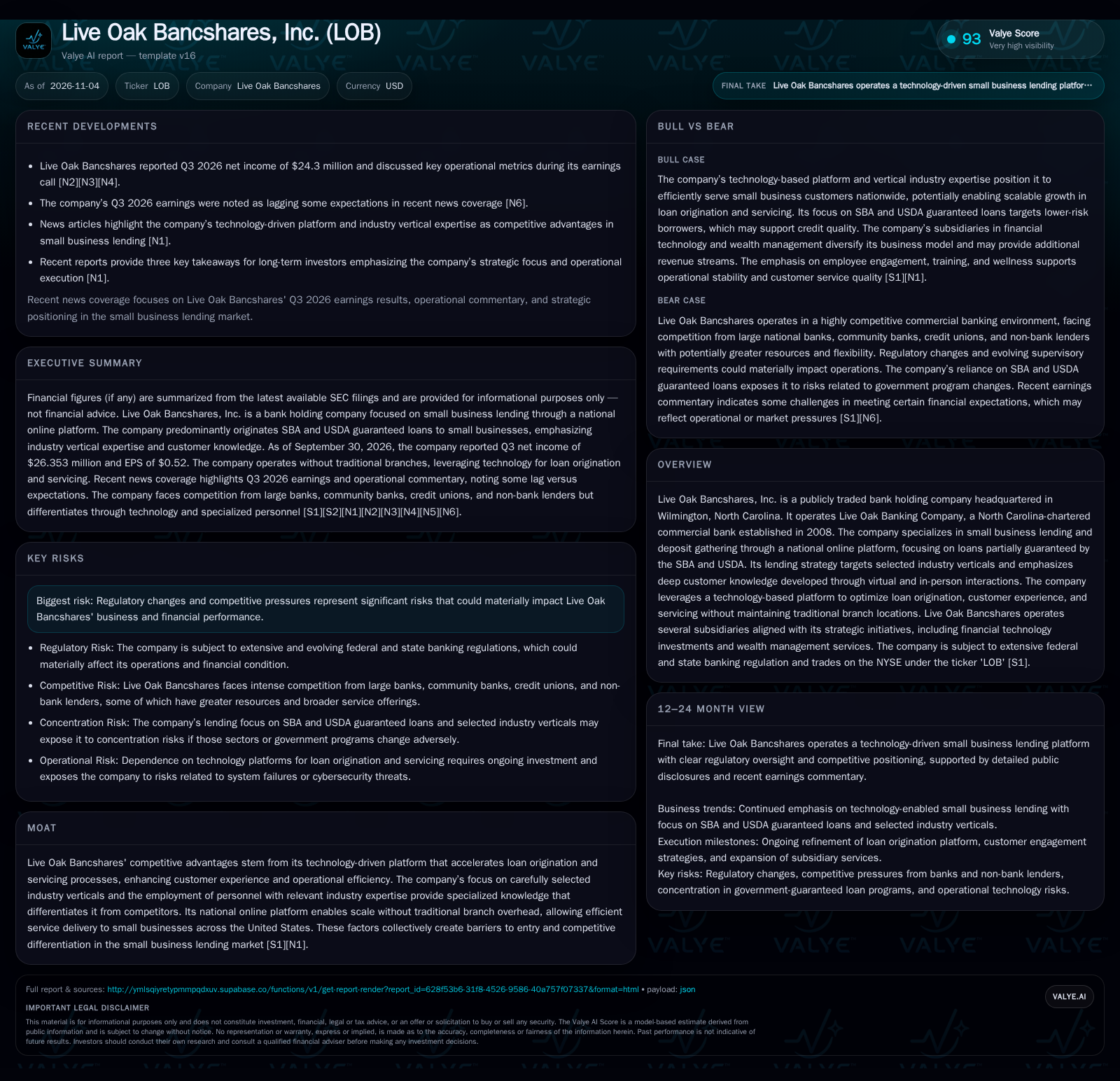
Live Oak Bancshares’ national, technology-driven small business lending model produced Q3 2026 net income of $24.3 million but missed some expectations. The bank’s reliance on government-guaranteed loans and vertical specialization underpins its competitive edge, yet exposes the business to regulatory and margin risks as competition and customer acquisition costs shift.
Live Oak Bancshares’ digital-first approach and SBA/USDA lending focus remain its core strengths, but Q3 2026 earnings lagged some expectations. The company’s scalable platform and vertical expertise support growth, though government program reliance and competitive intensity may pressure margins and credit quality if market or policy conditions change. Watch for loan volume trends, non-interest revenue mix, credit performance, and customer acquisition costs as indicators of the model’s resilience and scalability. [S2] [N2] [N6]
Live Oak Bancshares, Inc. has built a differentiated position in U.S. small business banking by marrying a technology-first origination model with deep expertise in selected industry verticals. The company’s ability to deliver loans nationwide—primarily through government-guaranteed SBA and USDA programs—has allowed it to grow without the expense of a traditional branch network. Yet, as Q3 2026 results came in below some expectations, questions emerge about the scalability, profitability, and durability of this digital lending model as competitive and regulatory landscapes evolve. The next phase for Live Oak will test whether its advantages in customer targeting, credit risk management, and technology can sustain above-peer returns amid margin pressures and shifting policy risk. [S2] [N2] [N6]
Q3 Earnings Miss Highlights Both Strengths and Frictions
Live Oak Bancshares reported Q3 2026 net income of $24.3 million and basic/diluted earnings per share of $0.52, according to its 10-Q filing and earnings call coverage. These results lagged some analyst and market expectations, as noted in recent news reports. [S2] [N2] [N6]
The company continues to emphasize its technology-driven platform for originating SBA and USDA loans, focusing on select industry verticals and deep customer knowledge. Its business remains concentrated in government-guaranteed lending, with a national reach but no traditional branch infrastructure. [S1]
Recent commentary underscores both Live Oak’s operational execution and the challenges posed by competition, regulatory constraints, and the need to meet investor expectations for growth and profitability. [N1] [N6]
How Live Oak’s Digital Model Drives (and Constrains) Profitability
Live Oak’s core economics stem from originating and servicing loans—predominantly those partially guaranteed by the SBA and USDA—which typically offer lower credit losses and attractive yield spreads relative to conventional commercial loans. The absence of a branch network reduces fixed overhead, theoretically boosting operating leverage as volume scales. However, this approach shifts the cost structure toward technology investment, compliance, and customer acquisition.
Loan origination fees, servicing income, and the potential for premium sales of government-guaranteed loans create non-interest revenue streams, while deposit gathering via the online platform provides lower-cost funding compared to wholesale or brokered sources if scale is achieved. Net interest margins may be supported by government guarantees, but subject to compression if competition intensifies or if funding costs rise.
Variable costs include technology development, regulatory compliance, credit underwriting, and ongoing customer engagement. As volumes increase, operating leverage could improve, but only if loan growth outpaces incremental costs in technology and risk management. Capital needs are tied to regulatory capital ratios and loan portfolio growth, with capital intensity somewhat mitigated by the partial guarantee of much of the loan book.
The mix of guaranteed versus non-guaranteed loans, as well as any shift toward fee-based non-lending services through subsidiaries, will influence the sustainability and cyclicality of earnings.
Competing for Small Business: Technology, Focus, and the Threat of Imitation
Live Oak’s competitive edge rests on its technology platform, which enables faster, more efficient loan origination and servicing, and its specialized knowledge within targeted industry verticals. This allows for more tailored underwriting and a differentiated customer experience compared to generic small business lenders. [S1] [N1]
However, barriers to entry may be eroding as large banks and fintechs invest heavily in digital platforms, and as non-bank lenders pursue similar government-guaranteed lending strategies. Community banks, credit unions, and specialized fintechs target the same customer segments, often with broader product suites or larger marketing budgets.
Switching costs for small business customers may be moderate—while Live Oak’s expertise and service quality can foster loyalty, borrowers are sensitive to rates, speed, and approval certainty. If competitors replicate Live Oak’s technology or undercut pricing, the bank may face margin compression or higher marketing spend. The company’s lack of a branch footprint could be a double-edged sword: it enables national scale but may limit relationship depth and cross-sell opportunities compared to hybrid banks.
The real test will be whether Live Oak’s vertical specialization and customer engagement approach can continue to deliver superior credit outcomes and customer retention as the market matures.
Digital Scale and Vertical Insight Unlock Sustainable Growth
If Live Oak successfully leverages its technology platform to increase loan origination volumes while maintaining high credit quality, it could achieve significant operating leverage. Growth in government-guaranteed lending—especially if SBA/USDA programs remain robust—could allow the bank to expand its market share nationally without needing to build costly branches.
Continued refinement of vertical expertise could support strong underwriting performance, lowering charge-offs and enabling premium pricing in specialized segments. Expansion of non-interest revenue through premium loan sales, servicing, or cross-selling wealth and fintech services could diversify income and reduce cyclicality.
Confirmation would come from sustained double-digit loan growth, stable or improving net interest margins, low credit costs, and rising fee-based revenues. Evidence that technology investments are driving down per-loan origination and servicing costs, or that customer acquisition cost remains stable even as volumes grow, would further support the bull case. Visible traction in subsidiary revenue lines would indicate successful business model diversification.
Scaling Up, but Margin Pressures and Policy Risks Persist
The most plausible outcome is that Live Oak continues to grow its loan book at a moderate pace, supported by its technology platform and vertical expertise, but faces ongoing margin pressure from intensifying competition and fluctuating funding costs. Government-guaranteed lending remains the core engine, but regulatory or policy changes introduce episodic risk. Operating leverage improves incrementally, but technology and compliance costs offset some scale benefits.
Earnings remain positive, but growth rates are tempered by rising customer acquisition costs, competitive pricing, and the need to invest in new technology to keep pace with larger rivals. Credit quality remains manageable, but any uptick in defaults or a reduction in government guarantee programs would stress the model.
This scenario would be confirmed by continued, but slowing, loan and revenue growth, stable-to-narrowing net interest margins, and periodic earnings volatility tied to credit or regulatory developments. Limited diversification beyond lending would leave overall returns tied closely to macro and policy cycles.
Competitive Convergence and Policy Shifts Undermine Differentiation
In a more adverse scenario, large banks, fintechs, and alternative lenders rapidly close the technology gap, eroding Live Oak’s speed and cost advantages in SBA/USDA lending. Increased competition compresses pricing, raises customer acquisition costs, and reduces the premium Live Oak can command in its chosen verticals.
A significant policy shift—such as reduced government guarantee rates, tighter SBA/USDA eligibility, or adverse regulatory changes—could sharply curtail loan growth, raise required capital, or increase credit losses. Without a branch network, Live Oak may struggle to cross-sell or retain customers, amplifying pressure on deposit gathering and non-interest income.
Confirmation would come from declining loan origination volumes, rising credit losses, net interest margin compression, and a spike in technology or compliance expenses. If new customer acquisition slows or retention falls, the model’s scalability and resilience would be in question. Failure to gain traction in subsidiary businesses would exacerbate dependence on the core lending engine.
Thesis-Testing Metrics for Live Oak’s Digital Lending Model
Net loan origination growth by quarter: A sustained increase would support platform scalability, while deceleration could indicate competitive or demand headwinds.
Net interest margin trends: Compression may signal intensifying competition or rising funding costs; stability would affirm pricing power and funding efficiency.
Credit performance metrics—charge-offs and delinquencies: Deterioration would undermine the value of vertical expertise and risk controls.
Non-interest income as a share of total revenue: Growth here would confirm successful diversification beyond core lending.
Customer acquisition cost per loan (if disclosed): Rising costs may indicate competitive intensity or diminishing digital marketing efficiency.
Deposit growth and cost of funds: Flat or declining deposits, or rising funding costs, would test the viability of the online-only model.
Regulatory or policy developments affecting SBA/USDA programs: Any material change could alter the risk/reward profile and growth trajectory.
Operating expense per loan originated: A declining trend would validate the technology-driven efficiency thesis.
Disclaimer: This is research-only, informational analysis and not investment advice. It may include AI-generated interpretation and general industry context. Always verify important details using primary sources.

Comments