
Fuel Tech’s Profit Challenge: Navigating Liquidity Strength and Regulatory Tailwinds in Pollution Control
Fuel Tech, Inc. stands at the intersection of robust environmental regulation and persistent profitability struggles. While its reported liquidity position positions the company to weather near-term volatility, the longer-term trajectory hinges on converting industry demand into sustainable margin expansion.
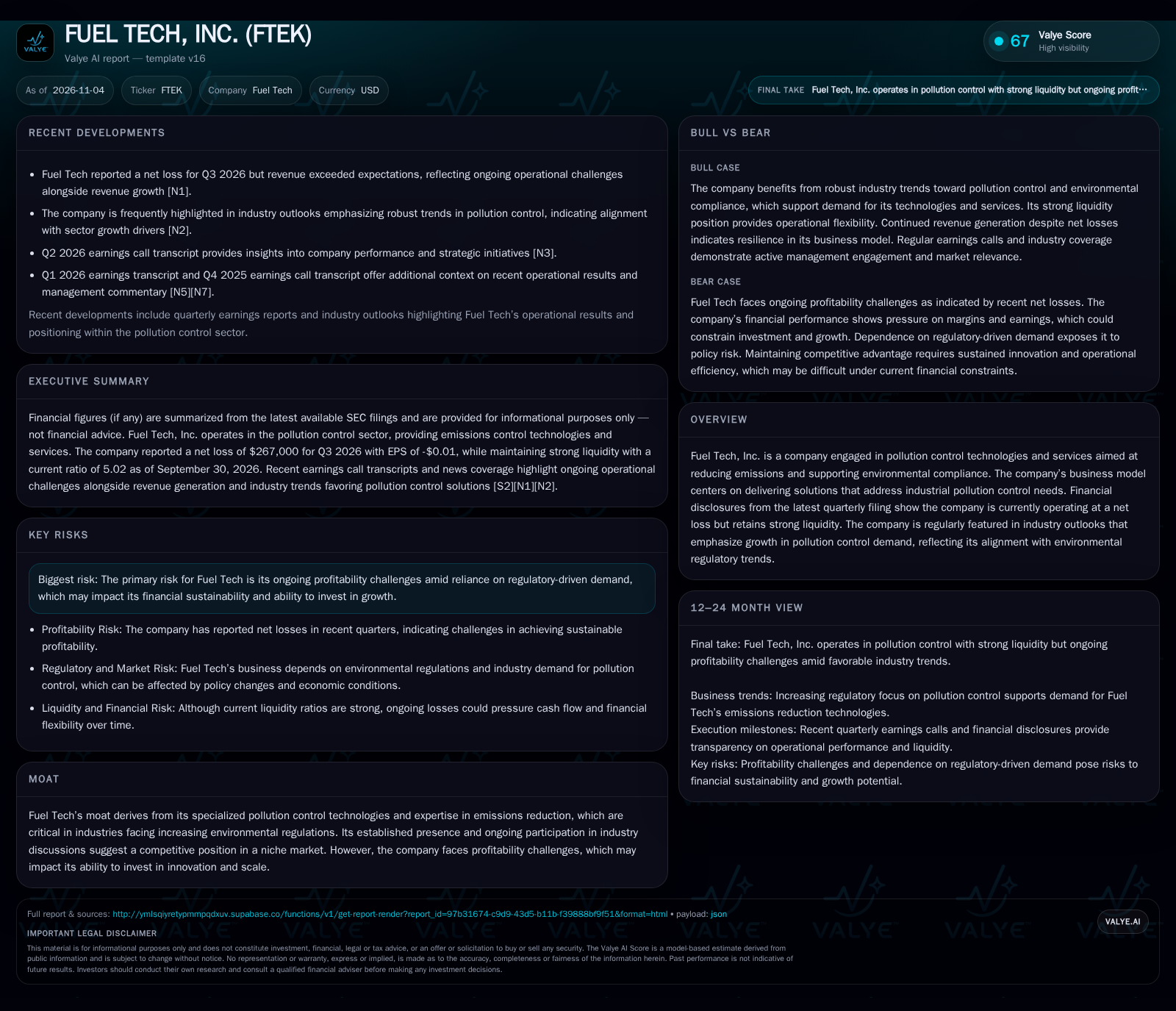
Fuel Tech reported a Q3 2026 net loss of $267,000 despite revenue exceeding expectations, reflecting ongoing pressure on profitability. The company’s reported liquidity position, with $6.83 million in cash and a current ratio of 5.02 as of September 30, 2026. As environmental regulation intensifies, Fuel Tech’s technology portfolio aligns well with market demand, but operational execution and margin improvement remain critical hurdles for value creation over the next 12–24 months. [S2] [N1]
Fuel Tech, Inc. operates at a critical juncture for emissions control technology providers. The company’s Q3 2026 net loss, despite beating revenue estimates, underscores a persistent struggle to translate regulatory-driven demand into lasting profitability. The question for investors is whether operational discipline and industry momentum can converge to shift the company from resilience to true value creation.
Recent Results Spotlight Liquidity and Margins
Fuel Tech reported a net loss of $267,000 for Q3 2026, with basic and diluted EPS of -$0.01 per share—a continuation of its recent unprofitable trend. Notably, this loss came despite revenue exceeding analyst expectations, suggesting that the company is capturing demand but struggling to convert it into bottom-line gains. As of September 30, 2026, Fuel Tech had $6.83 million in cash and cash equivalents, total current assets of $25.0 million, and current liabilities of $4.98 million, resulting in a current ratio of 5.02 and a cash ratio of 1.37. The company reported cash and liquidity metrics for the period; these figures do not by themselves establish operating runway, investment capacity, financial flexibility, or financing capacity. Industry news and analyst coverage continue to highlight robust trends in pollution control, situating Fuel Tech within a favorable macro environment, even as profitability remains elusive. [S2] [N1]
Revenue Generation vs. Cost Structure: The Economics of Emissions Control
Fuel Tech’s business model is built around providing emissions control technologies and services to industrial clients subject to environmental regulation. Revenue is likely driven by a mix of project-based solution sales, ongoing service contracts, and potentially recurring maintenance or technology licensing agreements, though the precise mix is not disclosed. The economics of this sector are shaped by high technical requirements, project customization, and a sales cycle tied to regulatory or compliance deadlines.
Profitability in pollution control is often challenged by the need for continual innovation, project bidding competition, and exposure to commodity or manufacturing costs. Fixed costs include R&D, engineering, and a specialized workforce, while variable costs are tied to project delivery and service execution. With ongoing net losses, Fuel Tech’s current cost structure appears to be absorbing most, if not all, of its gross margin, suggesting limited operating leverage at current scale. Capital needs are moderate compared to heavy industrial peers but could rise if the company pursues larger projects or invests in new technology platforms.
Specialization and Scale: Where Fuel Tech Sits Among Pollution Control Peers
Fuel Tech’s competitive position is shaped by its technological specialization and its alignment with regulatory trends. In the broader pollution control market, competitors range from diversified industrial conglomerates offering environmental divisions to niche players specializing in specific emissions or process technologies. Fuel Tech’s moat rests on its expertise and established reputation in emissions reduction—factors that may create switching frictions for long-term industrial clients, particularly where regulatory compliance is critical.
However, the company’s relatively small scale and ongoing profit challenges may limit its ability to out-invest larger, better-capitalized rivals in R&D, sales reach, or project delivery. Technology substitution risk is real: advances in alternative emissions control methods, process redesigns, or new regulatory standards could shift demand away from Fuel Tech’s core offerings. Customer incentives are often driven by compliance deadlines and cost-benefit calculations, making the market sensitive to both regulation and macroeconomic cycles.
Margin Expansion Through Execution and Regulation-Driven Demand
The most favorable pathway for Fuel Tech is one where regulatory pressure continues to intensify, driving increased demand for emissions control solutions across industrial sectors. If the company can leverage its liquidity to invest in operational efficiency, project delivery, and targeted innovation, it could convert higher revenue into margin expansion. Signs of this scenario would include a sustained reduction in net losses or a pivot to profitability, improved gross margins, and new contract wins—especially multi-year or recurring service agreements.
Evidence that would confirm this scenario includes management commentary on cost reduction initiatives, disclosure of higher-margin product/service mixes, and sequential improvements in operating margin. Industry news highlighting regulatory tightening or large-scale infrastructure upgrades driven by environmental policy would also support the upside view.
Steady Demand, Incremental Progress, and Ongoing Margin Pressure
The most plausible near-term outlook is that Fuel Tech continues to benefit from steady, regulation-driven demand but struggles to achieve sustainable profitability. Revenue may remain resilient as industrial clients comply with environmental mandates, but margin improvement will likely be incremental absent a significant shift in project economics or cost structure. The company’s liquidity allows it to weather operational volatility, but recurring net losses may persist unless management can extract greater operational leverage or shift the revenue mix toward higher-margin offerings.
Confirmation would come from continued modest revenue growth, stable or slightly improving cash balances, and management guidance that emphasizes operational discipline without signaling a dramatic turnaround. Falsification would involve either a sharp deterioration in liquidity (e.g., cash burn accelerating) or a sudden, material improvement in profit margins.
Profitability Erosion from Cost Overruns or Regulatory Shifts
The adverse case centers on a situation where Fuel Tech’s operational challenges deepen, either through rising input or project delivery costs, loss of key contracts, or a slowdown in regulatory momentum. If cost pressures outpace revenue growth, net losses could accelerate, eventually eroding the current liquidity cushion and forcing difficult operational or strategic choices. Alternatively, changes in environmental policy—such as regulatory rollbacks or delays—could soften market demand and increase competitive pricing pressure.
Signs confirming this scenario would include sequential increases in net losses, negative cash flow trends, management commentary on project delays or cancellations, and reductions in backlog or contract pipeline (if disclosed). Industry news of regulatory weakening or major industrial slowdowns would further heighten downside risk.
Milestones That Will Clarify Fuel Tech’s Path from Liquidity to Lasting Value
Sequential net income and EPS trends: Sustained movement toward breakeven or profitability would indicate operational progress. [S2]
Gross margin evolution: Any disclosed improvement in gross or operating margins would help test whether the company is extracting more value from its revenue base.
Contract win announcements: New or expanded customer contracts, especially those with multi-year or recurring components, would demonstrate commercial momentum.
Cash flow from operations: Positive or improving operating cash flow would confirm that revenue is translating into real financial strength, not just top-line growth.
Commentary on regulatory trends: Updates from earnings calls or filings regarding changes in environmental policy or compliance deadlines could materially affect demand outlook. [N3] [N5] [N7]
R&D and product development milestones: Disclosure of new technology launches or successful project deployments would indicate ongoing innovation and competitive relevance.
Customer concentration or diversification: If disclosed, a shift in customer mix or reduced reliance on a small set of clients would lower revenue risk and support sustainability.
Disclaimer: This is research-only, informational analysis and not investment advice. It may include AI-generated interpretation and general industry context. Always verify important details using primary sources.

Comments