
DiamondRock Hospitality: Portfolio Expansion, Guidance Momentum, and the Economics of Hospitality REITs
Recent acquisition activity and raised 2026 guidance put DiamondRock’s operating strategy in focus, but the company’s fortunes remain closely tied to underlying travel demand and the cyclicality of the lodging sector.
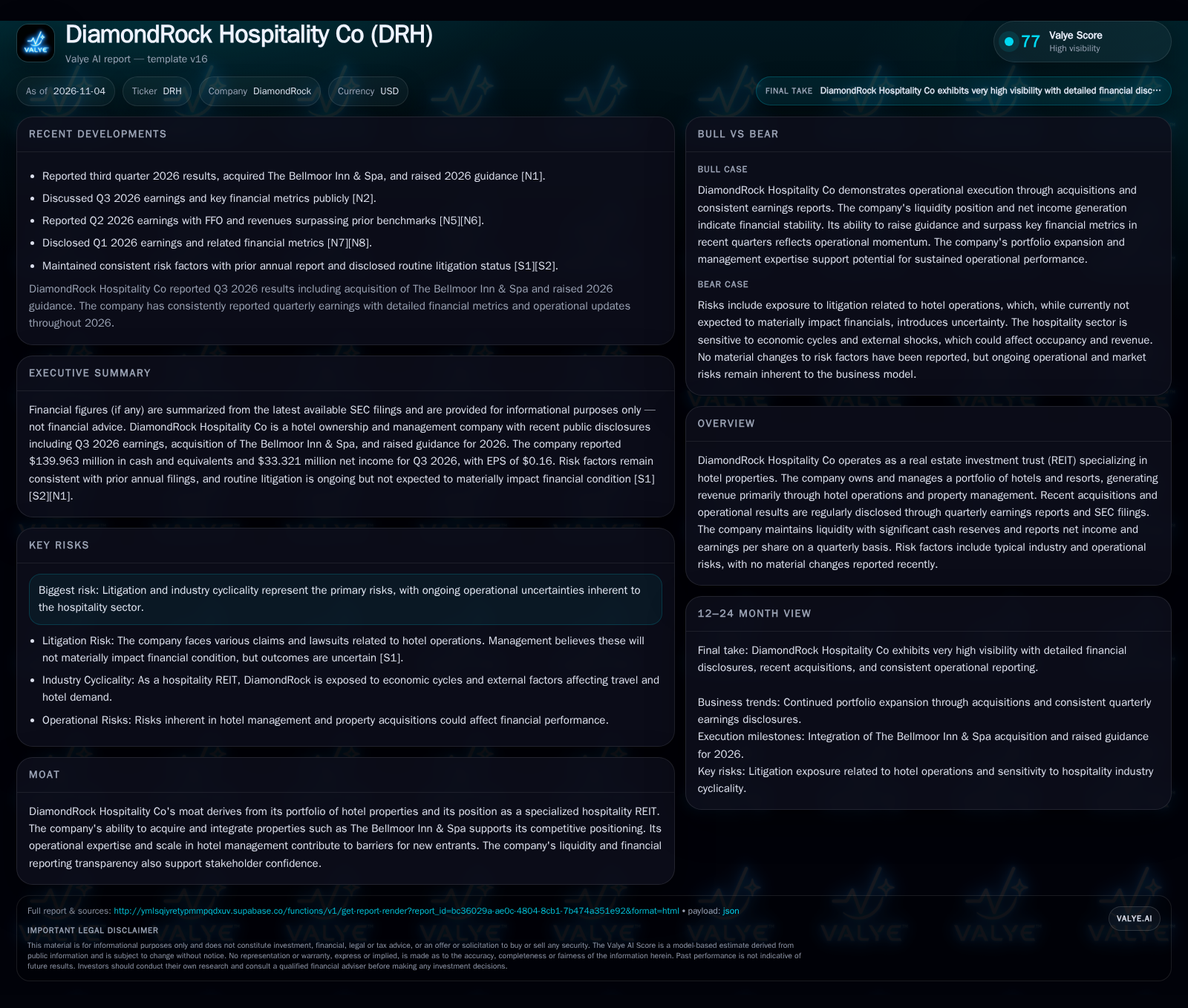
DiamondRock Hospitality reported Q3 2026 results featuring the acquisition of The Bellmoor Inn & Spa and raised its full-year guidance. The company posted $33.3 million in net income and maintained nearly $140 million in cash as of September 30, 2026. While operational momentum is evident, DiamondRock’s risk profile remains shaped by hospitality sector cycles and ongoing litigation exposure, with no material changes to risk factors reported. The central question is whether recent portfolio expansion and guidance raises can translate into durable earnings growth despite sector volatility. [S2] [N1]
DiamondRock Hospitality’s latest quarter underscores a blend of operational momentum and sectoral exposure. The company’s acquisition of The Bellmoor Inn & Spa and its decision to raise 2026 guidance spotlight a management team leaning into portfolio expansion even as industry-wide travel demand ebbs and flows. With nearly $140 million in cash and continued net income generation, DiamondRock appears positioned to capitalize on strategic opportunities. However, the company’s results and risk profile remain closely tied to the cyclical nature of the hospitality industry, where exogenous shocks and routine operational litigation can quickly alter the outlook.
Acquisition, Guidance Raise, and Financial Snapshot Shape the Current Landscape
DiamondRock Hospitality reported net income of $33.321 million for Q3 2026, with basic and diluted earnings per share of $0.16 and cash and equivalents totaling $139.963 million as of September 30, 2026 [S2]. The company’s acquisition of The Bellmoor Inn & Spa and concurrent decision to raise full-year 2026 guidance signal a strategic push to expand its portfolio and capitalize on operational momentum [N1]. These developments matter because they reflect management’s confidence in near-term market conditions and the company’s ability to deploy capital for growth. However, the company continues to face routine litigation tied to hotel operations, a persistent feature of the sector that management currently expects will not materially impact financial results [S1]. No material changes to risk factors have been reported since the 2025 annual filing, suggesting stable risk assessments despite ongoing industry challenges [S2].
How DiamondRock’s Portfolio and REIT Model Drive Earnings Potential
DiamondRock operates as a hospitality-focused REIT, generating revenue primarily from hotel operations and property management. As is typical for hotel REITs, top-line performance is driven by occupancy rates, average daily rates (ADR), and revenue per available room (RevPAR), all of which are highly sensitive to macroeconomic trends and travel demand. Operating leverage is substantial: fixed costs such as property maintenance, debt service, and staff wages create meaningful profit expansion potential in periods of rising occupancy, but also expose the company to sharper earnings contractions during downturns.
Acquisitions, such as the recent addition of The Bellmoor Inn & Spa, may offer accretive growth if the asset is integrated at favorable terms and if it enhances portfolio ADR or RevPAR. However, the economics depend heavily on acquisition pricing, financing structure, and the ability to drive operational improvements or reposition the property within local markets. The cited source reports dividend-related activity; that disclosure alone does not establish dividend-policy continuity, management confidence, or a material constraint on capital flexibility. The company reported cash and liquidity metrics for the period; these figures do not by themselves establish operating runway, investment capacity, financial flexibility, or financing capacity.
Assessing Competitive Advantages in a Fragmented Hospitality Market
DiamondRock competes with other public hotel REITs, private equity-backed portfolios, and independent property owners. The company’s portfolio scale, specialization in hotel assets, and demonstrated capability to execute property acquisitions provide certain competitive advantages, particularly in sourcing and integrating assets like The Bellmoor Inn & Spa. Operational expertise and established relationships with hotel brands or management companies can also facilitate occupancy and rate optimization.
However, barriers to entry in the hotel real estate market are moderate: while capital requirements and operational know-how are non-trivial, the sector remains fragmented, with many players vying for attractive assets. Technology-enabled platforms for travel booking, shifts in consumer lodging preferences (e.g., short-term rentals), and the power of global hotel brands all exert competitive pressure. The key question is whether DiamondRock’s property selection and management discipline can consistently deliver above-peer returns, or if it risks being caught in broader sector headwinds when travel demand softens.
Unlocking Value Through Successful Integration and Demand Resilience
The most favorable scenario for DiamondRock sees the company leveraging its recent acquisition and raised 2026 guidance into sustained earnings growth. If The Bellmoor Inn & Spa is integrated smoothly and delivers above-average ADR or occupancy, it could lift overall portfolio performance. Continued strength in travel demand—driven by business travel recovery, leisure trends, or favorable macroeconomic conditions—would support higher RevPAR and operating margin expansion.
Confirmation of this scenario would come from sequential improvements in portfolio-level ADR and occupancy, outperformance relative to guidance, and evidence of accretive acquisition economics (e.g., property-level EBITDA margins exceeding portfolio averages). Additional acquisitions at attractive valuations, without diluting shareholder value or overleveraging the balance sheet, would further bolster the bull case. Conversely, if integration costs overrun or the asset underperforms, it would undermine the thesis.
Sustaining Performance Amid Sector Cyclicality and Operational Realities
The most plausible path is one of steady but unexceptional performance, with DiamondRock’s results tracking broader industry trends. Portfolio occupancy and ADR may fluctuate in line with national travel patterns, and incremental gains from The Bellmoor Inn & Spa contribute modestly but do not fundamentally alter the company’s earnings power.
Evidence supporting this middle scenario would include quarterly results that meet (but do not consistently exceed) guidance, stable property-level margins, and no significant litigation or operational disruptions. Falsification would come from material underperformance relative to peers, an inability to integrate new assets effectively, or a sudden deterioration in macroeconomic conditions leading to declining travel demand.
Vulnerability to Shocks: Litigation, Cyclical Downturns, and Integration Risks
In a negative scenario, DiamondRock could be hit by a combination of sectoral downturn and company-specific setbacks. A sharp decline in travel demand—due to recession, geopolitical events, or health crises—would drive down occupancy and RevPAR, pressuring both revenue and margins. If routine litigation were to escalate or result in an unfavorable outcome, it could introduce unexpected costs or operational constraints.
Integration missteps with The Bellmoor Inn & Spa or other acquisitions could lead to higher-than-expected expenses, distraction of management resources, or impairment charges. Confirmation of this scenario would come from consecutive quarters of declining net income, negative revisions to guidance, shrinking cash balances, or public disclosure of material adverse litigation outcomes.
What Will Prove Out DiamondRock’s Portfolio Strategy and Earnings Durability?
Quarterly trends in portfolio-level ADR, occupancy, and RevPAR—especially relative to guidance and industry benchmarks—will be critical to monitor.
The performance and contribution of The Bellmoor Inn & Spa to overall earnings and margins, if disclosed, will help test the success of recent acquisitions.
Updates to 2026 guidance or forward-looking commentary in earnings releases can signal management’s outlook and confidence.
Cash and liquidity levels, particularly in the context of dividend payments and acquisition activity, should be tracked for signs of financial resilience or strain.
Any material litigation developments or new risk disclosures could quickly alter the investment case.
Acquisition pipeline and integration updates—frequency, scale, and announced economics—will inform the sustainability of the company’s expansion strategy.
Macro indicators of travel demand, such as national hotel occupancy rates, business travel recovery, and consumer confidence, will frame the external risk environment.
Disclaimer: This is research-only, informational analysis and not investment advice. It may include AI-generated interpretation and general industry context. Always verify important details using primary sources.

Comments